

Using a VPN in China is unlike using a VPN anywhere else in the world. China operates the most advanced and aggressive internet filtering system currently in use, commonly known as the Great Firewall. Unlike basic website blocking, this system actively detects, disrupts, and disables VPN connections in real time.
As of 2026, the majority of consumer VPNs still fail in China. Connections may work briefly, collapse without warning, or appear connected while blocking all usable traffic. This makes generic “VPN for China” recommendations unreliable and often outdated within months.
This guide focuses exclusively on VPNs that have been tested against China’s current filtering techniques, including deep packet inspection, protocol fingerprinting, IP blacklisting, and active probing. The goal is not to list the most popular VPNs, but to identify services that consistently maintain usable connections inside mainland China.
While this is a China-specific stealth guide, it is also relevant for travelers, expats, and remote workers moving throughout Asia. VPNs capable of bypassing the Great Firewall are typically engineered to survive other restrictive or monitored networks found in the region, including state-controlled ISPs, hotel networks, and mobile data providers.
If you are traveling to China, living there long-term, or passing through multiple Asian countries where internet access is restricted, this page explains what actually works, what fails, and how to avoid common VPN mistakes that lead to blocked connections or exposed traffic.
How the Great Firewall Works in 2026
China’s internet censorship system, commonly referred to as the Great Firewall, is not a single tool or blacklist.
It is a layered, adaptive system designed to identify, disrupt, and block VPN traffic at multiple stages of a connection.
This is why many VPNs appear to work briefly before slowing down, dropping connections, or failing entirely.
Unlike basic country-level blocking, China actively inspects traffic patterns in real time. When encrypted traffic
resembles known VPN protocols, connections can be throttled, reset, or silently blackholed. These measures are applied
dynamically and can change without notice, making long-term VPN reliability difficult without specialized stealth features.
VPNs that perform well on restricted networks
are typically engineered to disguise traffic rather than simply encrypt it. This distinction is critical in China,
where encryption alone is often enough to trigger interference.
Common Blocking Methods Used in China
| Blocking Method | What It Does | Impact on VPNs |
|---|---|---|
| Deep Packet Inspection (DPI) | Analyzes packet structure and metadata | Detects standard VPN protocols |
| IP Blacklisting | Blocks known VPN server ranges | Causes sudden connection failures |
| Active Probing | Tests suspected VPN servers | Leads to rapid server shutdowns |
| Traffic Throttling | Artificially slows encrypted traffic | Makes VPNs unusable despite connection |
| Protocol Fingerprinting | Identifies VPN handshake patterns | Blocks connections at setup stage |
Because these techniques operate at both the ISP and backbone level, VPN failures in China often appear inconsistent
or random. In reality, they are the result of automated detection systems responding to identifiable traffic signatures.
When connections fail repeatedly, proper diagnosis requires more than switching servers or reinstalling an app.
If your VPN connects but fails to load websites, drops frequently, or works only at certain times of day, the issue is
usually related to protocol detection rather than bandwidth. In those cases, following a structured setup and diagnostic
process, such as the steps outlined in this
VPN troubleshooting guide, is often necessary.

Why Most VPNs Fail in China
Most VPNs fail in China not because they are poorly designed, but because they are not built for an actively hostile network environment. Services that work reliably in Europe or North America often collapse under China’s filtering systems within minutes or days of use.
A common failure pattern is a VPN that appears to connect successfully but cannot load websites, apps, or messaging services. In these cases, the connection itself is not blocked outright; instead, traffic is throttled or selectively disrupted after detection. This creates the false impression of a working VPN while rendering it unusable.
Another frequent issue is short-term success followed by sudden, repeated failures. Some VPNs work briefly after installation or after switching servers, only to stop functioning once their traffic patterns are identified. This leads users to cycle through servers, protocols, or apps without addressing the underlying detection problem.
Free VPNs are especially unreliable in China. They typically rely on shared IP addresses, standard protocols, and easily identifiable traffic signatures. Once detected, entire server ranges are blocked, affecting all users at once. This is one of the key differences explained in the comparison between free VPNs and paid VPN services.
Even paid VPNs can fail if they do not actively maintain stealth infrastructure. Services that advertise support for China but do not update obfuscation methods regularly often experience prolonged outages during major filtering updates. In these cases, the VPN may technically support encryption but lacks the ability to disguise traffic well enough to avoid detection.
Understanding these failure patterns is essential before choosing a VPN for China. Without specialized stealth features and ongoing network adaptation, even well-known VPN brands can become unreliable or completely unusable inside the country.

What Actually Works in China: Stealth VPN Requirements
To function reliably in China, a VPN must do more than encrypt traffic. Standard VPN setups are routinely identified and disrupted by automated filtering systems. As a result, only VPNs with specialized stealth capabilities are able to maintain stable connections over time.
The most important requirement is traffic obfuscation. This process disguises VPN traffic so it no longer resembles known VPN protocols. Without obfuscation, encrypted connections are often detected and interfered with within minutes, regardless of the provider’s size or reputation.
Protocol flexibility is also critical. VPNs that rely on a single protocol are vulnerable to targeted blocking. Reliable services allow users to switch between multiple protocols or automatically adapt when one method is disrupted. This is especially important on mobile networks and hotel Wi-Fi, where filtering behavior can change frequently.
Privacy architecture matters as well. VPNs operating in China should follow a strict no-logs policy and avoid storing user activity or connection metadata. Providers that operate RAM-only server infrastructure reduce the risk of data retention if servers are compromised or seized. This approach is explained in more detail in this guide to no-log VPN services.
Essential VPN Features for China
| Feature | Required | Why It Matters in China |
|---|---|---|
| Traffic Obfuscation | Yes | Disguises VPN traffic to avoid detection |
| Kill Switch | Yes | Prevents IP leaks if the connection drops |
| No-Logs Policy | Yes | Reduces privacy and legal exposure |
| Multiple Protocols | Yes | Allows adaptation when protocols are blocked |
| RAM-Only Servers | Strongly Recommended | No persistent data storage |
| Manual Configuration Options | Recommended | Provides fallback methods during outages |
VPNs lacking these features may connect intermittently but are unlikely to remain usable long-term. In China, reliability depends less on raw speed and more on how effectively a VPN can blend into normal internet traffic without drawing attention from filtering systems.

Best VPNs for China in 2026
Choosing a VPN for China requires a different evaluation process than choosing a VPN for general privacy or streaming. Many well-known services advertise support for China but lack the stealth infrastructure needed to remain usable under sustained filtering and protocol detection.
The VPNs listed below are services that have demonstrated consistent performance in restrictive network environments. They are not ranked purely on speed or popularity, but on their ability to maintain stable connections using obfuscation, adaptive protocols, and resilient server infrastructure.
China VPN Comparison (2026)
| VPN | Works in China | Stealth / Obfuscation | Reliability | Best For |
|---|---|---|---|---|
| NordVPN | Yes | Advanced | High | Long-term expats and remote workers |
| ExpressVPN | Yes | Automatic | High | Travelers needing minimal setup |
| Surfshark | Partial | Manual | Medium | Backup or secondary option |
NordVPN is generally favored for extended stays due to its advanced obfuscation options and consistent performance across different networks. A full breakdown of its stealth capabilities and limitations can be found in this NordVPN review.
ExpressVPN is often preferred by short-term travelers because of its ease of use and automatic handling of protocol selection. While it offers less manual control, it requires minimal configuration, which is covered in detail in this ExpressVPN review.
Surfshark can function in China under specific conditions but is less consistent than the options above. It may be useful as a secondary VPN or fallback, particularly for users who already subscribe. Its limitations in restrictive environments are explained further in this Surfshark VPN review.
No VPN can guarantee uninterrupted access in China at all times. Filtering rules change frequently, and even the most reliable services may experience temporary disruptions. For this reason, many users maintain more than one VPN option when staying in the country for extended periods.
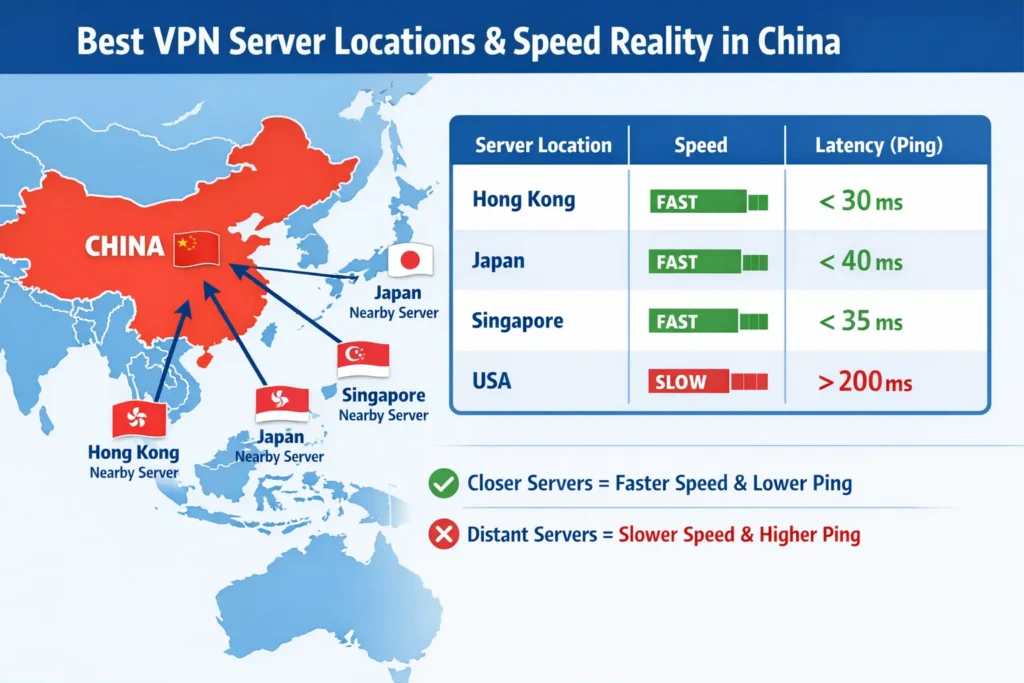
VPN Server Locations and Speed Reality in China
VPN performance in China is heavily influenced by server location and routing rather than raw bandwidth. Because VPN providers do not operate servers inside mainland China, all encrypted traffic must exit the country before reaching a VPN server. This adds unavoidable latency and makes distance a key factor in connection quality.
In practice, the fastest VPNs in China are not always those advertising the highest global speeds. Instead, reliable performance depends on how well a provider optimizes routing to nearby regions and adapts to frequent network interference. This is why real-world performance in China often differs from results published in general VPN speed rankings.
Nearby regions typically provide the best balance between speed and stability. However, some locations that were historically reliable have become inconsistent due to increased filtering or congestion. Users should be prepared to test multiple locations rather than relying on a single default server.
Best VPN Server Locations When Connecting from China
| Server Location | Latency | Stability | Notes |
|---|---|---|---|
| Japan | Low | High | Most consistent overall performance |
| Singapore | Medium | High | Reliable routing, slightly higher latency |
| Taiwan | Low | Medium | Can fluctuate during peak hours |
| South Korea | Medium | Medium | Good fallback option |
| Hong Kong | Low | Low | Increasingly unreliable due to filtering |
Users should expect slower speeds during peak local hours and occasional instability during major filtering updates. Maintaining flexibility with server selection and avoiding reliance on a single location significantly improves the overall VPN experience in China.
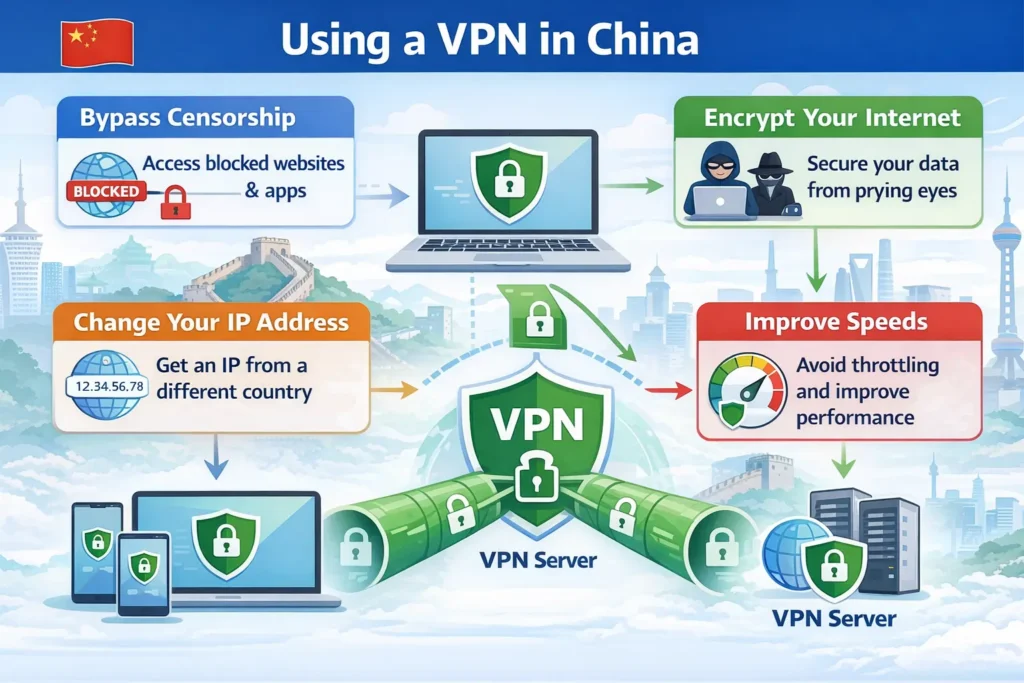
Using a VPN in China Safely
Using a VPN in China requires more preparation than in most countries. The most common mistake is installing or configuring a VPN after arrival, when access to app stores, VPN websites, and support documentation may already be restricted.
VPN apps and configuration files should always be downloaded and tested before entering China. This includes enabling stealth or obfuscation modes, confirming the kill switch is active, and verifying that the VPN can connect reliably on both Wi-Fi and mobile data. Once inside China, downloading updates or reinstalling software may not be possible without an existing working connection.
Public Wi-Fi networks in hotels, airports, cafés, and coworking spaces are particularly sensitive environments. These networks often apply additional filtering or traffic monitoring on top of national-level restrictions. Using a VPN without a kill switch on public Wi-Fi can expose real IP addresses if the connection drops unexpectedly. This risk is explained in more detail in guides covering VPN use on public Wi-Fi networks.
Mobile networks in China behave differently from fixed broadband connections. Some VPNs perform better on mobile data during off-peak hours, while others are more stable on hotel or residential Wi-Fi. Testing multiple networks early in your stay helps identify the most reliable setup for your location.
It is also advisable to avoid discussing VPN usage openly or seeking technical help through local channels. VPN reliability can change quickly during major filtering updates, and maintaining a low profile reduces unnecessary attention. Keeping backup connection methods and alternative servers configured in advance can prevent sudden loss of access.
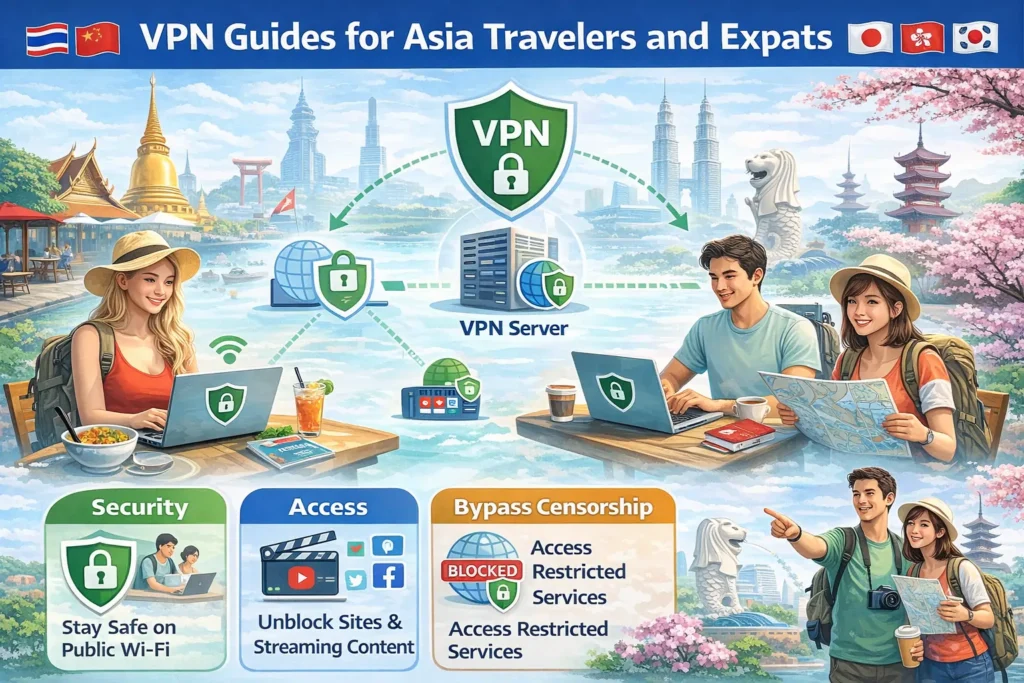
VPN Guides for Asia Travelers and Expats
While China presents the most challenging environment for VPN use, many travelers and long-term residents move between multiple countries in Asia. Internet restrictions, surveillance, and network filtering vary significantly across the region, and a VPN that works reliably in China is often chosen for broader regional travel as well.
If you are planning extended travel, working remotely, or relocating within Asia, it may be helpful to review VPN considerations specific to your situation. Guides such as this overview of the best VPNs for travelers and this breakdown of VPNs suited for expats provide additional context beyond short-term use.
Internet controls also differ widely by sub-region. Some areas apply light monitoring, while others use state-run ISPs or selective blocking similar to China. For country-specific guidance, the following regional hubs may be useful depending on your travel plans.
These guides expand on regional differences in VPN reliability, legality, and performance, while this page remains focused on China’s unique requirements. If a VPN can operate consistently under the Great Firewall, it is generally better equipped to handle less restrictive networks elsewhere in Asia.
Legal and Practical Risks of Using a VPN in China
The legal status of VPN use in China is often misunderstood. While only government-approved VPNs are technically permitted for business use, enforcement against individual users varies significantly. In practice, the majority of restrictions are enforced at the network level rather than through direct action against tourists or expats.
For most users, the primary risk is not legal trouble but loss of access. VPN connections may stop working without warning, particularly during major political events, regulatory updates, or national holidays. These disruptions are usually temporary but can last days or weeks depending on the provider’s ability to adapt.
Tourists and short-term visitors rarely face direct consequences for personal VPN use, especially when VPNs are used discreetly for everyday activities such as messaging, email, or accessing blocked services. Long-term residents and remote workers should be more cautious, particularly when using VPNs on work-related networks or for business communications.
From a privacy standpoint, using a reputable VPN with a strict no-logs policy reduces exposure compared to browsing without protection on monitored networks. This is one reason many users in restrictive environments rely on services designed specifically for countries with heavy internet controls.
Ultimately, VPN use in China is best approached as a practical necessity rather than a guarantee. Users should avoid assuming permanent access, keep backup options available, and remain aware that reliability can change quickly based on local network conditions and policy shifts.
Frequently Asked Questions About VPNs in China
Is using a VPN legal in China?
China officially permits only government-approved VPNs for business use. However, enforcement against individual tourists and expats using personal VPNs is inconsistent and typically handled through network blocking rather than direct penalties. Most users experience technical restrictions rather than legal consequences.
Do VPNs stop working suddenly in China?
Yes. VPNs in China can stop working without warning due to changes in filtering rules, protocol detection updates, or server blacklisting. Even reliable services may experience temporary outages, especially during major political events or regulatory updates.
Should I install my VPN before entering China?
Yes. VPN apps, setup guides, and configuration files should always be installed and tested before arrival. Once inside China, access to VPN websites, app stores, and support resources may be blocked or unreliable.
Why does my VPN connect but not load websites?
This usually means the VPN connection has been detected and traffic is being throttled or selectively blocked. While the connection may appear active, data packets are disrupted after detection, preventing normal browsing and app usage.
Which VPN protocol works best in China?
Standard VPN protocols often fail in China without modification. VPNs that use obfuscation or disguise traffic to look like normal HTTPS connections tend to be more reliable than those relying on default protocol settings.
Will a VPN that works in China also work in other countries?
In many cases, yes. VPNs capable of operating reliably under China’s filtering systems are usually well equipped to handle less restrictive or monitored networks elsewhere. However, performance and reliability can still vary by country and network conditions.
Choosing a VPN for China in 2026
Using a VPN in China remains one of the most challenging scenarios for personal internet access. The Great Firewall is designed to actively detect and disrupt VPN traffic, and most consumer VPNs are not equipped to operate reliably under these conditions. As a result, choosing the wrong service often leads to unstable connections, blocked access, or complete failure shortly after arrival.
The VPNs discussed in this guide are selected based on their ability to function in restrictive environments, not marketing claims or general popularity. Stealth capabilities, protocol flexibility, and ongoing infrastructure maintenance are far more important in China than raw speed or the size of a provider’s server network.
No VPN can guarantee uninterrupted access in China at all times. Filtering rules change frequently, and even the most reliable services may experience temporary outages. Preparing in advance, installing and testing your VPN before arrival, and maintaining realistic expectations are essential for avoiding disruption.
For travelers, expats, and remote workers, a VPN that can operate under the Great Firewall is typically better equipped to handle restrictive or monitored networks elsewhere. While this page is focused on China, the principles outlined here apply broadly to any environment where internet access is actively controlled.
If reliable access to communication tools, information, and online services is important during your time in China, selecting a VPN built specifically for stealth and adaptability is not optional. It is a practical requirement.
Recommended VPNs for China
Not all VPNs are capable of operating reliably under China’s filtering systems. The services below are selected specifically for their ability to maintain usable connections in restrictive network environments. These recommendations are based on technical capability rather than general popularity.
Top Choice for China
NordVPN is widely used by expats and long-term visitors due to its advanced obfuscation options, strong privacy architecture, and consistent performance across different networks.
Check NordVPN availability for China
Best for Short-Term Travelers
ExpressVPN is often chosen by travelers who prefer minimal configuration and straightforward apps. While it offers fewer manual controls, it is easier to set up and maintain.
Visit ExpressVPN official site
Alternative / Backup Option
Surfshark may work in China under certain conditions and can be useful as a secondary VPN. It is best treated as a fallback rather than a primary solution.
Because VPN reliability in China can change without notice, many users maintain more than one option to avoid complete loss of access during filtering updates.
Related VPN Guides and Regional Resources
The following guides provide additional context for VPN use in restrictive networks, regional travel, and long-term stays. These resources expand on specific use cases while this page remains focused on VPN reliability in China.
| Category | Guide | Focus |
|---|---|---|
| Core VPN Guides | Best VPN Services (2026) | Overall VPN comparison and feature overview |
| Privacy & Security | Best Privacy VPNs | No-logs, encryption, and anonymity |
| Restricted Networks | Best VPNs for Restricted Countries | VPNs built for censorship and filtering |
| Troubleshooting | VPN Troubleshooting Guide | Fixing blocked or unstable VPN connections |
| Travel Use | Best VPNs for Travelers | Short-term and multi-country travel |
| Long-Term Stays | Best VPNs for Expats | Living abroad and remote work |
| Regional Hub | East Asia VPN Guide | Regional VPN considerations |
| Regional Hub | Southeast Asia VPN Guide | Travel and censorship overview |
| Regional Hub | Central Asia VPN Guide | Highly restricted ISP environments |
| Entertainment | Best VPN for Netflix | Streaming access while abroad |
These internal links are provided to support broader research and planning. For users staying in China, the primary considerations remain stealth capability, reliability, and preparation before arrival.