
Why Restricted Countries Are Different
Using a VPN in a restricted country is not the same as using one in Europe, North America, or other open internet regions. In countries with censorship, surveillance, or state-level filtering, most VPNs simply do not work — or stop working shortly after connecting.
In 2026, restricted countries increasingly rely on advanced techniques such as traffic inspection, protocol blocking, and ISP-level interference. As a result, many VPNs that perform well for streaming or general privacy fail entirely when used in places like Iran, Saudi Arabia, the United Arab Emirates, or other parts of the Middle East.
This guide focuses on one question only:
Which VPNs actually work in restricted countries — and why?
Rather than listing features or marketing claims, we explain how censorship works, why VPNs fail, and which providers are built to survive real-world restrictions.
For a broader global overview of where VPN use becomes essential rather than optional,
see
The 10 Countries You Need a VPN For (2026)
.
Who This Guide Is For (and Who It Isn’t)
This guide is written for people who face real internet restrictions, not casual inconvenience.
It is specifically designed for:
- Residents living under censorship or ISP monitoring
- Expats and remote workers accessing international platforms (see also Best VPNs for Expats)
- Journalists, researchers, and NGOs operating in high-risk regions
- Travellers entering countries where VPN traffic is filtered or unstable
It is not intended for users whose primary goal is streaming, gaming, or basic Wi-Fi privacy in unrestricted countries. In restricted environments, speed and entertainment features are secondary to connection reliability and safety.
Many readers arrive here after discovering that a VPN which works perfectly at home becomes unreliable abroad. This page explains why that happens — and how to avoid it.
What Makes a Country “Restricted” for VPN Use?
A restricted country is not defined by a single law or rule. In practice, restriction is enforced technically, through national network infrastructure and ISP behaviour.
Countries are considered restricted when one or more of the following are present:
- Active VPN blocking using protocol detection
- Deep packet inspection (DPI) to identify encrypted traffic
- IP address blacklisting of known VPN servers
- Traffic throttling that slows or destabilises VPN connections
- Forced connection resets once VPN use is detected
- Temporary crackdowns during protests, elections, or unrest
Because enforcement methods vary, a VPN that works in one restricted country may fail completely in another. For example, VPN reliability in Iran is often affected by throttling and shutdowns, while Saudi Arabia and the UAE rely more on filtering and selective blocking.
This is why a single “best VPN” recommendation is rarely enough without understanding the environment it will be used in.

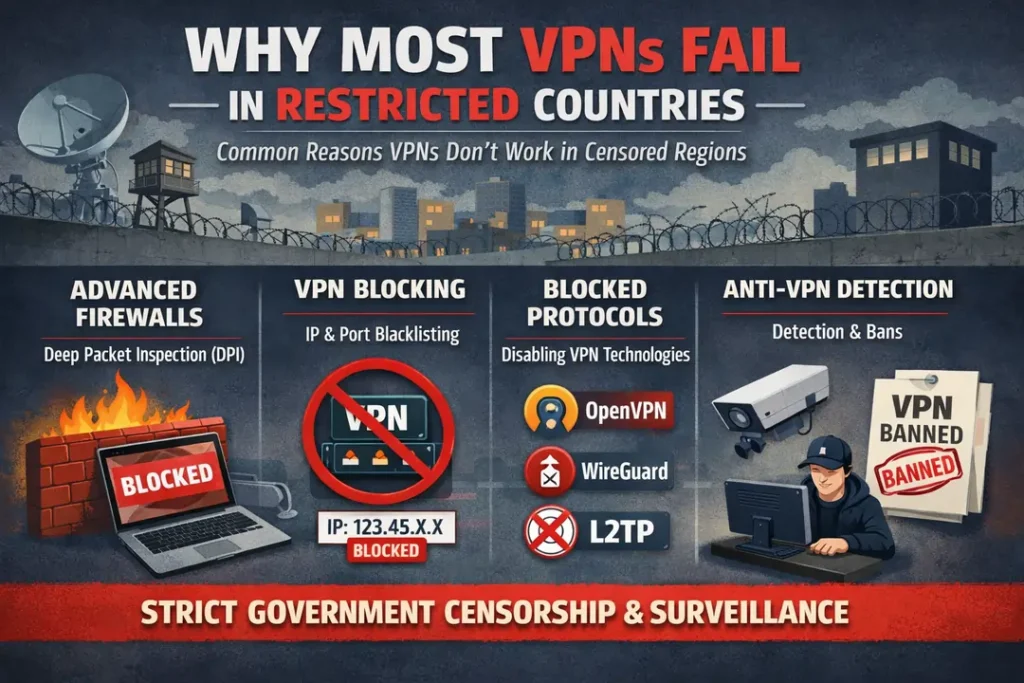
Why Most VPNs Fail in Restricted Countries
Most VPNs are designed for open internet environments. They are built to bypass simple geo-blocks, protect users on public Wi-Fi, or unblock streaming platforms. That design breaks down quickly in restricted countries.
In places like Iran, China, and Russia, VPN traffic is not just filtered — it is actively targeted. As a result, many VPNs will connect briefly, then slow down, disconnect repeatedly, or stop working entirely.
The most common failure points include:
- Protocol fingerprinting, where VPN handshakes are identified and blocked
- Deep packet inspection (DPI) that detects encrypted traffic patterns
- IP blacklisting of known VPN server ranges
- Intentional throttling of encrypted connections
- Forced connection resets once VPN usage is detected
This is why users often report that a VPN “works for a few minutes” and then becomes unusable. The VPN itself is not broken — it simply isn’t designed for that level of enforcement.
If you’ve experienced this behaviour in countries such as Iran or Turkey, it follows a well-documented pattern seen across restricted environments.
How Censorship and VPN Blocking Actually Work
Censorship is not implemented the same way everywhere, but most restricted countries rely on a layered approach rather than a single block.
At the simplest level, some countries block websites or services based on IP addresses or DNS requests. Standard VPNs can bypass this easily. The real challenge begins when countries move beyond basic blocking.
More advanced enforcement includes:
-
Deep packet inspection (DPI)
This examines traffic behaviour rather than content. Even when data is encrypted, VPN protocols often leave recognisable patterns. -
Protocol-specific blocking
Certain VPN protocols are identified and disrupted, while others may continue working temporarily. -
Selective enforcement
Restrictions often intensify during protests, elections, or periods of political sensitivity, as seen in Iran and Turkey. -
Network-level throttling
Instead of blocking VPNs outright, ISPs deliberately slow encrypted traffic until it becomes unusable.
Because these methods are adaptive, a VPN that works today may stop working tomorrow. This is why reliability in restricted countries is about resilience, not guarantees.
For a broader overview of where this kind of enforcement is common,
see
The 10 Countries You Need a VPN For (2026)
.
VPN Features That Actually Matter Under Restriction
In restricted countries, many advertised VPN features are irrelevant. What matters is whether a VPN can connect, stay connected, and fail safely.
The table below summarises the features that make a real difference under censorship.
Essential VPN Features for Restricted Countries
| Feature | Why It Matters | What Happens Without It |
|---|---|---|
| Traffic obfuscation / stealth mode | Makes VPN traffic resemble normal HTTPS traffic | VPN detected and blocked quickly |
| Reliable kill switch | Prevents traffic leaks if the VPN disconnects | Real IP address briefly exposed |
| Multiple protocols | Allows switching when one protocol is blocked | No fallback option |
| Strict no-logs policy | Limits stored data under legal or ISP pressure | Long-term privacy risk |
| Stable mobile performance | Mobile networks are often the most restricted | Frequent drops and reconnects |
These requirements apply across most restricted environments, although enforcement intensity varies. For example, Saudi Arabia and the UAE rely more on filtering and inspection, while Iran and China frequently combine throttling with forced connection resets.
This is why VPNs optimised only for speed or streaming consistently fail in restricted countries.

Best Overall VPN for Restricted Countries – NordVPN
Across the restricted environments we test,
NordVPN consistently performs better than most competitors.
It is not always the fastest option,
but it is one of the most resilient when VPN traffic is actively filtered.
NordVPN is particularly effective in countries where
deep packet inspection,
protocol blocking,
and forced connection resets are common.
In practice, it maintains usable connections longer
than most VPNs under enforcement pressure.
Why NordVPN Works Well Under Restriction
- Advanced obfuscation that disguises VPN traffic as normal HTTPS
- Strict no-logs policy that has been independently audited
- Reliable kill switch to prevent traffic leaks during disconnects
- Strong recovery behaviour after resets or protocol blocks
These strengths are especially noticeable in high-risk environments
such as Iran and China,
where many VPNs fail repeatedly or stop working altogether.
For a full technical breakdown,
including testing results in censored regions,
see our
NordVPN review (2026).
If you want to check current plans and availability,
you can also visit the
official NordVPN website.
Best VPN for Stability and Ease of Use – ExpressVPN
While NordVPN leads in overall censorship resistance, ExpressVPN excels in stability and simplicity. It is often the most reliable option for users who want a VPN that works with minimal configuration.
ExpressVPN performs particularly well on unstable networks and when switching frequently between Wi-Fi and mobile data, which is common in restricted countries.
Why ExpressVPN Performs Well in Restricted Countries
- Automatic obfuscation enabled by default
- Fast reconnection after signal drops or forced resets
- Strong encryption with an always-on kill switch
- Consistent performance across different network types
This makes ExpressVPN a strong choice for travellers, expats, and users who value reliability over advanced customisation.
For deeper testing notes and long-term reliability analysis, read our ExpressVPN review (2026).
You can also view current pricing and plans on the official ExpressVPN site.
Best Budget VPN for Restricted Countries – Surfshark
For users who need strong security at a lower cost, Surfshark is the most practical budget option for restricted countries in 2026.
Surfshark is not as resilient as NordVPN under extreme enforcement, but it offers a solid balance of stealth features, privacy protection, and usability.
Why Surfshark Works for Budget Users
- Camouflage mode to help disguise VPN traffic
- Unlimited simultaneous device connections
- Built-in kill switch and leak protection
- Good performance on mobile and shared networks
Surfshark performs best in countries with selective or moderate enforcement, rather than full-scale VPN crackdowns.
For limitations, trade-offs, and detailed testing, see our Surfshark VPN review.
You can check current deals directly on the Surfshark official website.
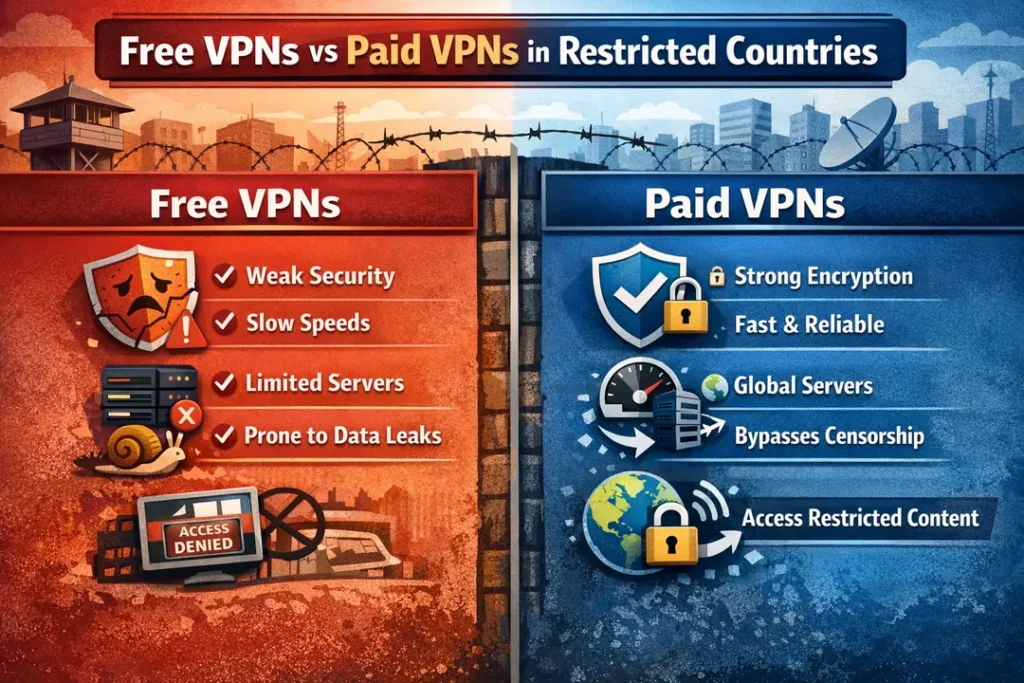
Free VPNs vs Paid VPNs in Restricted Countries
In restricted countries, free VPNs are not a lighter version of paid services.
They are an entirely different category of product — and usually the wrong one.
Most free VPNs are built to bypass basic geo-blocking in open internet environments.
They are not engineered to survive active censorship,
protocol fingerprinting,
or ISP-level traffic interference.
Why Free VPNs Break Down Under Censorship
- They use static IP ranges that are quickly identified and blocked
- They rely on standard VPN protocols without obfuscation
- They lack infrastructure for rapid server or protocol rotation
- Many collect connection metadata or activity logs
In practice, this results in short-lived connections,
frequent disconnections,
or complete failure after initial access.
In higher-risk environments,
a free VPN can actually increase exposure by failing unpredictably.
Why Paid VPNs Are Structurally Different
VPNs that work in restricted countries invest heavily in:
- Obfuscation layers designed to defeat DPI systems
- Large, frequently rotated IP pools
- Fail-safe kill switches that block traffic during disruption
- Infrastructure designed for hostile network conditions
This is why the same providers tend to appear consistently
across country-specific guides
and broader analyses such as
countries where VPN use is functionally necessary
.
In restricted environments,
a paid VPN is not about convenience or speed —
it is about reducing failure risk.
Frequently Asked Questions About VPNs in Restricted Countries
Do VPNs reliably work in restricted countries?
Some do.
Most do not.
Only VPNs with strong obfuscation,
adaptive protocols,
and resilient infrastructure maintain usable connections for extended periods.
Even then,
performance varies based on enforcement activity and network conditions.
Can authorities see that I am using a VPN?
ISPs and governments can usually detect encrypted traffic.
What they typically cannot see is the content inside the VPN tunnel.
When obfuscation is enabled,
VPN traffic is disguised as normal HTTPS,
making identification significantly harder.
Why does a VPN work one day and fail the next?
Censorship systems are dynamic.
IP addresses are blocked,
protocol signatures are updated,
and throttling rules change frequently.
A VPN that works today may stop working tomorrow
until servers or protocols are rotated.
Can a VPN guarantee access in restricted countries?
No.
No provider can guarantee uninterrupted access under active censorship.
Any service making that claim should be treated with skepticism.
A good VPN improves access probability — not certainty.
Is it safe to use a VPN on mobile data?
Often yes.
In some countries,
mobile networks are less aggressively filtered than fixed-line connections.
However,
mobile traffic is still monitored,
which makes kill switches and auto-reconnect features essential.
Should streaming be a deciding factor?
No.
Streaming performance is a poor indicator of censorship resistance.
A VPN that unblocks Netflix reliably
may still fail completely under state-level filtering.
What should users realistically expect?
Lower speeds,
occasional disconnections,
and the need to switch servers or protocols.
A VPN should be viewed as a resilience tool —
not a guarantee.
Final Verdict – Best VPNs for Restricted Countries (2026)
Using a VPN in a restricted country is a technical challenge,
not a consumer convenience.
Success depends far more on infrastructure,
adaptability,
and failure handling
than on speed or marketing features.
After evaluating real-world performance across censored networks:
- NordVPN is the strongest overall option for sustained access and privacy
- ExpressVPN offers the highest connection stability with minimal configuration
- Surfshark provides the best balance of cost and functionality for moderate restriction
No VPN is perfect.
All VPNs can fail under aggressive enforcement.
However,
choosing a provider built for hostile networks
dramatically improves reliability
and reduces exposure during connection failures.
This guide is designed to support broader decision-making
alongside resources such as
high-risk country assessments
and country-specific VPN guides.
Bottom line:
in restricted countries,
a VPN should be treated as security infrastructure.
Choose carefully,
configure correctly,
and use it with informed expectations.
Related VPN Guides for Restricted and High-Risk Countries
The guides below provide deeper, country-specific analysis for regions where VPN reliability, stealth, and failure handling are critical.
Strategic Country VPN Guides
| Country | Focus |
|---|---|
| Best VPNs for Iran (2026) | Severe censorship, DPI, throttling, and shutdown resilience |
| Best VPN for Saudi Arabia (2026) | Protocol blocking, filtering, and legal grey-zone usage |
| Best VPN for UAE (2026) | VoIP restrictions, DPI, and expat use cases |
| Best VPN for Turkey (2026) | Social media throttling, protest-related restrictions |
| Best VPN for Iraq (2026) | Unstable networks, monitoring, and mobile-first access |
Restricted Countries & Regional Context
| Guide | Why It Matters |
|---|---|
| 10 Countries You Need a VPN For (2026) | High-risk environments where VPN use is functionally necessary |
| Best VPNs for the Middle East (2026) | Regional comparison of censorship, legality, and VPN reliability |
| VPNs for Restricted Networks | Technical breakdown of VPN performance under blocking and DPI |