
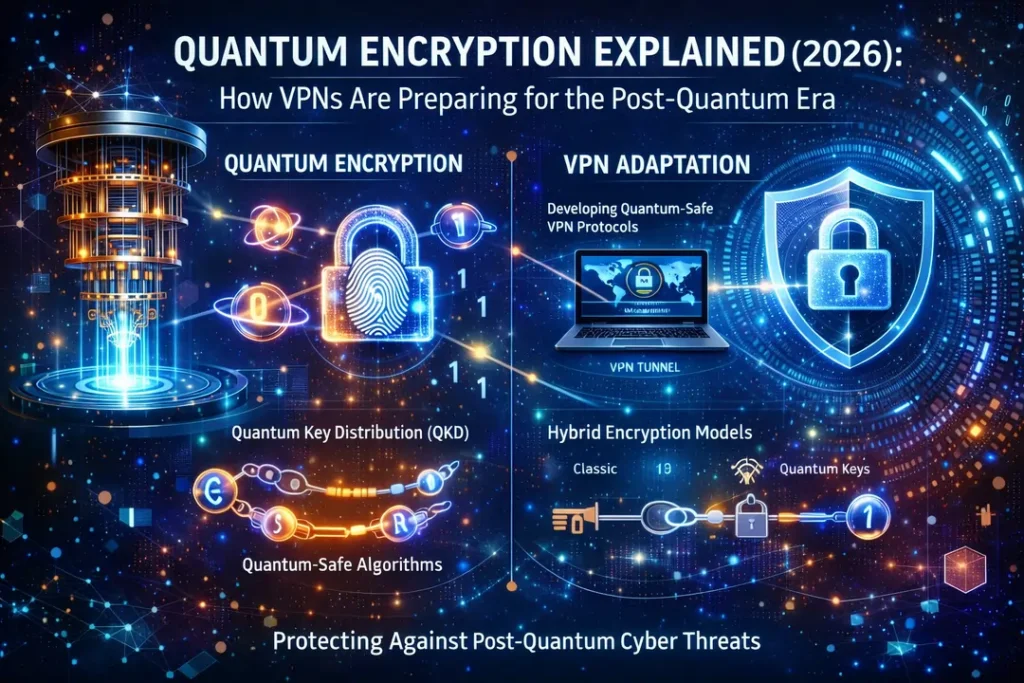
Quantum computing is no longer a distant theory. By 2026, it has become a planning problem for governments, security researchers, and privacy-focused VPN providers. While today’s internet encryption still protects your data in transit, the methods used to establish secure connections are facing a long-term challenge: quantum decryption.
This guide explains what quantum encryption really means, which parts of VPN security are affected, what the “harvest now, decrypt later” threat actually involves, and how modern VPNs are adapting. If you are choosing a VPN for long-term privacy — especially on routers, public Wi-Fi, or restricted networks — this context matters.


The Real Quantum Threat: “Harvest Now, Decrypt Later”
The most important concept to understand in 2026 is not instant quantum breakage, but delayed compromise. This is known as Harvest Now, Decrypt Later (HNDL).
Adversaries can already intercept and store encrypted VPN traffic. They may not be able to decrypt it today, but once sufficiently powerful quantum computers exist, previously captured data could be decrypted retroactively.
This matters most for:
- Financial records and identity data
- Legal, journalistic, or medical communications
- Corporate IP and trade secrets
- Users in high-surveillance or restricted regions
If you operate in or travel through countries with aggressive monitoring, see our related analysis: Best VPNs for Restricted Networks (2026).
Which Parts of VPN Encryption Are Actually Vulnerable?
A common misconception is that quantum computers will instantly break all encryption. That is not accurate.
What Remains Strong
Symmetric encryption — such as AES-256 — remains highly resistant, even against future quantum attacks. This means the data inside the VPN tunnel is still considered secure.
What Needs Reinforcement
The weak point is the key exchange process — the initial handshake where your device and the VPN server agree on encryption keys.
Traditional handshakes rely on RSA or Diffie-Hellman, which quantum algorithms (notably Shor’s Algorithm) are expected to weaken significantly.
This is why modern VPNs are not replacing encryption entirely, but upgrading how secure connections are established.
What “Quantum-Resistant” Encryption Actually Means
Quantum-resistant (or post-quantum) encryption does not mean “unbreakable forever.” It means using cryptographic methods that remain secure even when quantum computers are involved.
Most VPN implementations in 2026 use a hybrid approach:
- Traditional encryption for compatibility and performance
- Post-quantum key exchange for future resilience
The most common post-quantum methods are based on lattice-based cryptography, which is computationally difficult for both classical and quantum systems.
If you are interested in how these cryptographic upgrades affect VPN protocols directly, see: WireGuard vs OpenVPN vs IKEv2.
How Leading VPNs Are Responding to the Quantum Shift (2026)
Not all VPN providers are approaching post-quantum security with the same level of seriousness. Preparing for quantum-era threats requires fundamental protocol changes, not surface-level encryption upgrades or marketing labels. In 2026, the gap between providers actively engineering for the future and those merely acknowledging the problem has become very clear.
Providers Actively Implementing Post-Quantum Protections
- NordVPN — upgrading its NordLynx protocol with post-quantum key exchange mechanisms designed to protect session handshakes against future decryption. This is particularly relevant for users generating large volumes of encrypted traffic over time.
Read NordVPN Review - ExpressVPN — Lightway now uses a hybrid cryptographic model, combining classical encryption with quantum-resistant elements. This approach ensures backward compatibility while mitigating “harvest now, decrypt later” risk.
Read ExpressVPN Review - PureVPN — among the earliest commercial VPNs to test quantum-resistant handshakes on selected infrastructure. While not yet universal across all servers, it represents a meaningful early commitment.
Read PureVPN Review - IPVanish — currently rolling out hybrid encryption handshakes across parts of its US-based network. These updates focus on protecting long-lived sessions and high-throughput use cases.
Read IPVanish Review
These upgrades matter most where encryption is persistent rather than occasional. Users running VPNs on routers, gateways, or always-on devices generate far more interceptable data than mobile-only users. For a hardware-focused perspective, see: Best VPN Router Guide (2026).
Quantum Security on VPN Routers & Whole-Network Setups
Running a VPN at the router level fundamentally changes the threat model. Instead of protecting individual sessions, a router VPN encrypts every packet from every device, often continuously and for years at a time. From a “harvest now, decrypt later” standpoint, this dramatically increases the value of intercepted traffic.
This is why post-quantum readiness becomes significantly more important for whole-network deployments than for casual app-based VPN use. If your router is encrypting backups, smart home traffic, work devices, and personal communications simultaneously, the long-term confidentiality window matters.
If you are deploying modern hardware, our configuration guide applies quantum-aware best practices at the firmware and protocol level:
How to Set Up a VPN on a Wi-Fi 7 Router (2026)
Do You Actually Need a Quantum-Resistant VPN in 2026?
For short-lived, low-sensitivity browsing, the immediate risk remains limited. However, quantum threats are not about today’s access — they are about future decryption of today’s data. If your encrypted traffic has long-term value, waiting is not a neutral choice.
You should actively prioritise post-quantum readiness if you:
- Handle financial, legal, medical, or identity-linked data
- Regularly use public or shared networks
- Live in or travel through high-surveillance or restricted regions
- Run VPNs at the router, gateway, or always-on network level
For a broader geopolitical view of where long-term encryption risk is highest, see: The 10 Countries You Need a VPN For (2026) .
Final Verdict: Quantum Encryption & VPNs in 2026
Quantum computing will not suddenly break the internet. But it does change what “secure” means over time.
The VPNs best positioned for the future are not the loudest, but the ones quietly rebuilding their cryptographic foundations. Hybrid key exchanges, protocol agility, and router-level protection are now markers of serious security infrastructure.
If you are choosing a VPN in 2026, do not ask whether it is “quantum-proof.” Ask whether it is quantum-aware, adaptable, and designed for the next decade — not the last.
Classical VPNs vs Quantum-Aware VPNs (2026)
Not all VPNs marketed as “secure” are built for long-term privacy. The table below highlights the practical differences between traditional VPN implementations and modern, quantum-aware designs.
| Security Layer | Classical VPN (Pre-Quantum) | Quantum-Aware VPN (2026) |
|---|---|---|
| Encryption (Data Tunnel) | AES-256 (secure today) | AES-256 (secure today) |
| Key Exchange | RSA / Diffie-Hellman | Hybrid (Classical + Post-Quantum) |
| Resistance to HNDL | Low | High |
| Protocol Agility | Limited | Designed for future upgrades |
| Router-Level Protection | Often unsupported or basic | Optimised for continuous encryption |
| Long-Term Privacy | Short-to-medium horizon | Designed for multi-year confidentiality |
If you are deploying VPNs on gateways, routers, or shared networks, quantum-aware implementations offer meaningful long-term risk reduction — even though quantum computers are not yet breaking encryption in real time.