
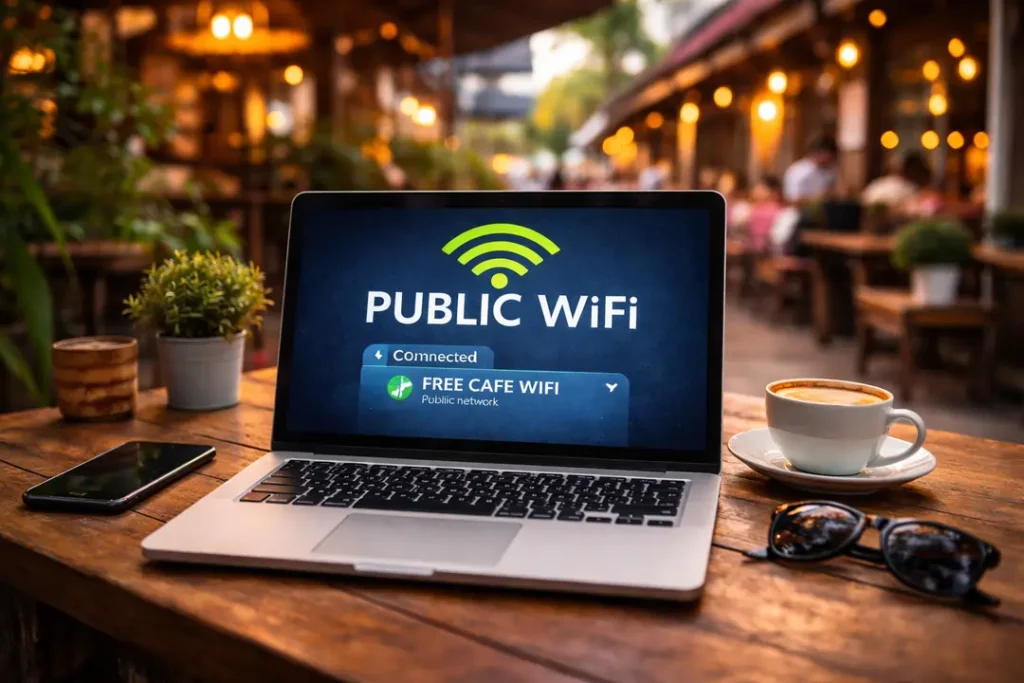
Why Public WiFi in Thailand Carries Risk
Public WiFi networks in Thailand prioritise accessibility and convenience. Cafés, hotels, airports, and shopping centres provide open or semi-secured connections to accommodate high user turnover. These networks are rarely configured for individual device isolation.
On shared infrastructure, multiple users connect to the same router or access point. In poorly configured environments, this increases exposure to traffic interception, session hijacking, and credential capture.
Common Public WiFi Risk Factors
| Risk Factor | What It Means | Typical Location |
|---|---|---|
| Open Networks (No Encryption) | Traffic may be readable between devices | Cafés & small shops |
| Shared Access Points | Multiple users on same local network | Hotels & airports |
| Captive Portal Logins | Login pages that do not encrypt traffic beyond entry | Shopping centres |
| Network Spoofing | Fake WiFi hotspots mimicking legitimate networks | Tourist areas & transit hubs |
| Peak Congestion | Reduced stability and inconsistent encryption enforcement | Busy urban cafés |
These risks are not unique to Thailand, but the country’s heavy reliance on public WiFi — especially in urban areas like Bangkok, Chiang Mai, and Phuket — makes exposure more routine.
What Can Actually Be Intercepted on Public WiFi?
On unsecured or poorly configured public WiFi networks, certain types of data may be exposed if additional protection is not in place. The level of risk depends on whether websites use HTTPS encryption and how the network is configured.
While modern websites increasingly use secure HTTPS connections, exposure can still occur during login sessions, unsecured app connections, or on networks that lack proper isolation between devices.
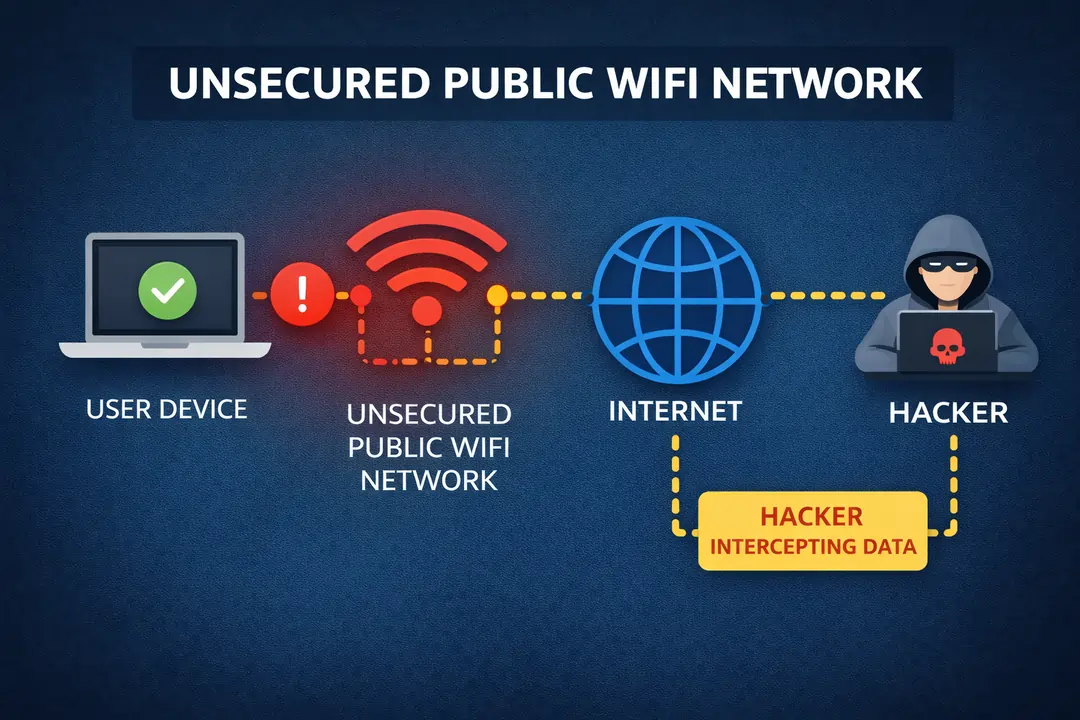
Data Exposure Risks on Public Networks
| Data Type | Risk Level Without Protection | Why It Matters |
|---|---|---|
| Login Credentials | Moderate to High | May be captured during unsecured sessions |
| Session Cookies | Moderate | Can allow account hijacking |
| Unencrypted Website Traffic | High | Readable by others on the same network |
| Email Metadata | Low to Moderate | Depends on app-level encryption |
| Banking Transactions (HTTPS) | Low | Typically encrypted, but network spoofing remains a risk |
Session Hijacking & Network Spoofing
Two of the more realistic risks on public WiFi are session hijacking and network spoofing.
Session hijacking involves intercepting active login sessions, allowing temporary access to accounts without needing a password.
Network spoofing occurs when attackers create fake WiFi networks that resemble legitimate ones. Unsuspecting users may connect to these networks, exposing traffic to interception.
These risks are more common in high-traffic environments such as airports, tourist districts, and large shopping centres.
How a VPN Protects You on Public WiFi
A Virtual Private Network (VPN) encrypts your internet traffic before it leaves your device. Instead of sending data directly across the local WiFi network, your connection is routed through an encrypted tunnel to a secure server.
This prevents other users on the same network from viewing your browsing activity, login sessions, or transmitted data.
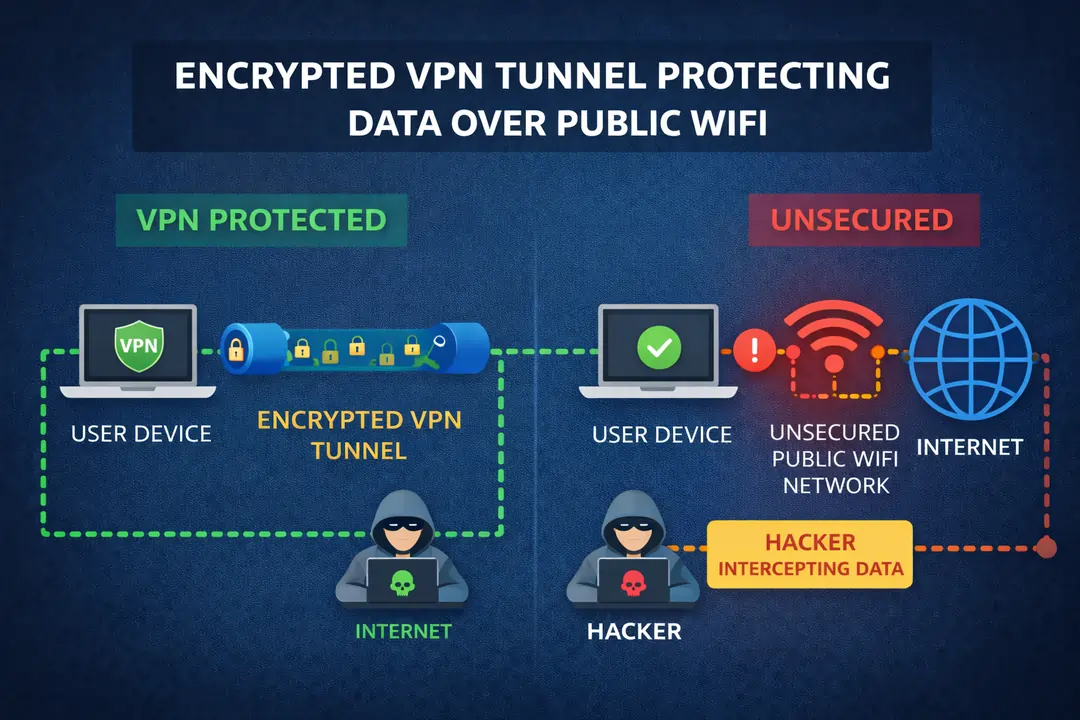
What Changes When a VPN Is Active
| Connection Element | Without VPN | With VPN |
|---|---|---|
| Local Network Visibility | Other devices may detect traffic | Traffic encrypted |
| Website Access | Readable if not HTTPS | Encrypted regardless |
| Session Hijacking Risk | Possible on insecure networks | Significantly reduced |
| ISP-Level Visibility | Sites visible | Only VPN server visible |
| Network Spoofing Protection | Vulnerable | Encrypted tunnel limits exposure |
Why This Matters in Thailand
Public WiFi usage is routine in Thailand. Many residents and travellers rely on café networks, hotel WiFi, and shared condominium broadband daily. These networks are built for convenience rather than individual security.
In these environments, encryption becomes the primary protective layer. A VPN does not eliminate all online risk, but it significantly reduces exposure on shared infrastructure.
For providers tested under real Thai fibre and 4G/5G conditions, see our
Best VPN for Thailand (2026) guide.
When You Probably Don’t Need a VPN in Thailand
A VPN is useful on shared and public networks, but it is not required in every situation. Thailand has strong fibre infrastructure, widespread HTTPS adoption, and generally stable home broadband environments.
Understanding when protection is situational rather than constant helps users make informed decisions.
Low-Risk Scenarios
| Scenario | Risk Level | VPN Necessary? |
|---|---|---|
| Private home fibre connection | Low | Optional |
| Personal secured router (WPA3/WPA2) | Low | Optional |
| Banking apps with HTTPS & 2FA | Low | Situational |
| Mobile data on private device | Low to Moderate | Situational |
Why Context Matters
If you are using a properly secured private home connection, the primary benefit of a VPN shifts from network protection to privacy preference. In these cases, VPN use is optional rather than essential.
The higher-risk environments in Thailand remain shared WiFi networks and multi-user residential infrastructure.
This distinction keeps VPN use practical rather than constant.
Real-World Public WiFi Environments in Thailand
Public WiFi in Thailand varies significantly depending on location. Urban centres such as Bangkok, Chiang Mai, and Phuket offer widespread connectivity, but security configuration differs between cafés, hotels, airports, and shopping centres.
Understanding the environment helps determine when encryption is necessary.
Comparison of Common Public WiFi Locations
| Location Type | Typical Setup | Risk Level | VPN Recommended? |
|---|---|---|---|
| Cafés & Coffee Shops | Shared router, open or simple password | Moderate to High | Yes |
| Hotels & Resorts | Shared access points per floor | Moderate | Recommended |
| Airports & Transit Hubs | Large-scale public network | High | Strongly Recommended |
| Shopping Centres | Captive portal login system | Moderate | Recommended |
| Co-working Spaces | Shared business-grade WiFi | Moderate | Often |
Urban vs Tourist Areas
In high-traffic tourist districts, open networks are common and user turnover is constant. This increases the likelihood of unsecured connections and spoofed hotspots.
In residential areas, shared condominium broadband can expose multiple units to the same local infrastructure. While not inherently unsafe, it increases the value of encrypted connections.
For VPN providers tested specifically under Thai fibre and mobile conditions, see our
Best VPN for Thailand guide.
Common Public WiFi Mistakes in Thailand
Public WiFi risk in Thailand is usually the result of user behaviour rather than advanced cyber threats. Simple configuration mistakes and poor connection habits account for most exposure.
Frequent Mistakes on Shared Networks
| Mistake | Why It Increases Risk | Better Practice |
|---|---|---|
| Connecting to open networks automatically | May join spoofed or unsecured hotspots | Disable auto-join |
| Logging into sensitive accounts without protection | Session hijacking risk | Use VPN or mobile data |
| Ignoring HTTPS warnings | May expose credentials | Verify secure connection |
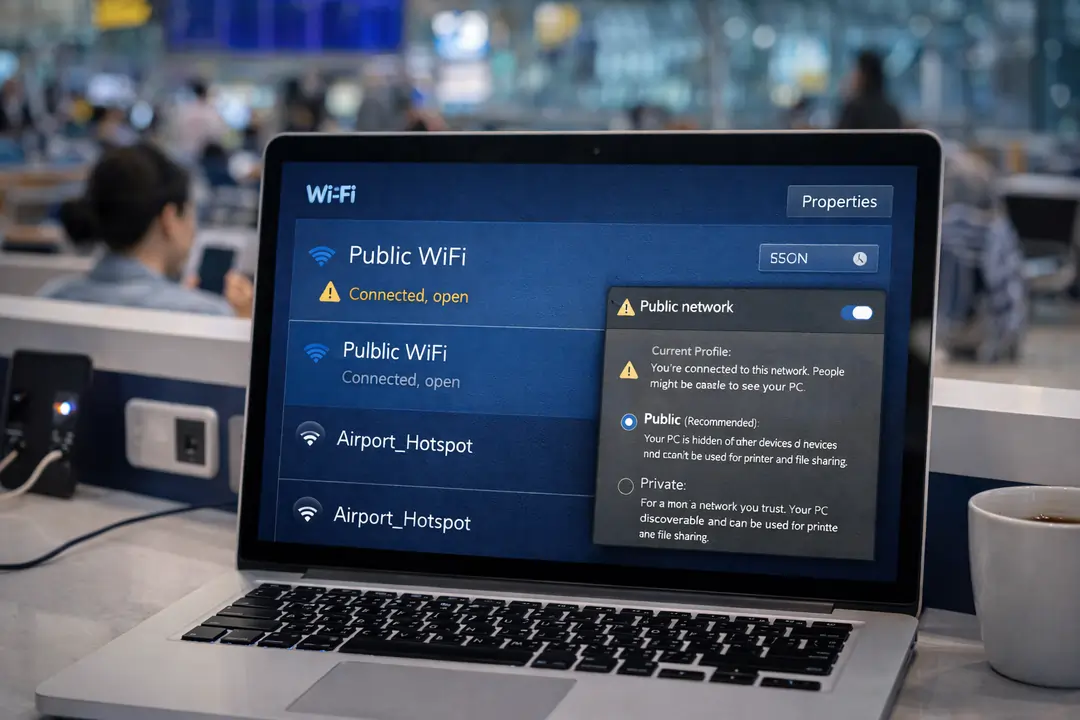
| Leaving file sharing enabled | Other users can scan device | Disable sharing on public networks |
| Using outdated apps or OS | Security vulnerabilities remain unpatched | Keep devices updated |
Mobile Device Oversight
Many users rely on smartphones in Thailand’s public WiFi environments. Auto-connect settings can cause devices to reconnect to unsecured networks without notice. Disabling automatic connection to known public hotspots reduces this exposure.
For a broader breakdown of configuration issues, see our
VPN Troubleshooting Pro Guide (2026).