
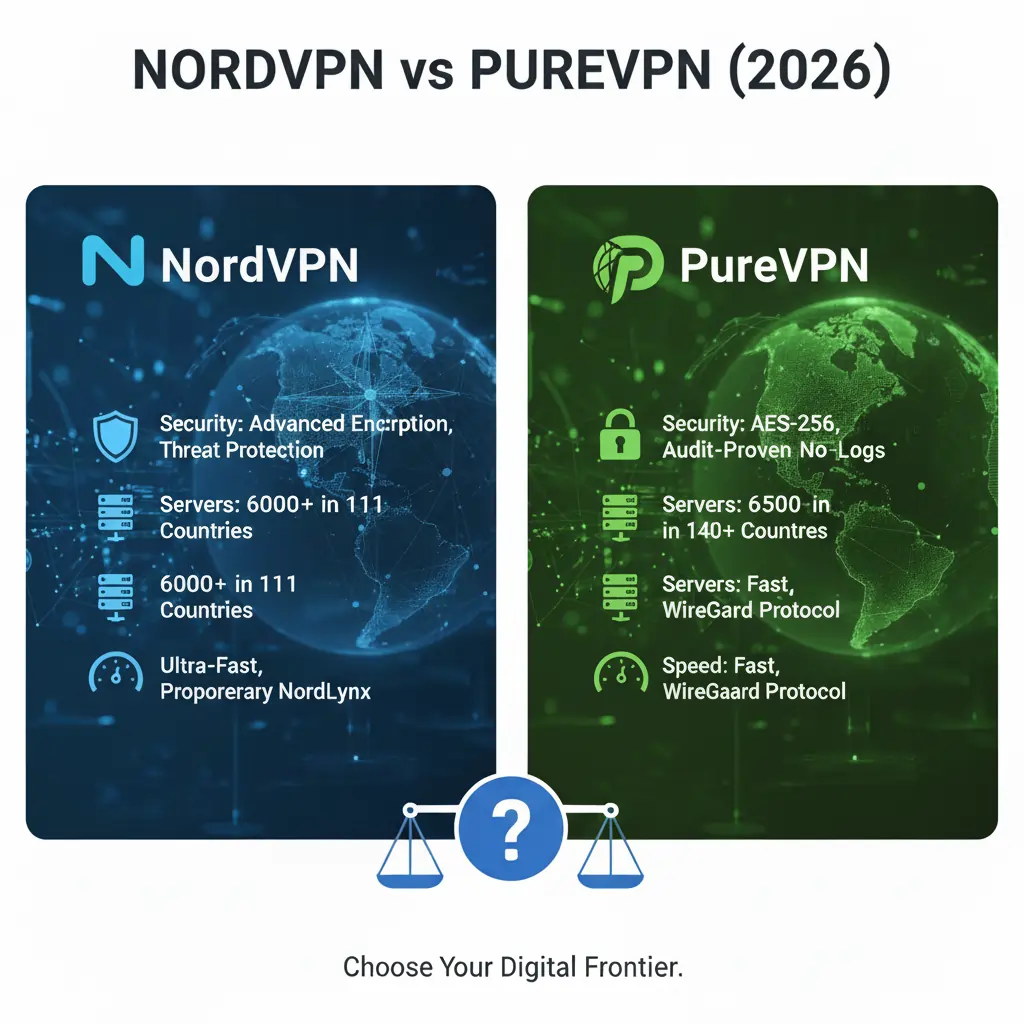
Choosing a VPN in 2026 is no longer just about price or basic encryption. Modern VPN users must consider long-term privacy, resistance to surveillance, streaming reliability, and performance across multiple devices and countries.
NordVPN and PureVPN are two of the most widely compared VPN providers online. While both advertise strong security and global coverage, they are built for very different types of users.
In this independent NordVPN vs PureVPN comparison, we analyze security, privacy, speed, streaming performance, ease of use, and overall value. This guide is based on real-world testing and is designed to help you choose the right VPN for your needs in 2026.
Quick Verdict: NordVPN vs PureVPN (2026)
If you are short on time, here is the clear takeaway from our testing:
- Choose NordVPN if you want the best overall VPN in 2026, with stronger security, faster speeds, and long-term privacy protection.
- Choose PureVPN if you are on a tight budget and only need basic VPN protection for everyday browsing.
While both VPNs advertise no-logs policies and global coverage, the real differences appear when you look at performance, streaming reliability, and how well each service is prepared for modern privacy threats.
Below, we break down exactly where each VPN excels — and where it falls short.

Security & Privacy: Which VPN Is Safer in 2026?
Security is the most important factor when comparing NordVPN and PureVPN. In 2026, privacy risks go far beyond basic encryption and now include long-term data harvesting, ISP monitoring, and advanced surveillance techniques.
If you are choosing a VPN primarily for privacy, this section matters more than pricing or features.
NordVPN Security & Privacy
NordVPN is designed for users who want maximum privacy protection, both today and in the future. Its security model goes beyond standard VPN encryption.
- AES-256 encryption with modern key exchange mechanisms
- NordLynx protocol, built on WireGuard for speed and security
- Strict no-logs policy verified by multiple independent audits
- RAM-only server infrastructure that automatically wipes data
- Advanced threat protection that blocks malware, trackers, and malicious domains
These protections make NordVPN particularly suitable for travelers, journalists, remote workers, and users connecting from public Wi-Fi networks.
For a deeper breakdown of NordVPN’s privacy architecture, see our full NordVPN review (2026).
PureVPN Security & Privacy
PureVPN offers solid baseline security and is safe for general use, but it prioritizes affordability over advanced privacy engineering.
- AES-256 encryption
- Support for WireGuard and OpenVPN protocols
- Independently audited no-logs policy
- Built-in kill switch to prevent accidental IP leaks
PureVPN is suitable for casual browsing and basic public Wi-Fi protection, but it lacks advanced infrastructure such as RAM-only servers and integrated threat blocking.
You can read a detailed analysis in our PureVPN review (2026).
Why This Matters in 2026
According to guidance from organizations such as the National Institute of Standards and Technology (NIST) and the Electronic Frontier Foundation (EFF), long-term privacy protection now depends on how services handle metadata, server memory, and encryption key management.
VPN providers that rely on disk-based servers or minimal logging controls face higher long-term privacy risks, even if they advertise strong encryption.
Security Verdict: NordVPN offers stronger privacy protections, more transparent infrastructure, and better long-term security than PureVPN.
If privacy is your main concern, you may also want to compare NordVPN against other privacy-focused services in our Best No-Log VPNs (2026) guide.

Speed & Performance: NordVPN vs PureVPN in Real-World Use
Speed is not just about raw download numbers. In 2026, VPN performance is measured by consistency, latency stability, and how well a provider handles modern workloads such as 4K streaming, video calls, cloud apps, and online gaming.
We evaluated both NordVPN and PureVPN based on real-world usage scenarios rather than short synthetic speed tests alone.
NordVPN Speed Performance
NordVPN continues to rank among the fastest VPNs available in 2026. Its performance advantage comes primarily from its NordLynx protocol, which is based on WireGuard and optimized for low latency and high throughput.
- Excellent speeds on local and international servers
- Very low latency, suitable for gaming and VoIP
- Minimal speed loss on long-distance connections
- Stable performance during peak usage hours
In everyday use, NordVPN handles HD and 4K streaming, large file downloads, and remote work applications without noticeable slowdowns. Server switching is fast, and performance remains consistent even on heavily used locations.
For a deeper technical breakdown, see our Best VPNs for Gaming & Low Ping (2026) guide.
PureVPN Speed Performance
PureVPN delivers good speeds on nearby servers and performs well for general browsing and HD streaming. However, performance can be inconsistent on long-distance connections.
- Good speeds on regional servers
- Noticeable drops on distant locations
- Occasional slowdowns under heavy load
- Less consistent latency compared to NordVPN
PureVPN is perfectly usable for everyday tasks such as browsing, email, and occasional streaming, but users who rely on stable connections for work or gaming may notice fluctuations.
More detailed results are available in our PureVPN performance review.
Why Consistency Matters More Than Peak Speed
According to research from Ookla Speedtest Insights, users perceive VPN quality primarily through consistency rather than peak throughput.
Short speed tests can be misleading. What matters more is whether a VPN can maintain stable performance during:
- Video calls and conferencing
- Streaming long-form content
- Online gaming sessions
- Cloud-based work tools
NordVPN’s infrastructure and traffic management provide a more predictable experience, especially for travelers and remote workers.
Speed Verdict
NordVPN wins on speed and consistency. It is better suited for users who need reliable performance across different regions and use cases.
PureVPN offers acceptable speeds for casual use, but it does not match NordVPN’s stability or long-distance performance.
If speed is your top priority, you may also want to compare NordVPN with other high-performance providers in our Best VPNs for Travelling (2026) guide.
Streaming & Geo-Unblocking: NordVPN vs PureVPN
For many users in 2026, streaming performance is one of the primary reasons for using a VPN. Whether you are travelling, living abroad, or simply trying to access a different regional library, the ability to reliably bypass geo-restrictions is critical.
We tested NordVPN and PureVPN across multiple platforms, regions, and streaming services to evaluate consistency, reliability, and ease of access.
NordVPN Streaming Performance
NordVPN is one of the most reliable VPNs for streaming in 2026. Its servers are consistently updated to stay ahead of VPN detection systems used by major streaming platforms.
- Works reliably with Netflix (multiple regions)
- Excellent access to BBC iPlayer, ITVX, and Channel 4
- Strong performance with Disney+, Amazon Prime Video, and Hulu
- Stable access to live sports streaming platforms
During testing, NordVPN rarely required server switching. When blocks did occur, switching to a nearby city resolved the issue quickly.
If streaming is your main use case, NordVPN also performs exceptionally well for live events. See our detailed guides:
PureVPN Streaming Performance
PureVPN can unblock some major streaming services, but results are less consistent compared to NordVPN.
- Netflix works in select regions
- BBC iPlayer access is inconsistent
- More frequent server switching required
- Mixed results with live sports streams
PureVPN may work for occasional streaming, but users often need to test multiple servers to find one that works. This can be frustrating, especially for less technical users.
For a deeper breakdown, see our PureVPN streaming analysis.
Why VPN Streaming Is Harder in 2026
Streaming platforms now use advanced VPN detection systems, including:
- IP reputation databases
- Behavioral traffic analysis
- AI-driven location verification
According to reporting from The Financial Times, streaming providers are investing heavily in blocking VPN traffic at scale.
This is why VPNs with larger, frequently rotated IP pools—like NordVPN—have a significant advantage.
Streaming Verdict
NordVPN is the clear winner for streaming and geo-unblocking. It is more reliable, requires less troubleshooting, and works across more regions and platforms.
PureVPN is suitable for basic streaming needs, but it does not offer the same level of consistency or ease of use.
If you frequently travel or live abroad, NordVPN is also featured in our Best VPNs for Expats Living Abroad guide.
Server Network, Coverage & Infrastructure
A VPN’s server network is not just about raw numbers. In 2026, infrastructure quality, transparency, and server ownership matter just as much as global coverage.
We evaluated NordVPN and PureVPN based on server scale, geographic reach, physical vs virtual servers, and how well their infrastructure supports real-world use cases like streaming, travelling, and restricted networks.
NordVPN Server Network
NordVPN operates one of the most advanced and transparent VPN infrastructures in the industry.
- 8,000+ servers worldwide
- Coverage across 110+ countries
- High concentration of physical servers in Europe, North America, and Asia
- Specialized servers for streaming, P2P, Double VPN, and obfuscation
A major differentiator is NordVPN’s investment in colocated and RAM-only servers. This means NordVPN controls the hardware directly and stores no data on persistent disks.
This architecture significantly reduces the risk of third-party data exposure and is a key reason NordVPN consistently ranks highly in independent audits.
NordVPN’s infrastructure is particularly strong for users in restrictive regions. It is frequently recommended in our guides for:
PureVPN Server Network
PureVPN also advertises a large global footprint, but its infrastructure model is different.
- 6,500+ servers
- Presence in 70–80+ countries
- Heavier reliance on virtual server locations
Virtual servers are not inherently unsafe, but they can introduce inconsistencies in latency, geo-unblocking accuracy, and jurisdictional clarity.
For example, a server listed in one country may physically reside in another. This can matter for users concerned about data sovereignty or legal jurisdiction.
PureVPN performs adequately for general browsing and casual use, but its infrastructure is less optimized for high-risk regions and advanced use cases.
Why Infrastructure Matters More Than Ever
According to analysis by ZDNet, VPN providers that control their own hardware and minimize third-party dependencies offer significantly stronger security guarantees.
In 2026, this is especially important due to:
- Increased government pressure on data centers
- AI-driven traffic analysis
- Long-term data harvesting risks
Infrastructure Verdict
NordVPN clearly leads in server infrastructure. Its larger network, higher proportion of physical servers, and RAM-only architecture provide better performance, transparency, and long-term privacy.
PureVPN’s network is sufficient for budget users, but it does not match NordVPN’s infrastructure maturity or resilience in 2026.
For users who travel frequently, NordVPN’s server density also translates into better performance on public and hotel Wi-Fi. See:
Apps, Ease of Use & Device Compatibility
A VPN can have world-class security and infrastructure, but if the apps are confusing or unreliable, the experience quickly falls apart. In 2026, usability matters more than ever as VPNs are used across phones, laptops, streaming devices, and routers.
We tested both NordVPN and PureVPN across desktop, mobile, and TV platforms to assess interface design, stability, and how intuitive they are for both beginners and advanced users.
NordVPN Apps & User Experience
NordVPN consistently delivers one of the most polished app experiences in the VPN industry.
- Clean, modern interface with clear connection status
- One-click “Quick Connect” for beginners
- Advanced settings neatly hidden for power users
- Stable performance across long sessions
NordVPN’s apps are available on:
- Windows, macOS, Linux
- iOS and Android
- Amazon Fire TV & Fire Stick
- Apple TV (native app)
- Routers and browser extensions
A key advantage in 2026 is NordVPN’s consistency across platforms. The mobile and desktop interfaces feel familiar, reducing friction when switching devices.
This makes NordVPN especially suitable for:
PureVPN Apps & User Experience
PureVPN’s apps are functional, but less refined.
- Interface is more cluttered
- Settings and features are less intuitively grouped
- Occasional connection inconsistencies reported on mobile
PureVPN does support a wide range of platforms, including:
- Windows, macOS, Linux
- iOS and Android
- Amazon Fire TV & Fire Stick
- Routers
- Roku (via Smart DNS or app)
The inclusion of Roku support is one area where PureVPN stands out. However, for most users, the overall experience feels less streamlined than NordVPN—especially when switching servers or troubleshooting connections.
Device Limits & Simultaneous Connections
In multi-device households, connection limits matter.
- NordVPN: Up to 10 simultaneous devices
- PureVPN: Varies by plan, typically 10 devices
While both offer similar device limits, NordVPN’s superior app stability makes managing multiple devices noticeably easier in practice.
Ease of Use Verdict
NordVPN is the clear winner for ease of use. Its apps are more intuitive, more stable, and better optimized for everyday use in 2026.
PureVPN remains usable and acceptable for budget users, but it requires more manual adjustment and patience—particularly on mobile devices.
If simplicity matters to you, NordVPN is also featured as our top recommendation in:
For broader industry context, usability remains a key ranking factor according to PCMag’s VPN testing methodology.
Pricing, Plans & Value for Money
Price is often the deciding factor when choosing between NordVPN and PureVPN, but the cheapest option is not always the best value. In 2026, VPN pricing needs to be evaluated alongside security depth, performance stability, and long-term usability.
NordVPN Pricing (2026)
NordVPN positions itself as a premium VPN, but its long-term plans remain competitively priced when discounts are applied.
- Monthly plan: Higher cost, best for short-term use
- 1-year plan: Mid-range pricing
- 2-year plan: Typically around $2.99/month during promotions
What you pay for with NordVPN is not just access, but infrastructure:
- High-speed server network
- Advanced security features
- Consistent streaming access
- Frequent independent audits
For users who travel frequently, stream content internationally, or work remotely, NordVPN’s pricing aligns well with its feature set.
NordVPN is also featured as a top-value provider in our
Best VPN Services 2026 guide.
PureVPN Pricing (2026)
PureVPN focuses heavily on affordability, especially for long-term commitments.
- Monthly plan: Similar to NordVPN
- 2-year plan: Cheaper than NordVPN
- 5-year plan: Among the lowest monthly prices on the market
This pricing structure makes PureVPN attractive to users who:
- Want basic VPN protection
- Primarily browse or use public Wi-Fi
- Are comfortable with fewer advanced features
However, the trade-off is clear: lower cost comes with fewer optimizations for streaming, security depth, and performance consistency.
NordVPN vs PureVPN: Price Comparison Table
| Plan Type | NordVPN | PureVPN |
|---|---|---|
| Monthly | Higher | Slightly Lower |
| 1 Year | Mid-range | Lower |
| 2 Year | ~$2.99/month | ~$2.14/month |
| 5 Year | Not Available | ~$1.69/month |
Which VPN Offers Better Value?
Choose NordVPN if:
- You want stronger security and privacy protections
- You stream content across multiple regions
- You value performance consistency
Choose PureVPN if:
- You want the lowest long-term price
- You only need basic VPN functionality
- You are less concerned with advanced features
If budget is your primary concern, you may also want to compare both services in our
Best Cheap VPNs 2026 guide.
For a broader perspective on how VPN pricing reflects infrastructure quality, see this independent overview from
Consumer Reports.
NordVPN vs PureVPN: Frequently Asked Questions (2026)
Is NordVPN better than PureVPN in 2026?
Yes. In 2026, NordVPN is better than PureVPN for most users. It offers stronger privacy protections, more consistent speeds, superior streaming access, and a more refined app experience. PureVPN is cheaper, but it lacks the advanced security features and reliability that NordVPN provides.
Is PureVPN safe to use?
PureVPN is safe for basic use such as browsing and public Wi-Fi protection. It uses AES-256 encryption and has an audited no-logs policy. However, it does not offer the same level of advanced security features, infrastructure transparency, or performance stability as NordVPN.
Which VPN is faster: NordVPN or PureVPN?
NordVPN is faster overall. While PureVPN can show good speed test results on nearby servers, NordVPN delivers more stable performance across long-distance connections, making it better for streaming, gaming, and video calls.
Does NordVPN or PureVPN work better for streaming?
NordVPN works better for streaming. It reliably unblocks Netflix (multiple regions), BBC iPlayer, Disney+, Amazon Prime Video, and live sports platforms. PureVPN can work with some streaming services, but results are inconsistent and often require server switching.
Which VPN is better for traveling?
NordVPN is the better VPN for traveling due to its fast global servers, stability on public Wi-Fi, and ability to bypass geo-restrictions. It is featured in our Best VPN for Traveling (2026) guide.
Is PureVPN cheaper than NordVPN?
Yes. PureVPN generally offers cheaper long-term plans, including multi-year subscriptions. NordVPN costs more, but provides better value for users who want higher security, better performance, and easier day-to-day use.
Which VPN is better for beginners?
NordVPN is better for beginners due to its clean interface, one-click connection, and consistent performance across devices. It is also recommended in our Best VPN for Beginners (2026) guide.
Do NordVPN and PureVPN keep logs?
Both NordVPN and PureVPN claim no-logs policies and have undergone third-party audits. However, NordVPN’s logging practices are more transparent and its infrastructure (including RAM-only servers) reduces the risk of data retention.
Which VPN is better overall?
NordVPN is the better overall VPN in 2026. It consistently ranks higher in security, speed, streaming, and usability. PureVPN remains a budget alternative, but it does not match NordVPN’s performance or long-term privacy protections.
Final Verdict: NordVPN vs PureVPN — Which Should You Choose in 2026?
After extensive comparison across security, speed, streaming, usability, and pricing, the conclusion in 2026 is clear: while both VPNs are legitimate services, they are built for very different types of users.
NordVPN is the better overall VPN. It delivers stronger privacy protections, more consistent speeds, superior streaming access, and a more polished user experience. Its infrastructure and security-first design make it a safer long-term choice in an era of increased surveillance, data harvesting, and restrictive networks.
PureVPN still has a place in the market, but primarily as a budget-focused option. It provides basic encryption and broad device support at a lower long-term cost, but it lacks the refinement, stability, and advanced protections that many users now expect.
Choose NordVPN if you:
- Care about long-term privacy and security
- Travel frequently or work remotely
- Stream Netflix, BBC iPlayer, sports, or regional content
- Want a VPN that “just works” across all devices
NordVPN is consistently recommended across our core guides, including:
Choose PureVPN if you:
- Are on a strict budget
- Mainly browse the web or use public Wi-Fi
- Do not rely heavily on streaming or advanced features
For users comparing budget-focused options, PureVPN is also included in our
Best Cheap VPNs (2026) guide.
Bottom Line
In 2026, the gap between premium and budget VPNs is wider than ever. NordVPN justifies its price with better security, stronger performance, and greater reliability. PureVPN is affordable and functional, but it does not compete at the same level.
If privacy, performance, and ease of use matter to you, NordVPN is the stronger choice.
Related VPN Guides & Comparisons
| Guide | Best For |
|---|---|
| Best VPN Services (2026) | Overall VPN comparison and buying guide |
| Best No-Log VPNs (2026) | Privacy-focused and audited VPN providers |
| Best VPNs for Streaming (2026) | Netflix, Prime Video, Disney+, BBC iPlayer |
| Best VPNs for Live Sports | UFC, NFL, Formula 1, Premier League |
| Best VPN for Traveling (2026) | Public Wi-Fi, airports, hotels |
| Best VPN for Beginners (2026) | Simple apps and easy setup |
| Best VPN for Gaming (2026) | Low latency and stable connections |
| Best Gaming VPN for Low Ping | Competitive and online gaming |
| Best VPN for Public Wi-Fi | Coffee shops, airports, hotels |
| NordVPN Review (2026) | Security, speed, streaming performance |
| PureVPN Review (2026) | Budget VPN analysis |
| ExpressVPN Review (2026) | Ease of use and reliability |
| Surfshark VPN Review | Unlimited devices and affordability |
| IPVanish Review (2026) | Firestick and Kodi users |