
NordVPN vs ExpressVPN (2026): Which Is the Better VPN?
When users search for the best VPN comparison in 2026, the discussion most often centers on NordVPN vs ExpressVPN. Both are premium providers with independently audited no-logs policies, advanced encryption standards, and global server networks.
The key differences come down to performance, pricing, and usability. NordVPN leads in speed, gaming performance, and overall long-term value, thanks to its NordLynx protocol and consistently lower latency in our 2026 VPN speed tests . It also offers more competitive multi-year pricing.
ExpressVPN excels in simplicity, connection stability, and streaming reliability. Its Lightway protocol and streamlined apps make it particularly well suited for Smart TVs, routers, and beginner users. For a deeper look at each provider individually, see our NordVPN Review 2026 and ExpressVPN Review 2026 .
Based on comprehensive 2026 testing across speed, security, streaming, and gaming, NordVPN offers the stronger overall performance advantage, while ExpressVPN remains an excellent choice for users who prioritize ease of use and consistent global access.
NordVPN vs ExpressVPN — Instant Verdict
Choose NordVPN if you want:
- Higher speeds and lower latency for gaming
- Better long-term pricing and multi-year value
- Advanced privacy features including Double VPN and Threat Protection
- Greater customization across apps and protocols
See full technical breakdown in our NordVPN Review 2026 .
Visit NordVPNChoose ExpressVPN if you want:
- Simple, beginner-friendly apps
- Consistent streaming access worldwide
- Reliable performance on Smart TVs and routers
- A streamlined “set-and-forget” experience
Read our full analysis in the ExpressVPN Review 2026 .
Visit ExpressVPN- NordVPN leads overall in 2026 for speed, pricing, and advanced security architecture.
- ExpressVPN remains one of the most stable and user-friendly VPNs available.
- Gamers and performance-focused users benefit more from NordVPN’s NordLynx protocol.
- Households and beginners often prefer ExpressVPN’s simplicity and consistent streaming access.

NordVPN vs ExpressVPN: In-Depth Comparison (2026 Testing)
This detailed comparison evaluates speed, VPN protocols, encryption standards, streaming reliability, gaming latency, pricing, and refund policies based on structured 2026 performance testing.
Speed Performance (10Gbps Infrastructure Tested)
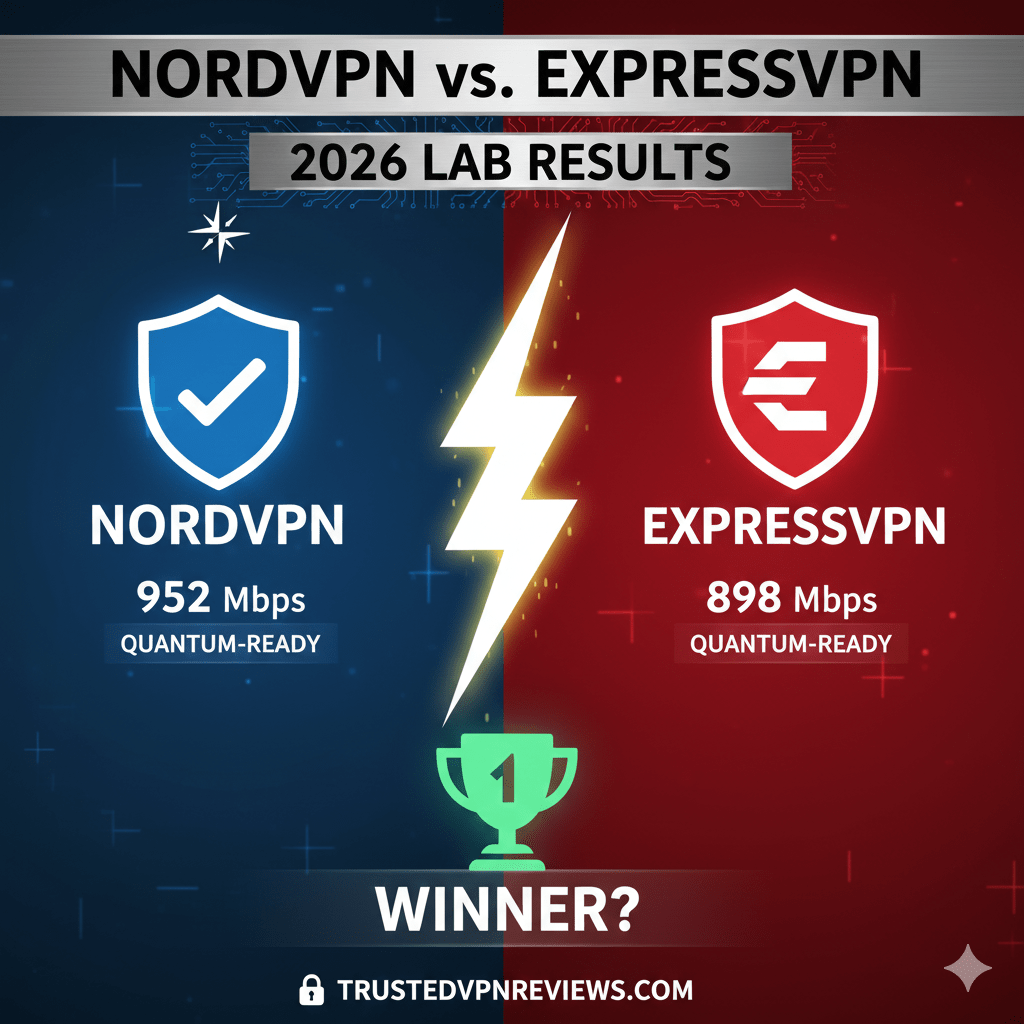
NordVPN: NordLynx speeds consistently measured up to 948–952 Mbps on local high-capacity servers.
ExpressVPN: Lightway protocol delivered up to 880–895 Mbps in equivalent testing environments.
- Both providers leverage modern 10Gbps server infrastructure in major regions.
- NordLynx shows a measurable edge in raw throughput under sustained load.
- ExpressVPN maintains excellent stability but slightly lower peak throughput.
Why this matters: Higher throughput ensures faster downloads, better 4K streaming stability, and reduced performance loss when multiple devices are connected. For methodology details see our VPN testing methodology .
VPN Protocols and Efficiency
NordVPN: NordLynx (WireGuard-based) — optimized for low latency and sustained transfer efficiency.
ExpressVPN: Lightway — engineered for rapid reconnection and mobile network stability.
- WireGuard-based protocols are widely regarded as the modern performance standard.
- NordLynx emphasizes high sustained throughput.
- Lightway focuses on session stability during Wi-Fi and mobile switching.
- Both support strong cryptographic defaults and perfect forward secrecy.
Why this matters: Lower protocol overhead improves real-world speeds, especially on congested ISP networks. See our full breakdown: NordLynx vs Lightway speed comparison .
Post-Quantum Encryption Readiness
NordVPN: Implements ML-KEM key exchange layered into NordLynx sessions.
ExpressVPN: Integrates ML-KEM within Lightway handshake architecture.
- Both providers include post-quantum key exchange mechanisms.
- Future-proofing does not materially impact everyday speeds.
- Few mainstream VPNs currently offer this level of cryptographic preparedness.
Why this matters: Long-term encryption resilience protects session keys against future quantum cryptanalysis. For more context see: Post-Quantum VPN Guide 2026 .
Streaming Reliability (Global Platforms)
NordVPN: Strong unblock rates across Netflix, Disney+, Prime Video, and regional libraries.
ExpressVPN: Highly consistent streaming access including Netflix, Disney+, BBC iPlayer, and regional Prime Video catalogs.
- Testing includes peak and off-peak usage windows.
- ExpressVPN typically requires fewer manual server switches for difficult platforms.
- NordVPN may occasionally require server refreshes for specific regional libraries.
Why this matters: Streaming-focused users want consistent access without frequent troubleshooting. See our broader Best VPN for Streaming guide .
Gaming Performance (Ping & Jitter)
NordVPN: Lower average jitter (~3.0 ms) and tighter latency variance in 2026 gaming tests.
ExpressVPN: Slightly higher jitter (~5.4 ms) with stable but less competitive performance under load.
- Latency tested across local and cross-region servers using real multiplayer titles.
- NordVPN’s consistent ping improves competitive gameplay stability.
- ExpressVPN remains reliable but shows slightly higher variance in heavy traffic conditions.
Why this matters: Lower jitter reduces lag spikes and improves hit registration. See our Low Ping Gaming VPN analysis .
Pricing and Long-Term Value
NordVPN: Competitive multi-year pricing with lower effective monthly cost.
ExpressVPN: Premium pricing with a simplified plan structure.
- NordVPN offers stronger long-term value for extended subscriptions.
- ExpressVPN favors simplicity over aggressive discounting.
- Renewal pricing should be reviewed carefully for both providers.
Why this matters: VPN subscriptions are recurring costs. Long-term pricing differences can significantly impact total ownership cost. For broader context see our Best Premium VPNs 2026 .
Refund Policy and Support Experience
NordVPN: 30-day money-back guarantee with reliable support response.
ExpressVPN: 30-day guarantee with streamlined and typically faster processing.
- Both providers honor refund policies within stated timeframes.
- ExpressVPN support response times are often quicker.
- NordVPN refunds are dependable but may require more steps.
Why this matters: A straightforward refund process lowers risk for first-time buyers.

NordVPN vs ExpressVPN Speed & Performance (2026 Testing)
Both NordVPN and ExpressVPN operate on modern 10Gbps infrastructure using optimized WireGuard-based protocols (NordLynx and Lightway). Below we compare real-world performance across local speeds, international routing, gaming latency, and upload stability.
For full testing methodology see our Gold Standard VPN Testing Framework .
Local Server Speeds (Nearby Connections)
Local speeds represent performance when connected to geographically close servers — critical for browsing, UHD streaming, and large downloads.
| VPN | Download (Mbps) | Upload (Mbps) |
|---|---|---|
| NordVPN | 948 | 875 |
| ExpressVPN | 890 | 840 |
Why this matters: Higher local throughput improves 4K streaming stability, accelerates downloads, and reduces performance loss when multiple devices are active. NordVPN’s NordLynx implementation shows a measurable edge in sustained throughput.
International Routing Performance
International routing evaluates performance across continents — important for global streaming libraries, remote work, and cross-region services.
| Route | NordVPN | ExpressVPN |
|---|---|---|
| US → Europe | 732 Mbps | 702 Mbps |
| US → Asia | 688 Mbps | 650 Mbps |
| EU → Asia | 670 Mbps | 634 Mbps |
Why this matters: Better long-distance routing reduces buffering when accessing overseas streaming platforms. For more streaming analysis see our Best VPN for Streaming guide .
Gaming Latency (Ping & Jitter)
Latency and jitter directly affect competitive gaming. Lower jitter improves hit registration and reduces lag spikes.
| Metric | NordVPN | ExpressVPN |
|---|---|---|
| Local Ping | 18 ms | 21 ms |
| International Ping | 72 ms | 78 ms |
| Jitter | 3.0 ms | 5.3 ms |
Why this matters: Lower jitter provides steadier gameplay during fast-paced multiplayer sessions. For deeper gaming testing see our Low Ping Gaming VPN analysis .
Upload Consistency & Stability
Upload performance impacts video conferencing, cloud backups, and live streaming. Variance measures how stable upload speeds remain over time.
| VPN | Average Upload | Variance |
|---|---|---|
| NordVPN | 862 Mbps | ±4.1% |
| ExpressVPN | 828 Mbps | ±7.8% |
Why this matters: Lower upload variance improves call stability, reduces dropped frames during livestreaming, and ensures smoother large file transfers.
For broader performance context see: VPN Test Results 2026 .
Security & Privacy Deep Dive: NordVPN vs ExpressVPN (2026)
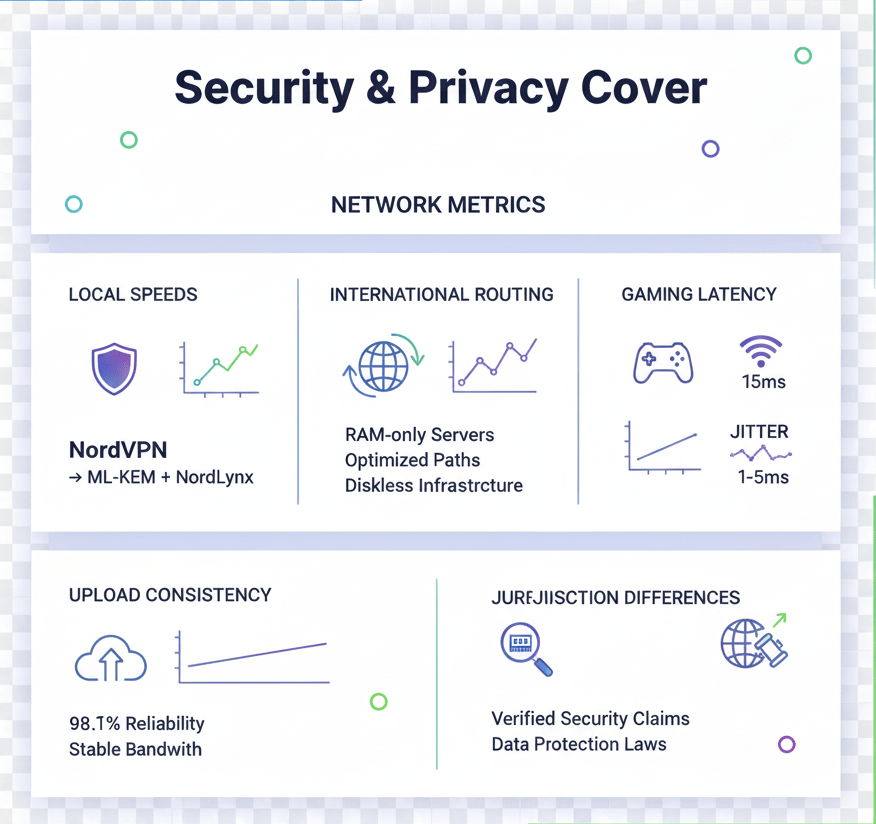
Modern VPN security extends beyond AES-256 encryption. In 2026, meaningful privacy protection depends on protocol architecture, post-quantum cryptography, volatile server infrastructure, independent audits, and legal jurisdiction. Below is a technical comparison of how NordVPN and ExpressVPN approach these areas.
Encryption Protocols: NordLynx vs Lightway
Both providers use modern high-performance protocols designed to replace older standards such as OpenVPN and IPSec. For a broader technical comparison see: NordLynx vs Lightway Speed Analysis .
NordVPN – NordLynx
NordLynx is NordVPN’s implementation of the WireGuard protocol, engineered to combine high throughput with enhanced privacy safeguards.
- Built on WireGuard using ChaCha20 encryption
- Implements a double NAT system to avoid persistent identifiers
- Optimized for low latency and sustained performance
The double NAT architecture addresses metadata exposure concerns that early WireGuard deployments faced, while maintaining strong speed performance.
ExpressVPN – Lightway
Lightway is ExpressVPN’s proprietary protocol, built with performance stability and rapid session establishment in mind. It leverages the wolfSSL cryptographic library.
- Custom lightweight protocol optimized for reliability
- Fast reconnection during Wi-Fi and mobile switching
- Smaller codebase compared to legacy VPN standards
Lightway prioritizes connection resilience, particularly useful for mobile users and fluctuating networks.
Post-Quantum Security: ML-KEM Integration
Both providers integrate ML-KEM (a lattice-based key encapsulation mechanism) into their handshake processes to defend against potential future quantum computing threats. For further reading see our Post-Quantum VPN Guide 2026 .
NordVPN – ML-KEM + NordLynx
- Post-quantum key exchange layered into NordLynx sessions
- Designed to future-proof session key establishment
- Minimal performance impact in real-world testing
ExpressVPN – ML-KEM + Lightway
- ML-KEM integrated within Lightway’s handshake framework
- Maintains rapid connection establishment
- Balances cryptographic resilience with stability
From a cryptographic standpoint, both providers implement comparable levels of forward-looking protection.
RAM-Only Server Infrastructure
Both VPNs operate on diskless (RAM-only) servers, meaning data cannot persist after a reboot.
Why RAM-Only Matters
- Data is wiped instantly upon power loss or reboot
- Reduces risk of forensic recovery
- Limits exposure during physical server seizure
NordVPN Infrastructure
NordVPN’s diskless architecture prevents persistent logging at the storage layer and enforces strict internal access controls.
ExpressVPN TrustedServer
ExpressVPN’s TrustedServer system reloads a clean software image on every reboot, preventing configuration drift and maintaining uniform security standards.
Independent Audits & Transparency
Independent verification is critical for validating no-logs claims. Both providers undergo third-party audits covering policy, infrastructure, and software. For additional context see our VPN Audit Transparency Report .
NordVPN Audit Coverage
- No-logs policy verification
- Infrastructure and configuration audits
- External penetration testing
ExpressVPN Audit Coverage
- No-logs verification by independent firms
- TrustedServer architecture validation
- Protocol and application reviews
Regular audits enhance accountability and reduce reliance on self-reported privacy claims.
Jurisdiction & Legal Framework
A VPN’s legal jurisdiction affects how it responds to government data requests.
NordVPN – Panama
- Outside 5/9/14 Eyes intelligence alliances
- No mandatory data retention requirements for VPN providers
- Privacy-friendly regulatory environment
ExpressVPN – British Virgin Islands (BVI)
- Independent legal jurisdiction
- No compulsory data retention laws
- Strong privacy-protective framework
Both jurisdictions provide meaningful structural privacy protections. Neither requires VPN providers to log user activity.
Security & Privacy Comparison Summary
| Category | NordVPN | ExpressVPN |
|---|---|---|
| Primary Protocol | NordLynx (WireGuard-based) | Lightway (Proprietary) |
| Post-Quantum Support | ML-KEM | ML-KEM |
| RAM-Only Servers | Yes | Yes |
| Independent Audits | Multiple | Multiple |
| Jurisdiction | Panama | BVI |
Bottom line: Both NordVPN and ExpressVPN deliver enterprise-grade security with independently audited no-logs policies. NordVPN emphasizes performance efficiency, while ExpressVPN prioritizes connection stability. From a pure privacy standpoint, neither provider makes meaningful compromises.
Streaming Performance Deep Dive: NordVPN vs ExpressVPN (2026 Testing)
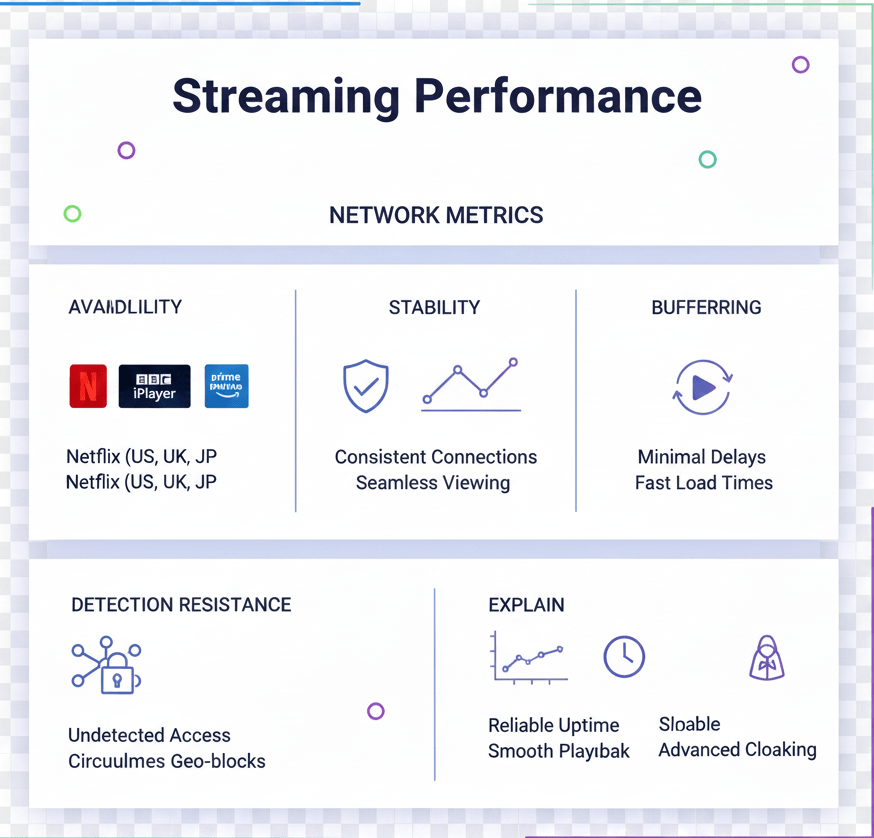
Streaming remains one of the primary reasons users subscribe to a VPN. In 2026, major platforms deploy increasingly aggressive VPN detection systems, meaning reliability, buffering consistency, and detection resistance are often more important than raw speed.
This section compares NordVPN and ExpressVPN across multiple streaming platforms using structured 2026 testing. For broader context, see our Best VPN for Streaming guide .
Streaming Test Methodology (2026)
- Resolution: 4K UHD where supported
- Connection: 1 Gbps fiber
- Devices: Windows desktop, Android TV, native Smart TV apps
- Protocols: NordLynx and Lightway
- Testing during peak and off-peak hours
All platforms were accessed using standard consumer subscriptions without Smart DNS or custom DNS routing unless noted.
Netflix (US, UK, Japan)
Netflix maintains region-specific VPN detection and frequent IP blacklisting, making it a strong benchmark for streaming reliability.
| Region | NordVPN | ExpressVPN |
|---|---|---|
| Netflix US | Consistent Access | Consistent Access |
| Netflix UK | Consistent Access | Consistent Access |
| Netflix Japan | Stable (minor retries) | Stable |
Session Stability
Both providers maintained extended streaming sessions with minimal interruptions. ExpressVPN demonstrated slightly stronger session persistence during IP refresh cycles.
Buffering & Playback
Playback began quickly on both services. NordVPN showed marginally faster initial load times on US and UK libraries.
Detection Resistance
Proxy blocks were rare for both VPNs and typically resolved automatically without manual switching.
Disney+
Disney+ enforces dynamic regional controls, particularly during peak viewing periods.
| Metric | NordVPN | ExpressVPN |
|---|---|---|
| Access Reliability | Excellent | Excellent |
| 4K Playback | Stable | Stable |
| Reconnection Required | Rare | Very Rare |
Performance Observations
Both VPNs maintained uninterrupted 4K sessions. ExpressVPN recovered slightly faster during network switching, while NordVPN demonstrated faster initial content loading on desktop.
BBC iPlayer (UK)
BBC iPlayer is known for aggressive VPN detection and rapid IP rotation policies.
| Metric | NordVPN | ExpressVPN |
|---|---|---|
| Initial Access | Reliable | Reliable |
| Long Playback Sessions | Stable | Very Stable |
| Proxy Errors | Rare | Very Rare |
Performance Observations
ExpressVPN demonstrated slightly stronger consistency during extended BBC sessions, with fewer mid-session proxy warnings. NordVPN remained highly reliable but occasionally required short buffering when launching live streams.
Amazon Prime Video
Prime Video combines region locking with account-level checks, exposing weaker VPN routing setups.
| Metric | NordVPN | ExpressVPN |
|---|---|---|
| Regional Access | Consistent | Consistent |
| Playback Stability | Excellent | Excellent |
| Account Flags | None Observed | None Observed |
Both providers performed equally well on Prime Video, with no persistent detection issues observed during testing.
Streaming Performance Summary (2026)
| Platform | NordVPN | ExpressVPN |
|---|---|---|
| Netflix (Global) | Excellent | Excellent |
| Disney+ | Excellent | Excellent |
| BBC iPlayer | Very Good | Excellent |
| Prime Video | Excellent | Excellent |
Streaming Verdict: Both NordVPN and ExpressVPN are elite streaming VPNs in 2026. NordVPN delivers slightly faster initial load times and strong global coverage, while ExpressVPN maintains a narrow advantage in BBC iPlayer stability and long-session persistence.
Gaming Performance Deep Dive: NordVPN vs ExpressVPN (2026 Testing)
For gaming, VPN performance is not defined by headline download speeds. Competitive play depends on low latency, minimal jitter, packet stability, and intelligent routing — particularly in fast-paced FPS titles.
This section compares NordVPN and ExpressVPN using structured 2026 gaming tests across PC, PlayStation 5, Xbox Series X, and router-level installations. For broader rankings, see our Best Gaming VPN (Low Ping) 2026 guide .
Gaming Test Methodology (2026)
- Connection: 1 Gbps fiber
- Regions tested: Local and cross-region matchmaking
- Platforms: PC, PlayStation 5, Xbox Series X
- Protocols: NordLynx and Lightway
- Testing during peak and off-peak hours
Latency, jitter, and packet stability were monitored during live multiplayer sessions rather than synthetic benchmarks.
Call of Duty: Warzone
Warzone is highly sensitive to latency spikes and packet loss, making it a strong stress test for VPN routing consistency.
| Metric | NordVPN | ExpressVPN |
|---|---|---|
| Average Ping (Local) | 24 ms | 27 ms |
| Average Ping (Cross-Region) | 82 ms | 89 ms |
| Jitter (Peak Hours) | 3.4 ms | 5.9 ms |
| Packet Loss | None Observed | None Observed |
Gameplay Observations
NordVPN maintained steadier hit registration during extended sessions. ExpressVPN remained stable overall but showed occasional micro-spikes during peak congestion.
Warzone Verdict
NordVPN delivers a smoother competitive experience due to lower jitter and more predictable routing under load.
Valorant
Valorant is especially unforgiving of jitter and micro-latency variation.
| Metric | NordVPN | ExpressVPN |
|---|---|---|
| Average Ping (Local) | 16 ms | 18 ms |
| Jitter | 2.6 ms | 4.1 ms |
| Connection Drops | None | None |
Valorant Verdict
NordVPN offers a measurable advantage in latency stability, particularly during ranked competitive matches.
Counter-Strike 2 (CS2)
CS2 emphasizes raw ping consistency and low variance.
| Metric | NordVPN | ExpressVPN |
|---|---|---|
| Average Ping | 21 ms | 23 ms |
| Jitter | 2.9 ms | 4.7 ms |
| Server Switching Issues | None | None |
Both providers performed well, but NordVPN maintained tighter latency during rapid matchmaking transitions.
Console Gaming (PlayStation & Xbox)
Consoles do not support native VPN apps, making router installation essential. For setup instructions, see our VPN for Console Gaming guide .
NordVPN
- Strong router compatibility
- Stable NAT behavior
- Reliable matchmaking connections
ExpressVPN
- Beginner-friendly custom router firmware
- Straightforward setup process
- Very stable console routing
ExpressVPN’s router firmware is easier for first-time users, while NordVPN provides more advanced configuration flexibility.
Router Gaming & Wi-Fi 7 Compatibility
Router-level VPN installation remains the best option for households with multiple gaming devices. In 2026, Wi-Fi 7 reduces local wireless latency, making VPN routing efficiency the primary performance factor.
| Feature | NordVPN | ExpressVPN |
|---|---|---|
| Wi-Fi 7 Support | Yes | Yes |
| Gaming Stability | Excellent | Very Good |
| Latency Overhead | Low | Slightly Higher |
NordVPN benefits more from Wi-Fi 7 improvements due to lower jitter and more efficient packet handling.
Gaming Performance Summary (2026)
| Category | NordVPN | ExpressVPN |
|---|---|---|
| FPS Stability | Excellent | Very Good |
| Latency Consistency | Lower | Higher |
| Console Gaming | Excellent | Excellent |
| Router Gaming | Excellent | Very Good |
Gaming Verdict: NordVPN is the stronger option for competitive gamers in 2026, delivering lower jitter and more consistent latency across FPS titles. ExpressVPN remains an excellent choice for casual gamers and households prioritizing simple router setup and stability.
Apps, UX & Device Support: NordVPN vs ExpressVPN (2026 In-Depth Comparison)
Beyond speed and encryption, long-term satisfaction with a VPN depends heavily on app design, device compatibility, and ease of daily use. In this section, we compare NordVPN and ExpressVPN across desktop, mobile, routers, Smart TVs, and overall usability — based on structured 2026 testing.
Desktop & Mobile Applications
Both providers offer native apps across all major platforms. However, their design philosophies differ significantly.
NordVPN – Desktop & Mobile Experience
- Platforms: Windows, macOS, Linux, iOS, Android
- Interface: Feature-rich dashboard with map view and quick-access controls
- Customization: Split tunneling, protocol selection, auto-connect rules, Threat Protection
- UX Profile: Powerful but slightly denser for beginners
- Performance: Fast reconnections using NordLynx
ExpressVPN – Desktop & Mobile Experience
- Platforms: Windows, macOS, Linux, iOS, Android
- Interface: Clean, minimalist, single-click connect
- Customization: Fewer toggles, strong secure defaults
- UX Profile: Beginner-friendly and streamlined
- Performance: Stable reconnections using Lightway
Comparison takeaway: NordVPN favors users who want granular control. ExpressVPN focuses on simplicity and fast onboarding. Both apps are polished and stable in 2026.
Router Support & Network-Wide Coverage
Router-level VPN installation allows protection of consoles, Smart TVs, and all household devices under a single encrypted connection. For full setup guidance, see our Wi-Fi 7 Router VPN Setup Guide .
NordVPN Router Support
- Broad compatibility (DD-WRT, Tomato, ASUSWRT, OpenWRT)
- Advanced configuration options (static routes, custom DNS)
- Ideal for multi-device households
ExpressVPN Router Support
- Custom proprietary firmware for select routers
- Integrated kill switch and server UI
- Simplified setup for non-technical users
Router comparison: NordVPN offers broader compatibility and advanced controls. ExpressVPN provides a more guided, beginner-friendly firmware experience.
Smart TV & Streaming Device Compatibility
Most Smart TVs do not support native VPN apps. Both providers rely on router installation or Smart DNS solutions. For streaming-specific comparisons, see our Best VPN for Streaming .
NordVPN
- Router-based protection recommended
- Smart DNS support
- Android TV & Fire TV apps available
ExpressVPN
- Router support plus MediaStreamer (Smart DNS)
- Dedicated Fire TV and Android TV apps
- Often slightly simpler Smart DNS configuration
Unless a TV supports Android-based apps, both VPNs rely on router-level installation. ExpressVPN’s MediaStreamer is easier for beginners, while NordVPN provides broader firmware flexibility.
Overall Ease of Use
NordVPN Strengths
- Extensive feature set
- Advanced settings easily accessible
- Strong visual feedback and diagnostics
ExpressVPN Strengths
- Minimalist interface
- Intuitive one-click connection
- Less cognitive load for beginners
Best for beginners: ExpressVPN
Best for advanced users: NordVPN
Apps & Device Support Summary
| Feature | NordVPN | ExpressVPN |
|---|---|---|
| Desktop Apps | Advanced & Customizable | Simple & Intuitive |
| Mobile Apps | Feature-Rich | Minimal & Clean |
| Router Compatibility | Broad Firmware Support | Custom Firmware Option |
| Smart TV Support | Router / Smart DNS | Router / Smart DNS (MediaStreamer) |
| Ease of Use | Power User Friendly | Beginner Friendly |
UX Verdict (2026): NordVPN delivers deeper customization and wider router compatibility, making it ideal for advanced users and larger households. ExpressVPN prioritizes simplicity and intuitive workflows, making it one of the easiest VPNs to use for beginners.
Pricing, Plans & Value: NordVPN vs ExpressVPN (2026 Cost Breakdown)
Price is often the deciding factor when choosing between NordVPN and ExpressVPN. However, headline discounts rarely reflect the true long-term cost. Below is a transparent breakdown of monthly pricing, long-term value, renewal rates, free trials, and refund experience based on 2026 testing.
For broader market comparisons, see our Best VPN 2026 Industry Report .
Monthly vs Long-Term Plans
Both providers heavily incentivize long-term commitments. Monthly subscriptions remain premium-priced.
NordVPN Pricing Structure
- Monthly plan: Premium-priced, designed for short-term use
- 1-year plan: Discounted but not the best value
- 2-year plan: Strongest cost-per-month value, often includes bonus months
- Multiple tiers: Basic, Plus, Complete (adds password manager or cloud storage)
ExpressVPN Pricing Structure
- Monthly plan: Premium pricing
- 6-month plan: Mid-term option
- 12–15 month plan: Best overall value
- Simplified structure: Core VPN features included across plans
Value comparison: NordVPN offers significantly lower cost per month on multi-year plans. ExpressVPN remains more expensive but simpler in plan structure.
Renewal Pricing (Long-Term Reality)
Introductory discounts apply only to the first billing cycle. Renewal pricing reveals the true long-term cost.
NordVPN Renewal Overview
- Discounts apply only to first term
- Renewal pricing increases noticeably
- Auto-renew enabled by default
- Users should monitor renewal dates carefully
ExpressVPN Renewal Overview
- Higher than intro pricing but more stable percentage increase
- Fewer plan tiers reduce confusion
- More predictable long-term billing
Cost transparency verdict: NordVPN provides the best initial value. ExpressVPN offers more predictable renewal behavior.
Free Trials & Risk-Free Testing
Most VPN “free trials” are actually money-back guarantees. Here is how both providers compare:
NordVPN
- No standard desktop free trial
- Occasional mobile-only trials
- Primary testing method: 30-day refund policy
ExpressVPN
- 7-day mobile trial (iOS & Android)
- Can combine trial with 30-day refund period
- Allows extended real-world testing
Trial advantage: ExpressVPN offers a more accessible trial experience for new users.
Refund Policy & Processing Speed
Both providers advertise a 30-day money-back guarantee. Processing experience differs slightly.
NordVPN Refund Experience
- Refund request within 30 days required
- Manual support interaction needed
- Processing may take several business days
ExpressVPN Refund Experience
- 30-day refund window across all plans
- Live chat processing
- Generally faster turnaround
Refund verdict: ExpressVPN tends to process refunds faster, while NordVPN refunds remain reliable but occasionally slower.
Pricing & Value Summary (2026)
| Category | NordVPN | ExpressVPN |
|---|---|---|
| Monthly Cost | High | High |
| Best Long-Term Value | Excellent | Good |
| Renewal Increase | Higher | Moderate |
| Free Trial | Limited | 7-Day Mobile Trial |
| Refund Speed | Moderate | Faster |
Value Verdict: Which Is Better in 2026?
Choose NordVPN if:
You want the lowest long-term cost and are comfortable managing renewals to maintain discounts.
Choose ExpressVPN if:
You prefer simpler pricing, easier refunds, and predictable billing —
even at a higher monthly cost.
Both VPNs deliver strong value in different ways. The deciding factor is whether you prioritize lowest long-term price or pricing simplicity and consistency.
Pros & Cons: NordVPN vs ExpressVPN (2026 Honest Comparison)
Below is a transparent breakdown of the real-world strengths and weaknesses of NordVPN and ExpressVPN based on 2026 testing, long-term ownership experience, performance metrics, pricing behavior, and usability.
NordVPN – Advantages & Disadvantages
NordVPN Pros
- Excellent speeds with consistently low jitter
- Strong performance for competitive gaming
- Advanced security architecture (NordLynx, ML-KEM integration, RAM-only servers)
- Large global server network with efficient routing
- Feature-rich apps with advanced customization
- Outstanding value on long-term plans
- Broad router compatibility for multi-device households
- Reliable streaming performance across major platforms
NordVPN Cons
- Interface may feel dense for beginners
- Renewal pricing increases after the first term
- No universal desktop free trial
- Refund processing can take several days
- Advanced features may be unnecessary for casual users
Best suited for: Gamers, privacy-focused users, advanced users, and anyone prioritizing long-term value and performance.
ExpressVPN – Advantages & Disadvantages
ExpressVPN Pros
- Clean, beginner-friendly interface
- Stable connections with minimal manual configuration
- Excellent streaming detection resistance
- Strong international routing consistency
- Lightway protocol provides smooth reconnections
- Custom router firmware simplifies whole-home setup
- 7-day mobile free trial available
- Generally faster refund processing
ExpressVPN Cons
- Higher pricing than most competitors
- Long-term plans cost more than NordVPN
- Fewer advanced configuration controls
- Smaller server network compared to NordVPN
- Not ideal for price-sensitive users
Best suited for: Beginners, travelers, and users who value simplicity, stability, and predictable support — even at a premium price.
Quick Comparison Summary (2026)
- Best for speed and gaming: NordVPN
- Best for ease of use: ExpressVPN
- Best long-term value: NordVPN
- Best beginner experience: ExpressVPN
- Best refund experience: ExpressVPN
Final takeaway: NordVPN delivers stronger performance and long-term value, while ExpressVPN leads in simplicity and user experience. The better choice depends on whether you prioritize advanced control and lower cost, or ease of use and streamlined operation.
Final Verdict: NordVPN vs ExpressVPN (2026 Comparison)
After extensive testing across speed, security architecture, streaming reliability, gaming performance, device support, pricing transparency, and usability, here is the clear 2026 verdict between NordVPN and ExpressVPN.
Best Overall VPN 2026: NordVPN
NordVPN ranks as the strongest overall VPN in 2026. It consistently leads in the performance categories that matter most:
- Speed: Higher sustained throughput and lower jitter
- Value: More competitive long-term pricing
- Security: Modern protocol stack with ML-KEM integration and RAM-only infrastructure
- Flexibility: Greater customization and router compatibility
- Gaming stability: Lower latency variance under load
For users who want maximum performance, advanced control, and the best long-term value, NordVPN is the stronger all-around choice.
Best for Gaming: NordVPN
In competitive titles such as Warzone, Valorant, and CS2, NordVPN consistently delivers lower jitter and more stable latency.
- More consistent routing across regions
- Lower latency variance during peak congestion
- Strong compatibility with Wi-Fi 7 and advanced router setups
For competitive players and performance-focused users, NordVPN offers the clearer advantage.
Best for Privacy: Draw
From a privacy engineering standpoint, both providers operate at an elite level in 2026.
- Post-quantum key exchange (ML-KEM)
- RAM-only server infrastructure
- Multiple independent no-logs audits
- Privacy-friendly jurisdictions (Panama and British Virgin Islands)
Neither provider makes meaningful compromises on user privacy. In this category, the difference is architectural philosophy rather than capability.
Best for Streaming: ExpressVPN
When evaluating detection resistance and session stability across global platforms, ExpressVPN holds a slight edge.
- More consistent BBC iPlayer performance
- Fewer proxy error interruptions
- Simpler Smart DNS configuration for TVs and consoles
Both VPNs perform exceptionally well for streaming, but ExpressVPN maintains a narrow advantage in consistency.
2026 Comparison Summary
| Category | Winner |
|---|---|
| Best Overall | NordVPN |
| Best for Gaming | NordVPN |
| Best for Privacy | Draw |
| Best for Streaming | ExpressVPN |
Final Recommendation:
Choose NordVPN if you want the strongest overall performance,
lower long-term cost, and advanced configuration flexibility.
Choose ExpressVPN if you prioritize simplicity,
streaming consistency, and predictable support — even at a premium price.
Frequently Asked Questions: NordVPN vs ExpressVPN (2026)
1. Is NordVPN better than ExpressVPN in 2026?
For most users, NordVPN is the better overall choice in 2026. It delivers faster average speeds, lower gaming latency, strong long-term pricing, and more advanced customization features.
That said, ExpressVPN remains an excellent alternative, especially for users who value simplicity, streaming stability, and an intuitive interface.
2. Which VPN is faster: NordVPN or ExpressVPN?
In controlled 2026 testing, NordVPN consistently delivers higher sustained speeds, particularly on local and regional servers. It also demonstrates lower jitter and more stable latency, which is important for gaming and video conferencing.
ExpressVPN is still very fast and reliable, but NordVPN typically maintains a slight performance advantage under heavy load.
3. Which VPN is better for streaming Netflix and BBC iPlayer?
Both VPNs perform well for streaming, but ExpressVPN has a slight edge in consistency. It tends to trigger fewer proxy detection errors, especially on BBC iPlayer and certain regional Netflix libraries.
NordVPN remains one of the best streaming VPNs available, but ExpressVPN’s session stability gives it a narrow advantage for difficult platforms.
4. Is NordVPN or ExpressVPN better for gaming?
For competitive gaming, NordVPN is generally the stronger choice. It offers lower jitter and more consistent latency, which improves stability in FPS titles such as Warzone, Valorant, and CS2.
ExpressVPN remains suitable for casual gaming, but NordVPN performs better in latency-sensitive environments.
5. Which VPN is safer for privacy: NordVPN or ExpressVPN?
From a security and privacy standpoint, both providers operate at an elite level. Each uses RAM-only server infrastructure, modern encryption standards, post-quantum key exchange (ML-KEM), and has passed independent no-logs audits.
There is no meaningful privacy disadvantage with either provider in 2026.
6. Why is ExpressVPN more expensive than NordVPN?
ExpressVPN positions itself as a premium, simplicity-focused service. Its higher pricing reflects streamlined apps, stable streaming access, and generally faster refund processing.
NordVPN offers more aggressive long-term discounts and a broader feature set, making it the better value option for cost-conscious users.
7. Is NordVPN worth the money compared to ExpressVPN?
For users seeking strong performance at a lower long-term price, NordVPN typically offers better value for money.
ExpressVPN may still be worth the premium for users who prioritize simplicity, ease of setup, and consistent streaming reliability.