

In 2026, a VPN is no longer a simple privacy add-on. It is a core piece of network infrastructure — responsible for securing high-bitrate streaming, low-latency gaming, whole-home encryption, and long-term data protection against emerging quantum threats.
At TrustedVPNReviews.com, we do not rely on app demos, marketing claims, or short-lived speed tests. Every VPN we recommend is subjected to sustained, real-world stress testing on controlled infrastructure, including multi-gigabit fiber, router-level deployments, and restricted-network simulations.
This methodology exists for one reason: to answer a question most review sites cannot — which VPNs still perform when conditions are no longer ideal? That includes 8K streaming sessions that run for hours, competitive gaming where milliseconds matter, and encrypted traffic that must remain secure for decades.
Our testing framework underpins all of our rankings, including the Best VPNs of 2026 — Independent Lab Results, our real-world 8K Streaming VPN testing, and our low-jitter benchmarks for competitive gaming VPNs.
Unlike comparison sites that rely on vendor-supplied metrics, we audit infrastructure directly. That includes protocol behavior under sustained load, kill-switch failure testing, routing stability, and post-quantum cryptography implementation — areas explored in depth in our Quantum Encryption Explained (2026) guide.
The result is a single, transparent standard. If a VPN earns a top recommendation on TrustedVPNReviews.com, it has already survived the same conditions that break most services in the real world.

The TrustedVPNReviews.com Gold Standard (2026)
A VPN does not earn a recommendation on TrustedVPNReviews.com by checking feature boxes. To meet our Gold Standard in 2026, a provider must demonstrate verifiable infrastructure strength, protocol resilience, and long-term privacy guarantees.
This standard exists because modern VPN use cases — 8K streaming, competitive gaming, router-level encryption, and censorship resistance — expose weaknesses that casual testing never reveals.
To qualify for full evaluation, a VPN must meet all of the following:
- Independent third-party audits within the last 12 months
- RAM-only (diskless) server infrastructure
- Modern, actively maintained protocols (WireGuard-class or better)
- Kill switch integrity under forced disconnect conditions
- Demonstrated performance beyond 1Gbps environments
Providers that fail any of these criteria are excluded before scoring begins. This is why our rankings differ sharply from generic “best VPN” lists and why our results feed directly into our independent 2026 VPN test results.
The 10Gbps Performance Lab: Why Speed Tests Lie
Most VPN reviews rely on short, burst-based speed tests conducted over consumer Wi-Fi. These tests are meaningless for real-world usage in 2026.
At TrustedVPNReviews.com, performance testing is conducted on dedicated multi-gigabit fiber in controlled lab environments. This allows us to isolate VPN behavior from ISP congestion, Wi-Fi interference, and hardware bottlenecks.
Our core performance metrics include:
- Sustained throughput over 30–60 minute encrypted sessions
- Jitter variance under constant load
- Packet loss during protocol renegotiation
- Latency stability rather than raw ping
This methodology explains why some VPNs that “win” speed tests fail during long-form 8K playback or ranked gaming sessions. These findings directly inform our 8K streaming VPN rankings and low-ping gaming VPN analysis.
Any VPN that cannot sustain a stable encrypted connection above 100 Mbps for extended periods is not considered future-ready, regardless of advertised peak speeds.
Protocol Stress Testing: What Actually Survives in 2026
Protocol choice is the single biggest determinant of VPN performance and reliability in 2026. We do not treat protocols as interchangeable.
Each provider is tested across all supported protocols under identical conditions. This includes:
- Connection establishment time
- Throughput decay over time
- Recovery behavior after forced disconnects
- Stability under encrypted burst traffic
In practice, this is where clear separation occurs:
- WireGuard-class protocols (including NordLynx and Lightway) dominate sustained performance testing
- Legacy OpenVPN often collapses under prolonged high-bitrate load
- IKEv2 performs well on mobile but inconsistently on routers
Protocol behavior under censorship and traffic inspection is tested separately and documented in our restricted-network analysis, including VPNs for restricted environments and our technical deep dive on post-quantum VPN protocols .
A protocol that performs well in isolation but fails under sustained or hostile conditions is scored accordingly — regardless of marketing claims.
Router-Level & Whole-Network VPN Testing
Running a VPN on a router or network gateway exposes weaknesses that app-based testing never detects. Encryption is continuous, traffic volumes are higher, and failure impacts every connected device.
For this reason, router-level testing is a mandatory component of our 2026 methodology — not an optional add-on.
Our router testing focuses on:
- Sustained CPU encryption load over multi-hour sessions
- Protocol stability under simultaneous device traffic
- Kill switch behavior during WAN and tunnel failures
- DNS handling to prevent silent IP or resolver leaks
Testing is performed on modern hardware capable of exposing real bottlenecks, including Wi-Fi 6E and Wi-Fi 7 routers with multi-core ARM CPUs.
These findings directly influence our recommendations in the Best VPN Router Guide and our step-by-step configuration walkthrough: How to Set Up a VPN on a Wi-Fi 7 Router .
Any VPN that cannot maintain a stable tunnel under router-level load is capped in our final scoring, regardless of app performance.
Post-Quantum Cryptography Verification
In 2026, encryption strength is no longer judged solely by symmetric ciphers like AES-256. The primary long-term risk is the VPN handshake — the moment keys are exchanged.
Our testing explicitly audits for resistance to “Harvest Now, Decrypt Later” scenarios, where encrypted traffic is stored today for future decryption.
To verify quantum readiness, we examine:
- Hybrid key exchange combining classical and post-quantum algorithms
- NIST-aligned implementations such as ML-KEM (Kyber)
- Protocol integration rather than marketing-layer add-ons
Providers that advertise “quantum protection” without verifiable protocol-level changes do not receive credit.
Our quantum readiness results feed directly into:
Post-quantum support is weighted heavily for users operating VPNs at the router or gateway level, where data volumes are highest and retention risk is greatest.
Privacy, Audits & Kill Switch Integrity
A VPN cannot be trusted on claims alone. Privacy must be verifiable, repeatable, and enforced by architecture — not policy statements.
Every provider we evaluate is subjected to a privacy integrity audit that includes:
- Verification of RAM-only server deployment
- Independent audit history (Deloitte, PwC, KPMG, Cure53)
- Jurisdiction analysis and legal exposure review
- Kill switch stress testing under forced disconnects
Kill switches are tested aggressively. We simulate:
- Server crashes mid-session
- Network interface resets
- Protocol renegotiation failures
Any VPN that leaks traffic — even briefly — fails this stage and cannot receive a Gold Standard rating.
These results directly inform our privacy-focused rankings, including Best No-Log VPNs (2026) and our comparison against bundled services in VPNs vs Big Tech Privacy Tools .
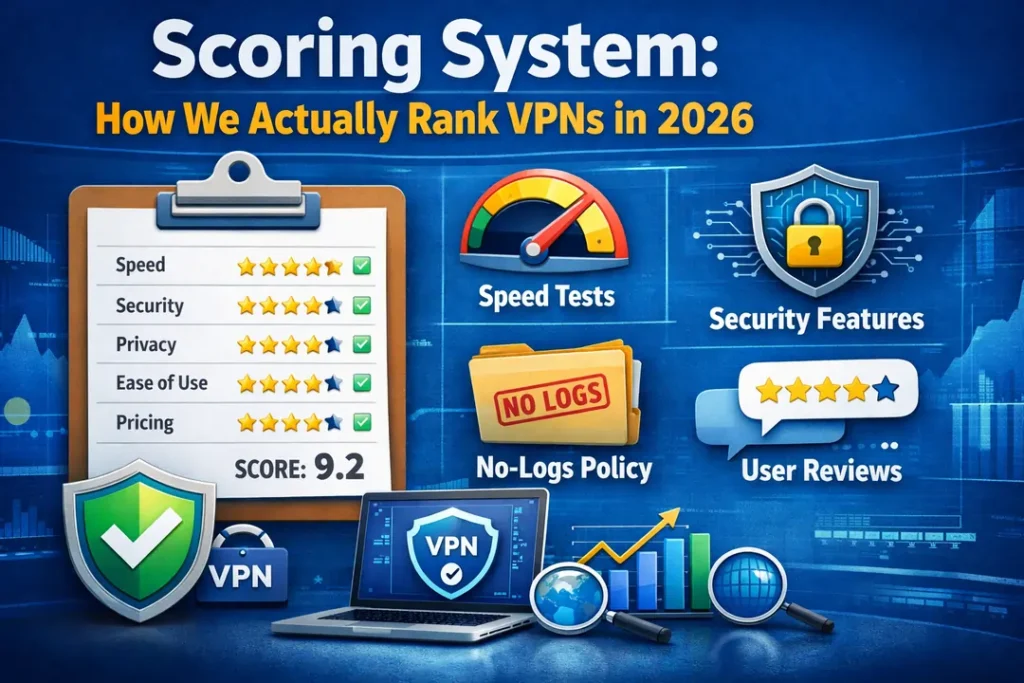
Scoring System: How We Actually Rank VPNs in 2026
Most VPN sites rely on vague star ratings or affiliate-driven “editor scores.” We do not. Every VPN reviewed by TrustedVPNReviews.com is graded using a weighted scoring model designed around modern, measurable risk. A provider cannot compensate for weak security with speed, or mask poor infrastructure with flashy features. Scores are capped automatically if a critical category fails.Weighted Scoring Breakdown
- Protocol design and implementation (WireGuard, Lightway, NordLynx)
- Post-quantum readiness (hybrid or ML-KEM key exchange)
- Kill switch behavior under forced disconnect
- Independent audit history and frequency
- RAM-only server verification
- Jurisdiction and legal exposure
- Sustained throughput (not burst speed)
- Latency consistency and jitter
- Streaming and gaming stability
- Router support and advanced configuration
- Platform coverage (Apple TV, consoles, mobile)
- Pricing transparency and renewal behavior
What Automatically Disqualifies a VPN
Not every VPN that passes speed tests deserves a recommendation. Some failures are immediate disqualifiers — no exceptions.Instant Disqualification Criteria
- Kill switch leakage Any exposure of the real IP during reconnect, sleep, or network change results in immediate removal.
- No independent audit Claims without third-party verification are treated as marketing, not proof.
- Disk-based logging servers Persistent storage is incompatible with modern threat models.
- Protocol misrepresentation Rebranded OpenVPN or insecure WireGuard forks are rejected outright.
- Unstable long-session performance VPNs that degrade after 20–30 minutes fail our sustained-load tests.
Why Our Methodology Changes What “Best VPN” Actually Means
In 2026, the phrase “best VPN” is meaningless without context. The needs of an 8K streaming household, a competitive gamer, and a traveler crossing censorship zones are radically different. Our methodology is designed to expose failure points, not just headline speeds. That is why our recommendations differ depending on use case:- Streaming & Apple TV: Stability, IP reputation, Smart DNS reliability → Best VPNs for 8K Streaming
- Gaming & low latency: Jitter control, routing efficiency, DDoS protection → Best Low-Ping Gaming VPNs
- Whole-home privacy: Router performance, sustained encryption, firmware support → Best VPN Router Guide
- High-risk regions: Obfuscation, protocol resilience, enforcement survivability → Best VPNs for Restricted Countries

How We Test VPNs Under Real Network Failure Conditions
Most VPN reviews assume ideal conditions: stable fiber, clean routing, and no interference. That is not how the internet works in 2026.
Our methodology intentionally introduces failure scenarios to observe how a VPN behaves when things go wrong — because that is when privacy is most likely to break.
Simulated Failure Events We Trigger
-
Forced ISP drops
We intentionally interrupt the underlying connection to verify kill switch response time and leak prevention. -
Protocol interruption
We block WireGuard or UDP traffic mid-session to test fallback behavior. -
Network switching
Mobile handoffs (Wi-Fi → LTE → 5G) are tested for IP exposure. -
High-load concurrency
Streaming, gaming, downloads, and VoIP run simultaneously to observe CPU saturation and packet prioritization.
A VPN that performs well only under ideal conditions does not pass. Stability during disruption is mandatory for a Gold Standard score.
This is especially important for users relying on VPNs for:
- Remote work and financial activity
- Whole-home router deployments
- Travel in unstable or restricted networks
For hardware-level resilience, see: Best VPN Router Guide (2026).
Transparency, Independence, and Affiliate Separation
In 2026, most “VPN review” sites are no longer independent. They are owned, funded, or quietly influenced by the companies they rank.
TrustedVPNReviews.com operates under a strict separation model:
What We Do (and Do Not) Accept
We do:
- Purchase our own subscriptions
- Run tests on privately owned infrastructure
- Use affiliate links only after scoring is finalized
- Publish negative findings when products fail
We do not:
- Accept paid placements or “editor fees”
- Modify scores based on commission
- Suppress failures at provider request
- Allow vendors to preview rankings
Affiliate links exist to fund testing — not to influence outcomes. If a VPN fails our methodology, it is excluded regardless of payout.
This is why our rankings sometimes differ sharply from large comparison portals and coupon-driven sites.
To see how this independence changes outcomes, compare:
What Our Methodology Is Designed to Protect You From
Most users think VPNs fail loudly. In reality, the most dangerous failures are silent.
Our testing framework is designed to surface issues that do not trigger warnings but still compromise privacy.
Silent Failures We Actively Look For
-
Brief IP exposure during reconnect
Often lasting less than one second — enough to log a real IP. -
DNS fallback to ISP resolvers
Especially common on mobile and router-based setups. -
Protocol downgrade without user consent
VPN silently switching from WireGuard to weaker transports. -
Long-session degradation
Performance slowly collapsing after 30–60 minutes of use.
These issues rarely appear in short reviews or synthetic benchmarks, but they define whether a VPN can be trusted long-term.
This is why our testing includes:
- Multi-hour continuous sessions
- Router-level encryption audits
- Real streaming and gaming workloads
- Censorship and DPI resistance testing
If a VPN survives all of the above, it earns a recommendation. If it fails silently, it is removed — no matter how popular it is.
For readers who want to apply these standards to their own use case:
Frequently Asked Questions About Our VPN Testing Methodology (2026)
Why do your rankings differ from other VPN review sites?
Most review sites test VPNs on residential connections using short speed tests. We test on dedicated multi-gigabit infrastructure, run sustained workloads, and disqualify providers that fail silently under stress. This exposes weaknesses that surface only after 30–60 minutes of real use.
Do VPN providers know your test results in advance?
No. Providers are never given previews, never allowed to influence scoring, and never informed of failures before publication. If a VPN breaks under our tests, it is removed — regardless of brand size or affiliate potential.
Why do you focus so much on jitter and stability instead of peak speed?
Peak speed is meaningless if it cannot be sustained. Jitter, packet loss, and long-session degradation are what break gaming, 8K streaming, VoIP, and remote work. A slower but stable VPN always outperforms a fast but unstable one.
How often are VPNs retested?
Top-ranked VPNs are continuously monitored and formally retested on a rolling basis. Major app updates, protocol changes, or infrastructure migrations trigger immediate re-evaluation.
Do you test VPNs in restricted or censored countries?
Yes. We evaluate obfuscation, protocol survivability, and reconnect behavior under simulated DPI and throttling. This data feeds directly into our Restricted Countries VPN rankings .
Can a VPN lose its Gold Standard status?
Absolutely. If audits lapse, performance regresses, or silent leaks are detected, a VPN is downgraded or removed immediately. There are no permanent “winners.”
Final Verdict: Why This Methodology Exists
In 2026, VPN marketing is louder than ever — but reliability is rarer.
AI-driven censorship, post-quantum threats, and ultra-high-bandwidth use cases have exposed a simple truth: most VPNs were never built for modern networks.
This methodology exists to answer one question only:
Which VPNs still work when conditions are hostile, bandwidth is sustained, and failure is not allowed?
We do not optimize for:
- Affiliate payout size
- Brand recognition
- Short-term benchmarks
- Feature checklists
We optimize for:
- Long-session stability
- Infrastructure integrity
- Audit-verified privacy
- Real-world survivability
If a VPN earns a recommendation here, it has survived conditions that most review sites never test.
This is not a popularity list. It is a durability list.
TrustedVPNReviews.com – Core Guides & Test Results
| Category | Guide | Why It Matters |
|---|---|---|
| Lab Results | Best VPNs 2026 – Independent Lab Results | Raw performance data from 10Gbps stress testing |
| Infrastructure | Independent VPNs vs Big Tech VPNs | Why bundled VPNs collapse under real load |
| Streaming | Best VPNs for 8K Streaming (2026) | Stable 100Mbps+ performance without buffering |
| Gaming | Best Low-Ping Gaming VPNs | Jitter-focused rankings for competitive play |
| Routers | Best VPN Routers (2026) | Whole-network encryption without bottlenecks |
| Setup | VPN Setup on Wi-Fi 7 Routers | Step-by-step high-throughput configuration |
| Restricted Networks | VPNs for Restricted Countries | Surviving DPI, throttling, and censorship |
| Global Risk | 10 Countries You Need a VPN For | Where VPN use is essential, not optional |