
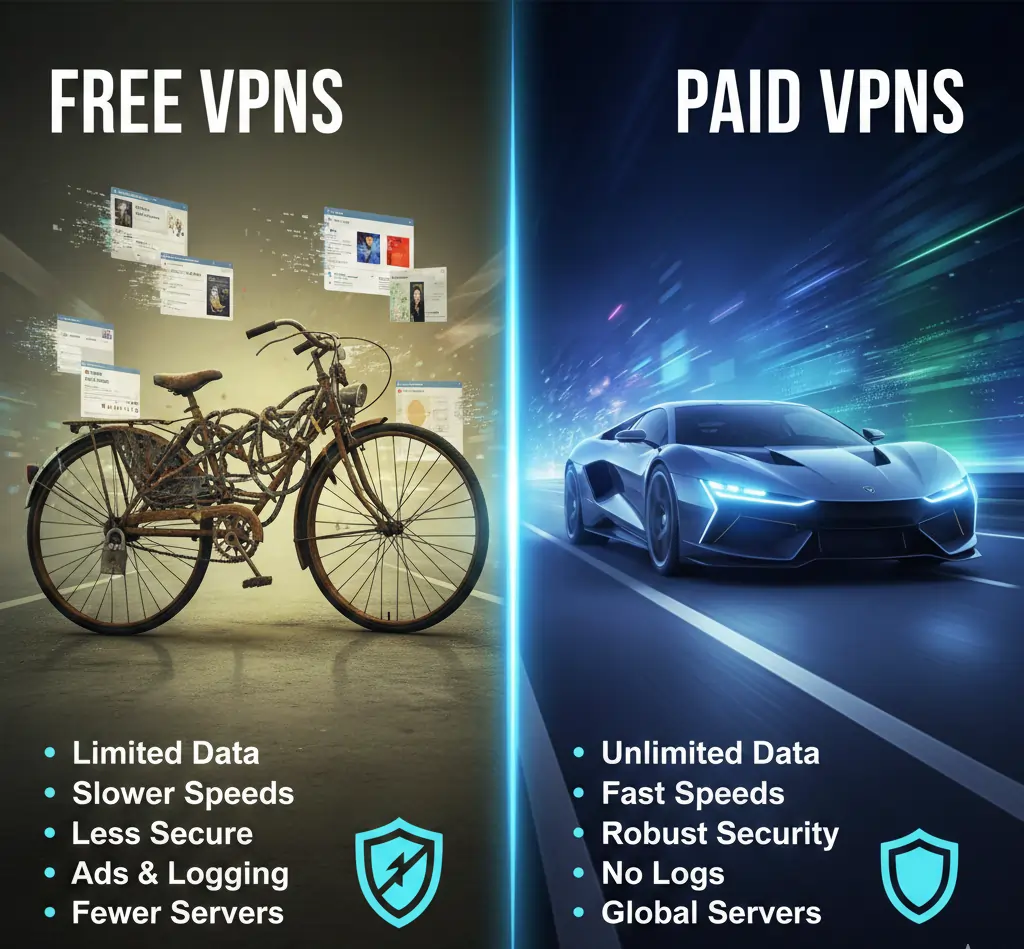
The question “Why pay for a VPN when free options exist?” is one of the most searched — and most misunderstood — topics in online privacy.
On the surface, free VPNs appear to offer the same core promise as paid services: hiding your IP address and encrypting your traffic. However, once you move beyond basic marketing claims, the differences between free and paid VPNs become substantial, particularly in areas that directly affect privacy, security, performance, and long-term reliability.
At TrustedVPNReviews, we test VPNs using a consistent evaluation framework that measures what actually happens behind the scenes. This includes how providers handle user data, how they fund their operations, how their networks perform under load, and whether their privacy claims hold up under scrutiny.
This guide compares free VPNs and paid VPNs in 2026 using real-world criteria — not promotional language. We explain where free VPNs can be useful, where they fall short, and why paid VPNs dominate categories such as streaming, torrenting, gaming, and censorship circumvention.
If you’re new to VPNs, this article complements our broader overview in Best VPN Services 2026. If privacy is your primary concern, you may also want to review our findings in Best No-Log VPNs 2026.
Bottom line: free VPNs are not “bad by default,” but they are rarely free in the way users expect. Understanding the trade-offs is essential before trusting any VPN with your data.
Free VPN vs Paid VPN: Quick Comparison
To understand the real differences between free VPNs and paid VPNs, it helps to compare how they perform across the areas that matter most: privacy, security, speed, reliability, and real-world usability.
The table below summarises the key differences based on hands-on testing, provider disclosures, and long-term performance analysis conducted for our Best VPN Services 2026 report.
| Feature | Free VPNs | Paid VPNs |
|---|---|---|
| IP address masking | Yes | Yes |
| Data encryption | Basic or limited | Strong, modern encryption |
| Monthly data limits | Common (often 2–10 GB) | Unlimited |
| Connection speeds | Often throttled | Optimised for performance |
| No-logs policy | Unclear or inconsistent | Clearly defined and audited |
| Kill switch | Rare or unavailable | Standard feature |
| Streaming support | Very limited or blocked | Reliable access to major platforms |
| Torrenting (P2P) | Restricted or disabled | Allowed on dedicated servers |
| Server network size | Very limited | Thousands of servers worldwide |
| Simultaneous devices | Usually 1 device | Multiple devices |
| Advanced features | Not available | Split tunnelling, ad blocking, multi-hop |
| Customer support | None or minimal | 24/7 live chat and email support |
| Business model | Ads, data monetisation, upsells | User subscriptions |
| Overall reliability | Inconsistent | High |
Key takeaway: free VPNs generally cover only the most basic use cases, while paid VPNs are built for sustained privacy, performance, and unrestricted access. This distinction becomes especially important for streaming, gaming, torrenting, and use on public Wi-Fi.
If your primary concern is protecting personal data, we recommend reviewing our findings in Best No-Log VPNs 2026. For performance-focused use cases, see Best VPN for Streaming 2026 and Best VPN for Gaming 2026.
Free VPN vs Paid VPN: Real-World Comparisons
A simple feature checklist only tells part of the story. To make an informed decision, it’s important to understand how free and paid VPNs behave in real-world scenarios such as privacy protection, speed-intensive tasks, and restricted environments.
Privacy Comparison: What Happens to Your Data?
The biggest difference between free VPNs and paid VPNs is how they fund their operations. Running a secure global VPN network is expensive, and free services must generate revenue elsewhere.
| Privacy Factor | Free VPNs | Paid VPNs |
|---|---|---|
| User activity logging | Common or unclear policies | Strict no-logs policies |
| Data monetisation | Often sold to third parties | No data selling |
| Independent audits | Rare | Common among top providers |
| Transparency reports | Uncommon | Frequently published |
This is why privacy-focused users are typically better served by paid providers featured in our Best No-Log VPNs 2026 guide.
Speed & Performance Comparison
Speed differences become noticeable as soon as you move beyond casual browsing. Free VPNs often throttle bandwidth to control costs, while paid VPNs optimise performance using modern protocols and dedicated infrastructure.
| Performance Factor | Free VPNs | Paid VPNs |
|---|---|---|
| Average speeds | Slow or inconsistent | Optimised for high-speed use |
| Server congestion | High | Low to moderate |
| Modern protocols (WireGuard) | Limited support | Standard |
| Gaming & low ping | Poor | Reliable |
These differences are particularly evident in our testing for Best VPN for Gaming 2026 and Best Gaming VPN for Low Ping.
Streaming & Content Access Comparison
Streaming platforms actively block VPN traffic. Free VPNs rarely have the resources to keep up with these blocks, whereas paid VPNs invest heavily in maintaining access.
| Streaming Capability | Free VPNs | Paid VPNs |
|---|---|---|
| Netflix & major platforms | Usually blocked | Consistently works |
| Live sports streaming | Unreliable | Stable and buffer-free |
| 4K / high-bitrate video | Rarely possible | Fully supported |
For reliable access, see our platform-specific guides such as Best VPNs for Netflix and Best VPNs for Live Sports Streaming.
Security Feature Comparison
Security tools that protect users from accidental exposure are often missing from free VPNs.
| Security Feature | Free VPNs | Paid VPNs |
|---|---|---|
| Kill switch | Rare | Standard |
| DNS / IP leak protection | Inconsistent | Comprehensive |
| Malware & ad blocking | No | Often included |
| Public Wi-Fi protection | Basic | Advanced |
If you frequently connect to unsecured networks, a paid VPN is strongly recommended. See Best VPN for Public Wi-Fi 2026 for practical guidance.
The True Cost Comparison
Although free VPNs do not charge money, they often impose hidden costs through reduced privacy, intrusive advertising, or poor performance.
| Cost Type | Free VPNs | Paid VPNs |
|---|---|---|
| Financial cost | $0 upfront | Low monthly subscription |
| Privacy cost | High | Low |
| Performance cost | High | Minimal |
| Usability cost | Frequent limitations | None |
Affordable paid options are covered in our Best VPN Services 2026 guide, where long-term plans often cost less than a cup of coffee per month.
How Free VPNs Make Money
Running a VPN service is expensive. Infrastructure costs include global server networks, bandwidth, security engineering, and ongoing maintenance. Because free VPNs do not charge subscription fees, they must generate revenue through alternative means.
Understanding these monetisation models is critical, because they directly influence how your data is handled and how safe a service actually is.
Selling User Data
One of the most common revenue sources for free VPNs is data monetisation. This can include browsing activity, connection timestamps, device identifiers, and approximate location data.
Even when a free VPN advertises a “no-logs” policy, the definition of logging is often narrow or vague. In practice, many free services collect enough metadata to build user profiles that can be sold to third parties such as advertisers or data brokers.
This is why logging policies and independent audits are central to our evaluations in Best No-Log VPNs 2026.
Advertising & Traffic Injection
Another widespread approach is advertising. Free VPNs may display in-app ads, but some go further by injecting advertisements directly into web pages.
This is typically achieved by intercepting and modifying web traffic as it passes through the VPN server. Beyond being intrusive, this practice introduces additional security risks, including exposure to malicious ads or tracking scripts.
Paid VPNs, by contrast, rely on subscription revenue and therefore have no incentive to alter user traffic. Many even include built-in ad and tracker blocking, a feature commonly tested in our Best VPN for Public Wi-Fi guide.
Bandwidth Throttling & Feature Restrictions
Free VPNs frequently impose strict data caps, speed limits, or server restrictions to control operational costs and encourage upgrades.
Common limitations include:
- Monthly data caps (often between 2–10 GB)
- Access to only one or two server locations
- Disabled torrenting or severely reduced P2P speeds
- No access to streaming-optimised servers
These restrictions explain why free VPNs consistently fail in performance-focused use cases such as streaming, gaming, and large downloads. For examples of how paid services remove these limitations, see Best VPN for Streaming 2026 and Best VPN for Gaming 2026.
Upselling to Paid Plans
Some free VPNs operate as limited versions of paid services. In these cases, the free tier exists primarily as a marketing funnel.
This model is generally safer than data selling or ad injection, but it still comes with meaningful constraints. Free users may experience slower speeds, limited server access, and reduced security features until they upgrade.
For users who want short-term protection without long-term commitment, a paid VPN trial or money-back guarantee is often a safer alternative. These options are covered in our comparison of leading providers in Best VPN Services 2026.
Why the Business Model Matters
The way a VPN makes money directly affects its incentives. Free VPNs must extract value from users in non-financial ways, whereas paid VPNs are accountable to subscribers who expect privacy, transparency, and performance.
In short: if you are not paying for the product, you are often the product.
When a Free VPN Is Actually Acceptable
Despite their limitations, free VPNs are not universally useless. There are a small number of scenarios where a free VPN can be acceptable — provided users understand the trade-offs and risks involved.
The key is recognising that free VPNs are suited only for low-risk, short-term, and non-performance-critical situations.
Acceptable Use Cases for Free VPNs
A free VPN may be sufficient in the following situations:
- Occasional IP masking: Briefly hiding your IP address while browsing non-sensitive websites.
- Accessing basic geo-restricted content: Viewing region-locked news sites or informational pages that do not actively block VPN traffic.
- Short-term travel needs: Temporary use while abroad when speed, streaming, and downloads are not required.
- Testing VPN functionality: Understanding how VPN apps work before committing to a paid service.
Even in these scenarios, users should avoid logging into sensitive accounts, transmitting confidential information, or using free VPNs on public Wi-Fi networks.
When a Free VPN Is the Wrong Choice
In many common situations, free VPNs introduce more risk than protection. These include:
- Streaming and live sports: Free VPNs lack the infrastructure to reliably access platforms like Netflix or live sports services. See Best VPNs for Netflix 2026 and Live Sports VPNs.
- Gaming and low-latency activities: High jitter and throttled speeds make free VPNs unsuitable for competitive gaming. Refer to Best VPN for Gaming 2026.
- Torrenting and P2P: Most free VPNs restrict or block torrenting entirely. For safer options, see Best VPN for Torrenting 2026.
- Public Wi-Fi usage: Free VPNs often lack kill switches and leak protection, increasing risk on unsecured networks. See Best VPN for Public Wi-Fi.
- Privacy-critical situations: Journalists, activists, and remote workers handling sensitive data should avoid free VPNs altogether.
Free VPNs vs Paid VPNs in Restricted Regions
In countries with internet censorship or aggressive VPN blocking, free VPNs are rarely effective. They lack obfuscation tools and server diversity needed to bypass restrictions.
Our country-specific testing consistently shows that paid VPNs outperform free options in these environments, including:
In these regions, using a free VPN can result in unstable connections, blocked access, or complete failure to connect.
Safer Alternatives to Free VPNs
If cost is the main concern, there are safer alternatives to relying on permanently free VPN services:
- Money-back guarantees: Many paid VPNs offer 30-day refund periods, allowing full access without long-term commitment.
- Free trials: Some providers offer limited-time trials with no data caps or speed restrictions.
- Low-cost plans: Long-term subscriptions often cost less than a few dollars per month.
We compare these options in detail in Best VPN Services 2026, including budget-friendly providers and risk-free trials.
Practical Takeaway
Free VPNs can be acceptable for light, short-term use where performance and privacy are not critical. However, for anything involving streaming, gaming, public Wi-Fi, sensitive data, or restricted networks, a paid VPN is the safer and more reliable choice.
For users prioritising privacy above all else, we recommend starting with our Best No-Log VPNs 2026 guide.
Best Free VPN Alternatives (Trials, Refunds & Low-Cost Plans)
If cost is the main reason you are considering a free VPN, there are safer alternatives that provide full functionality without the long-term risks associated with permanently free services.
In 2026, many reputable VPN providers offer risk-free trials, money-back guarantees, or low-cost plans that deliver the benefits of a paid VPN without a lasting commitment.
Why Trials and Refunds Are Better Than Free VPNs
Unlike free VPNs, trial-based and refundable paid VPNs:
- Do not rely on ads or data monetisation
- Provide full-speed servers with no data caps
- Support streaming, torrenting, and gaming
- Include modern security features such as kill switches and leak protection
This makes them a safer choice for short-term needs such as travel, remote work, or testing VPN compatibility with specific services.
Risk-Free Paid VPN Options
| VPN Provider | Risk-Free Option | Best For | Details | Try It |
|---|---|---|---|---|
| NordVPN | 30-day money-back guarantee | Streaming, gaming, privacy | Full NordVPN review | Try NordVPN Risk-Free |
| ExpressVPN | 30-day money-back guarantee | Mobile use, travel, stability | Full ExpressVPN review | Try ExpressVPN Risk-Free |
| Surfshark | 30-day money-back guarantee | Best value, unlimited devices | Full Surfshark review | Try Surfshark Risk-Free |
| IPVanish | 30-day money-back guarantee | Unlimited devices, US speeds | Full IPVanish review | Try IPVanish Risk-Free |
| PureVPN | Low-cost long-term plans | Budget users, wide country coverage | Full PureVPN review | View PureVPN Plans |
When a Paid Trial Makes More Sense Than a Free VPN
A paid VPN trial or refundable plan is the better choice if you need to:
- Stream services like Netflix, Prime Video, or Disney+
- Use public Wi-Fi safely in cafés, hotels, or airports
- Download or torrent files securely
- Access content while travelling abroad
- Evaluate VPN performance before committing
These use cases are covered in detail across our platform-specific guides, including Best VPN for Streaming 2026, Best VPN for Public Wi-Fi, and Best VPN for Torrenting 2026.
Key Takeaway
If your choice is between a permanently free VPN and a paid VPN with a trial or refund policy, the latter is almost always the safer option. You gain full access to secure infrastructure and modern features without sacrificing privacy or performance.
Comparing Free VPNs to Paid VPNs
Below, we compare three popular free VPN options with three leading paid VPN services — NordVPN, Surfshark, and ExpressVPN. This comparison focuses on performance, privacy, streaming support, data limits, and real-world utility to clearly show the differences between free and paid VPNs.
| VPN | Type | Best Use | Pros | Cons |
|---|---|---|---|---|
| ProtonVPN Free | Free | Basic privacy & light browsing |
|
|
| Windscribe Free | Free | Casual browsing & light use |
|
|
| Hide.me Free | Free | Privacy on the go |
|
|
| NordVPN | Paid | All-around performance & privacy |
|
|
| Surfshark | Paid | Unlimited devices & value |
|
|
| ExpressVPN | Paid | Mobile & travel reliability |
|
|
Summary: Free vs Paid — What You Gain
Free VPNs can mask your IP and provide basic encryption, but they come with meaningful limitations:
- Data caps or quotas
- Limited server locations and speeds
- No reliable access to streaming services
- Weak or unclear logging policies
Paid VPNs, such as NordVPN, Surfshark, and ExpressVPN:
- Offer strong privacy protections and modern encryption
- Provide unlimited data and high connection speeds
- Work with major streaming platforms
- Include advanced security features such as kill switches, leak protection, multi-hop, and obfuscation
- Support multiple devices simultaneously
For full breakdowns of how these paid VPNs perform across use cases, see our dedicated guides on:
Related VPN Guides & In-Depth Resources
If you want to explore specific use cases, regions, or deeper VPN testing, the guides below provide detailed analysis and recommendations based on real-world performance.
| Category | Guide | What It Covers |
|---|---|---|
| VPN Overview | Best VPN Services 2026 | Overall rankings, testing methodology, and top VPN picks |
| Privacy | Best No-Log VPNs 2026 | VPNs with audited no-logs policies and strong privacy practices |
| Streaming | Best VPN for Streaming 2026 | Unblocking Netflix, Disney+, Prime Video, and more |
| Live Sports | Best VPNs for Live Sports Streaming | Stable access to live sports without buffering |
| Gaming | Best VPN for Gaming 2026 | Low ping, stable connections, and gaming performance |
| Low Latency | Best Gaming VPN for Low Ping | VPNs optimized for competitive online play |
| Torrenting | Best VPN for Torrenting 2026 | P2P-friendly VPNs with fast and secure downloads |
| Public Wi-Fi | Best VPN for Public Wi-Fi | Protecting your data on cafés, airports, and hotels |
| Restricted Networks | VPNs for Restricted Networks | Bypassing censorship and network restrictions |
| China | Best VPN for China | Working VPNs behind the Great Firewall |
| Reviews | NordVPN Review 2026 | Speed, privacy audits, and protocol analysis |
| Reviews | Surfshark VPN Review | Best value VPN with unlimited devices |
| Reviews | ExpressVPN Review 2026 | Mobile performance, travel reliability, and security |
Free VPN vs Paid VPN: Frequently Asked Questions
Are free VPNs safe to use?
Some free VPNs are safe for very limited use, but many come with privacy and security trade-offs. Free services often rely on advertising, data collection, or feature restrictions to fund their operations. As a result, they may log user activity, inject ads, or lack essential security features such as kill switches and leak protection.
If privacy is important to you, a paid VPN with a verified no-logs policy is generally the safer option. See our analysis in Best No-Log VPNs 2026.
Why do free VPNs have data limits?
Bandwidth and server infrastructure are expensive to operate. Free VPNs impose data caps and speed limits to control costs and prevent abuse. Typical limits range from 2 GB to 10 GB per month, which is often insufficient for streaming, gaming, or regular browsing.
Paid VPNs remove these limits entirely, which is why they are recommended for everyday use and performance-heavy tasks.
Can free VPNs unblock Netflix or streaming services?
In most cases, no. Streaming platforms actively block VPN traffic, and free VPNs rarely have the resources needed to keep up with these restrictions. As a result, free VPNs are usually blocked by services like Netflix, Disney+, BBC iPlayer, and Prime Video.
For reliable streaming access, see our dedicated guides such as Best VPNs for Netflix 2026 and Best VPN for Streaming 2026.
Do free VPNs log your data?
Many free VPNs collect some form of user data, even if they advertise a “no-logs” policy. This may include connection timestamps, device information, or approximate location data, which can be monetised or shared with third parties.
Paid VPNs are more likely to operate under strict no-logs policies and undergo independent audits to verify their claims.
Is a paid VPN worth the money?
For most users, yes. Paid VPNs provide stronger privacy protections, faster speeds, unlimited data, and support for streaming, torrenting, and multiple devices. Long-term plans often cost only a few dollars per month, making them a cost-effective privacy tool.
We compare value-focused options in Best VPN Services 2026.
What is the best alternative to a free VPN?
The safest alternative is a paid VPN that offers a free trial or a 30-day money-back guarantee. This allows you to use a fully featured VPN without long-term commitment or the risks associated with permanently free services.
Recommended options include providers reviewed in our guides to NordVPN, Surfshark, and ExpressVPN.
Can I use a free VPN on public Wi-Fi?
Using a free VPN on public Wi-Fi is generally not recommended. Many free services lack kill switches and leak protection, which can expose your real IP address if the connection drops.
If you regularly connect to public hotspots, a paid VPN designed for this purpose is a safer choice. See Best VPN for Public Wi-Fi 2026 for guidance.
Should beginners start with a free VPN?
Free VPNs can be useful for understanding how VPN software works, but they should not be relied on for long-term privacy or security. Beginners are often better served by a paid VPN with a refund guarantee, which provides a safer learning experience without permanent commitment.
Final Opinion: Free VPN vs Paid VPN
In 2026, the gap between free VPNs and paid VPNs is no longer subtle — it is structural.
Free VPNs can offer basic IP masking and light encryption, but they do so under strict limitations and business models that often work against user privacy. Data caps, throttled speeds, unclear logging practices, and a lack of essential security features make free VPNs unsuitable for most real-world use cases.
Paid VPNs, by contrast, are built around a clear value exchange: users pay a small subscription fee in return for strong privacy protections, modern encryption, unrestricted performance, and reliable access to content and services. This model aligns provider incentives with user interests, which is why paid VPNs consistently outperform free alternatives across streaming, gaming, torrenting, public Wi-Fi protection, and restricted networks.
Our conclusion is simple:
- Free VPNs may be acceptable for short-term, low-risk browsing.
- Paid VPNs are the correct choice for privacy, security, speed, and reliability.
If you are serious about protecting your data, avoiding surveillance, or accessing content without limitations, a reputable paid VPN — especially one with a money-back guarantee — is the safer and more practical option.
For deeper comparisons and verified testing, we recommend starting with Best VPN Services 2026 or narrowing your focus using our Best No-Log VPNs 2026 guide.
