

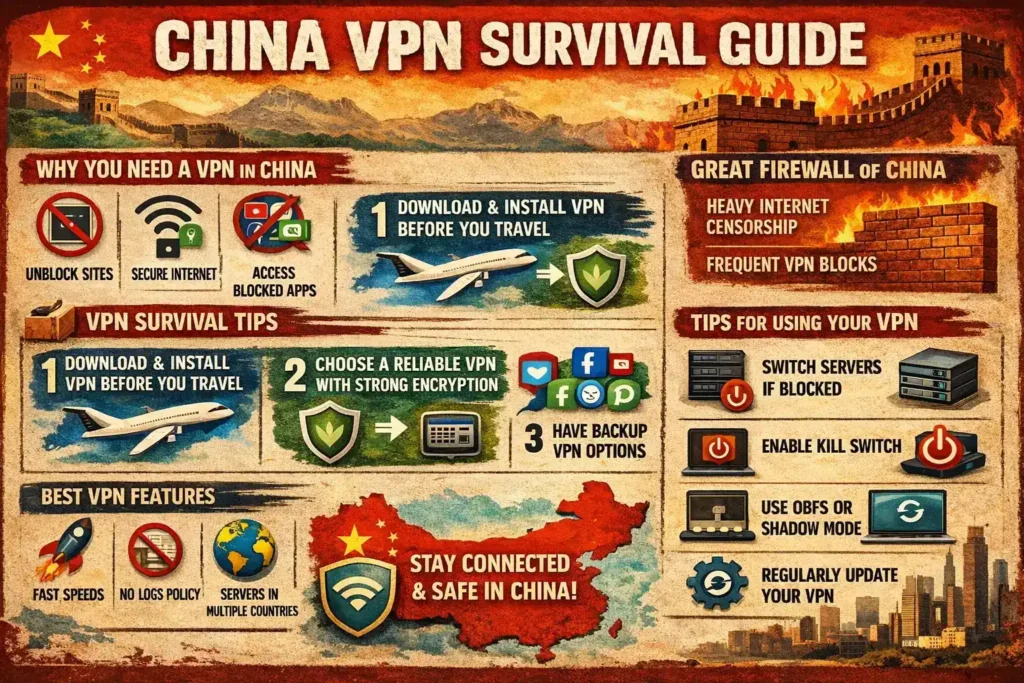
China operates the most sophisticated internet censorship system in the world. In 2026, popular services like Google, Gmail, WhatsApp, Instagram, YouTube, and many work-related tools remain inaccessible on Chinese networks by default. For travelers, expats, students, and remote workers, this is not an inconvenience — it is a connectivity risk that can disrupt communication, navigation, banking, and work.
This China VPN Survival Guide explains how internet access actually works inside mainland China, what is blocked, what still functions, and which VPN strategies are reliable in 2026. More importantly, it shows you exactly what to do before you arrive, how to stay connected during your trip, and how to recover quickly when VPNs inevitably fail.
This is not a generic VPN recommendation page. It is a practical, step-by-step survival manual designed to help you avoid being digitally stranded behind the Great Firewall.
Why China’s Internet Is Different in 2026
China’s internet restrictions are not based on simple website blacklists. Instead, the country operates a multi-layered censorship system commonly known as the Great Firewall. In 2026, this system actively identifies, filters, and disrupts foreign internet traffic in real time.
Unlike in many other countries where a VPN can simply “turn on and work,” China uses advanced techniques such as DNS poisoning, IP blocking, deep packet inspection (DPI), and automated traffic analysis to detect and interfere with encrypted connections. This is why many popular VPNs that work perfectly elsewhere fail completely inside mainland China.
The Great Firewall is also dynamic. Blocking rules change frequently, especially during politically sensitive periods, major holidays, or international events. As a result, even VPNs that normally work in China may experience temporary outages, reduced speeds, or unstable connections.
This constant cat-and-mouse game between Chinese internet regulators and VPN providers is the reason preparation matters so much. Success in China is not about finding a single “perfect” VPN — it is about understanding how the system works, choosing the right tools, and having backup options when disruptions occur.

What Is Blocked in China (2026)
China’s internet restrictions affect far more than social media. Entire ecosystems of services used daily by travelers and professionals are inaccessible on Chinese networks without a VPN. Some apps may partially load or work intermittently, which often creates confusion until they fail completely when you need them most.
| Category | Blocked or Restricted Services |
|---|---|
| Search & Email | Google, Gmail, Google Drive, Google Calendar, Google Maps |
| Social Media | Instagram, Facebook, X (Twitter), Snapchat, Pinterest |
| Messaging & Calls | WhatsApp, Telegram, Facebook Messenger, Line, Discord |
| Video & Streaming | YouTube, Netflix, Hulu, Disney+, HBO Max |
| Cloud & Work Tools | Slack, Dropbox, Trello, Notion, Google Workspace |
| News & Information | BBC, New York Times, Reuters, Wikipedia (partial) |
Because blocking occurs at the network level, simply switching apps or browsers does not solve the problem. Without a VPN designed to bypass the Great Firewall, these services remain inaccessible regardless of device or connection type.

What Still Works Without a VPN in China
Despite extensive restrictions, not everything on the internet is blocked in China. Some services continue to function normally, while others work inconsistently depending on location, network provider, or time of day. Understanding what still works helps you plan realistic backup options when a VPN is unavailable.
| Service | Status | What to Expect |
|---|---|---|
| Apple iMessage | Works | Text and attachments usually function reliably |
| Apple FaceTime | Works | Audio and video calls generally stable |
| Works | One of the few Western social platforms accessible | |
| Bing Search | Works | Usable alternative to Google |
| International SMS & Calls | Works | Reliable but often expensive |
| Chinese Apps | Works | WeChat, Alipay, Baidu Maps, Didi |
While these services can cover basic communication and navigation needs, they do not replace full internet access. Many travelers discover that relying only on what “still works” quickly becomes limiting, especially when work, cloud access, or emergency communication is required.


Do You Really Need a VPN in China?
Whether you need a VPN in China depends less on your travel style and more on how you normally use the internet. For most visitors, the question is not if a VPN is required, but how critical it will be to daily activities.
| Traveler Type | VPN Needed? | Why |
|---|---|---|
| Short-term tourist (1–5 days) | Strongly recommended | Navigation, messaging, emergency access |
| Business traveler | Mandatory | Email, cloud tools, video meetings |
| Student | Mandatory | Research platforms and coursework access |
| Digital nomad / remote worker | Non-negotiable | Work continuity and client communication |
| Offline-focused traveler | Optional | Only if fully prepared to disconnect |
Travelers who attempt to rely solely on services that still work in China often discover limitations within the first day. Tasks such as accessing airline bookings, contacting banks, retrieving documents, or coordinating with people outside China typically require a reliable VPN connection.
The most important factor is timing. Once inside mainland China, downloading or configuring a VPN becomes significantly more difficult. For this reason, even travelers who believe they might not need a VPN are strongly advised to prepare one in advance.`
The China VPN Survival Framework
Using a VPN in China is not a single action — it is a process. Success depends on preparation, correct usage, and knowing how to recover when connections fail. This framework breaks the experience into four practical phases.
Before You Enter China
Once you arrive in mainland China, VPN websites and app listings are often inaccessible. Preparation must be completed before your flight.
| Task | Why It Matters |
|---|---|
| Install your VPN on all devices | VPN provider sites are blocked inside China |
| Log in and test the VPN | Ensures your account is active and functional |
| Download backup protocols or configs | Some protocols stop working unexpectedly |
| Save support contacts offline | You cannot rely on Google for help |
| Install Chinese apps (WeChat, maps) | Local apps work better without a VPN |
The First 24 Hours in China
Your initial connection experience will usually be through hotel Wi-Fi or mobile data. This is when most travelers realize how different China’s internet feels.
| Activity | VPN On | VPN Off |
|---|---|---|
| Google, Gmail, Maps | Yes | No |
| WhatsApp, Instagram, Facebook | Yes | No |
| WeChat, Alipay | No | Yes |
| Chinese map apps | No | Yes |
It is normal to toggle your VPN on and off multiple times per day. Chinese apps often perform poorly when accessed through foreign VPN servers.
Daily VPN Usage Rules
| Use Case | Best Practice |
|---|---|
| Streaming and browsing | Use nearby servers (Japan, Singapore, Hong Kong) |
| Work and video calls | Connect during morning or late-night hours |
| Banking and sensitive logins | Enable kill switch and stable protocol |
| Using Chinese services | Disconnect VPN for better reliability |
When Your VPN Stops Working
Even the best VPNs experience outages in China. Knowing how to respond quickly prevents frustration and loss of access.
| Problem | Immediate Action | Backup Option |
|---|---|---|
| VPN will not connect | Switch protocol or server location | Use mobile data instead of Wi-Fi |
| Very slow speeds | Reconnect to a different nearby server | Try again during off-peak hours |
| Apps fail to load | Toggle VPN on or off | Use Chinese alternatives |
| Total connectivity loss | Restart device and network | Hotel business center or wired internet |
Best VPNs for China (2026)
Not all VPNs work in China. Many popular services function well in Europe or North America but fail entirely against the Great Firewall. VPNs that succeed in China use traffic obfuscation, frequent server rotation, and China-specific protocols designed to evade detection.
The VPNs listed below have a consistent track record of working in China in 2026. No VPN offers 100% uptime, but these providers recover faster and remain usable during most restriction periods.
| VPN | Reliability in China | China-Specific Features | Best For |
|---|---|---|---|
| Astrill VPN | Very high | StealthVPN protocol, strong obfuscation | Long-term expats and remote workers |
| ExpressVPN | High | Lightway protocol, fast nearby servers | Short trips and business travelers |
| NordVPN | Moderate | Obfuscated servers (manual selection) | Budget-conscious travelers |
| Surfshark | Moderate | NoBorders mode, unlimited devices | Families and multi-device users |
Reliability in China depends on more than the VPN brand alone. Performance varies by city, internet provider, time of day, and whether you are using hotel Wi-Fi or mobile data. For this reason, experienced travelers often install more than one VPN before arrival.
If you want deeper technical analysis, performance testing, and long-term reliability data, you can review the full provider breakdowns on our individual VPN review pages.
Read Full VPN Reviews (China Performance)
Recommended VPNs for China (Quick Access)
If you prefer to go straight to a provider, the VPNs below have the most consistent track record in China for 2026. Always install and test your VPN before arriving in mainland China.
-
ExpressVPN – Reliable for short trips and business travel
Visit ExpressVPN -
NordVPN – Strong value option with obfuscated servers
Visit NordVPN -
Surfshark – Best for multiple devices and families
Visit Surfshark -
IPVanish – Fast speeds, mixed China reliability
Visit IPVanish -
PureVPN – Budget-friendly option for restricted networks
Visit PureVPN
Free VPNs in China: What Actually Happens
Free VPN apps are often advertised as a quick solution for accessing blocked websites in China. In reality, they are one of the most common reasons travelers lose internet access entirely. China’s censorship systems are designed to detect and block low-quality, publicly shared VPN infrastructure.
Most free VPNs fail in China for three reasons: they lack traffic obfuscation, reuse heavily blocked IP addresses, and cannot afford the constant server rotation required to stay ahead of the Great Firewall. This is why free services that work elsewhere almost never work reliably in China.
| Feature | Free VPN | Paid VPN |
|---|---|---|
| Works reliably in China | Rarely | Yes |
| Traffic obfuscation | No | Yes |
| Safe for banking & logins | No | Yes |
| Connection stability | Unstable | Recoverable |
| Customer support | None | Available |
For a full breakdown of risks, limitations, and real-world performance differences, see our detailed comparison: Free VPN vs Paid VPN (2026) .
If you are considering a free option at all, make sure you understand which services are legitimate and which should be avoided entirely: Free VPNs That Aren’t Scams .
In restricted environments like China, it is safer to use a low-cost paid VPN designed for censorship-heavy networks rather than relying on free services that are frequently blocked or insecure.
VPN Use Cases That Matter Most in China
Internet restrictions in China affect more than just social media. Depending on how you use the internet, different VPN features become critical. The guides below break down which VPN characteristics matter most for specific use cases.
| Use Case | Recommended Guide |
|---|---|
| Streaming & Video Platforms | Best VPN for Streaming |
| Netflix Access | Best VPN for Netflix 2026 |
| Public Wi-Fi Security | Best VPN for Public Wi-Fi 2026 |
| Speed & Stability | Fastest VPNs 2026 |
| Privacy & No-Log Protection | Best No-Log VPNs 2026 |
| Expats Living in China | Best VPNs for Expats |
| Frequent Travellers | Best VPN for Travellers |
SIM Cards, Roaming & Firewall Bypass in China (2026)
A VPN alone does not guarantee internet access in China. Your underlying connection — whether international roaming, a Chinese SIM card, or portable Wi-Fi — plays a major role in reliability, speed, and firewall behavior.
Understanding how each option interacts with China’s network infrastructure helps you avoid false assumptions and choose the most stable setup for your trip.
| Connection Type | Cost | Bypasses Firewall | Best For |
|---|---|---|---|
| International roaming SIM | High | Sometimes | Short trips, convenience |
| Chinese local SIM | Low | No | Most travelers |
| Portable Wi-Fi hotspot | Medium | No | Groups & families |
| Chinese SIM + VPN | Low | Yes | Best overall solution |
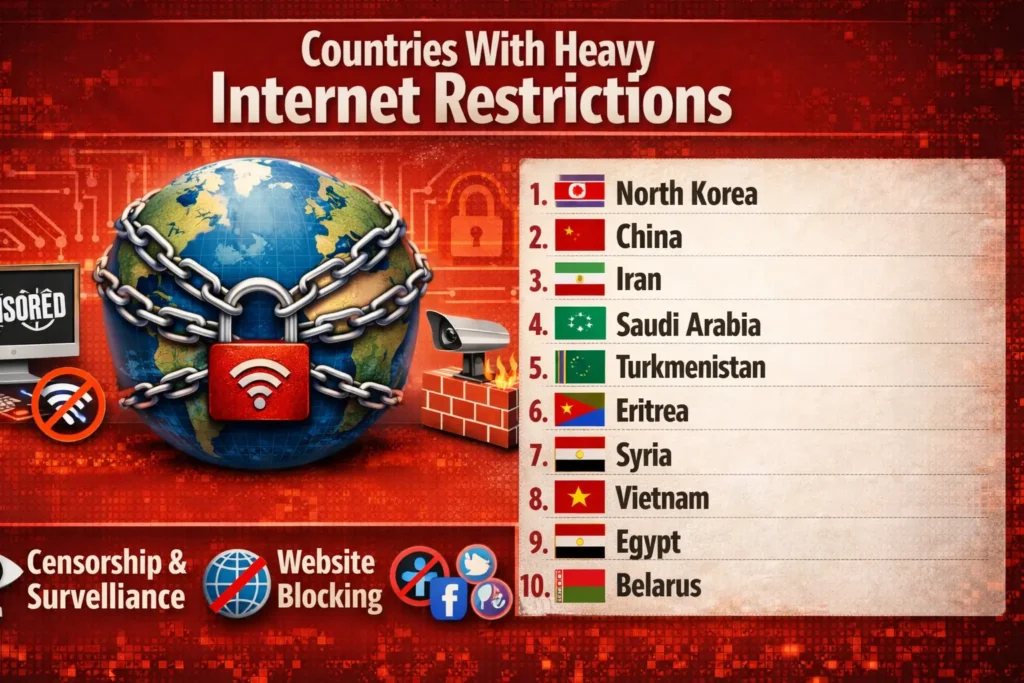
Countries With Heavy Internet Restrictions
| Country / Region | Restriction Level | Dedicated Guide |
|---|---|---|
| China | Extreme | China VPN Survival Guide 2026 |
| Iran | Extreme | Best VPN for Iran 2026 |
| Saudi Arabia | High | Best VPN for Saudi Arabia |
| UAE | High | Best VPNs for UAE 2026 |
| Qatar | High | Best VPN for Qatar 2026 |
| Syria | High | Best VPN for Syria 2026 |
Common VPN Problems in China (And How to Fix Them)
Even VPNs that work well in China can experience interruptions. These issues are usually caused by network-level blocking, temporary IP blacklisting, or unstable Wi-Fi connections rather than problems with your device. The key is knowing how to respond quickly instead of assuming your VPN has permanently stopped working.| Problem | Immediate Fix | Backup Action |
|---|---|---|
| VPN will not connect | Switch protocol or server location | Use mobile data instead of hotel Wi-Fi |
| Very slow speeds | Reconnect to a nearby server (JP, SG, HK) | Try again during off-peak hours |
| VPN connects but sites won’t load | Toggle VPN on/off | Change DNS or protocol |
| VPN works on mobile but not Wi-Fi | Hotel network blocking VPN traffic | Use mobile hotspot or SIM data |
| VPN suddenly stops after working | IP range likely blocked | Switch server or reconnect later |
Advanced Troubleshooting Tips
If basic fixes fail, deeper troubleshooting may be required. These steps resolve the majority of persistent VPN issues in China.
- Change VPN protocols (for example, from OpenVPN to obfuscated or stealth modes).
- Restart your device to force a fresh network connection.
- Disable IPv6 if supported by your VPN app.
- Update your VPN app when new versions are released.
- Keep at least one backup VPN installed before arrival.
For a complete step-by-step breakdown, see our in-depth guide: The Ultimate VPN Troubleshooting Guide (2026) .
Hotel Wi-Fi vs Mobile Data
Hotel and public Wi-Fi networks in China often apply additional filtering or block VPN protocols entirely. This is why a VPN may fail on hotel Wi-Fi but work instantly when you switch to mobile data.
If you regularly use shared or public networks, review: Best VPN for Public Wi-Fi (2026) .
When You Need a Backup Plan
Experienced travelers rarely rely on a single VPN in China. Having a secondary option dramatically reduces downtime during temporary crackdowns or regional outages.
If you travel frequently through restricted regions, these guides will help you plan redundancy: Best VPNs for Restricted Networks and Best VPNs for Restricted Countries (2026) .
Is Using a VPN Legal in China?
The legal status of VPN use in China is often misunderstood. Regulations focus on VPN providers and unauthorized commercial services, not on individual foreign travelers accessing everyday websites or work tools.
In practice, millions of expats, business travelers, students, and tourists use VPNs in China every day without issue. VPN use is common in international hotels, offices, and foreign-owned businesses.
Enforcement actions overwhelmingly target companies selling VPN services inside China or individuals operating VPN servers without authorization. There is no pattern of enforcement against foreign visitors for using VPNs to access email, messaging apps, or work platforms.
That said, travelers should avoid:
- Selling or distributing VPN services inside China
- Running private VPN servers locally
- Publicly promoting VPN usage on Chinese platforms
For travelers, expats, and remote workers, VPN use is widely regarded as a practical necessity rather than a legal risk. The most important step is choosing a reputable provider designed for restricted networks and installing it before arrival.
Frequently Asked Questions About VPNs in China (2026)
Will my VPN work 100% of the time in China?
No. There is no VPN that works perfectly at all times in China. Even the best providers experience temporary outages due to IP blocking or protocol detection. Reliability in China is measured by recovery speed, not uninterrupted uptime.
Can I install a VPN after arriving in China?
This is strongly discouraged. VPN provider websites and app listings are frequently blocked inside China, making downloads unreliable or impossible. Always install and test your VPN before arrival.
Is it better to use hotel Wi-Fi or mobile data with a VPN?
Mobile data is usually more reliable. Hotel and public Wi-Fi networks often block VPN protocols entirely. If you frequently use shared networks, see: Best VPN for Public Wi-Fi (2026) .
Do free VPNs work in China?
Most free VPNs do not work reliably in China due to blocked IP ranges and lack of obfuscation. For a detailed comparison, see: Free VPN vs Paid VPN (2026) .
Can international roaming bypass the Great Firewall?
Sometimes. Some roaming SIMs route traffic outside China, allowing access to blocked sites without a VPN. This behavior is carrier-dependent, inconsistent, and often expensive. It should not be relied on as a primary solution.
Should I install more than one VPN?
Yes. Experienced travelers often install a primary VPN and a backup VPN before entering China. T
Final Verdict: How to Stay Connected in China in 2026
China’s internet is not broken — it is deliberately restricted. In 2026, accessing familiar websites, communication tools, and work platforms still requires preparation, realistic expectations, and the right tools.
Travelers who struggle with connectivity in China almost always make the same mistake: waiting until arrival to solve the problem. Once inside mainland China, options become limited and unreliable.
Those who prepare in advance, understand how VPNs actually behave behind the Great Firewall, and keep backup options available rarely experience serious disruption.
China VPN Survival Checklist
| Step | Status |
|---|---|
| Install and test your VPN before departure | Essential |
| Download backup protocols or a secondary VPN | Strongly recommended |
| Install Chinese apps (WeChat, maps, payments) | Essential |
| Use mobile data when VPN fails on Wi-Fi | Recommended |
| Expect occasional VPN disruptions | Normal |
Related Guides & Next Steps
- The 10 Countries You Need a VPN For (2026)
- Best VPNs for Restricted Countries (2026)
- Best VPNs for the Middle East (2026)
- Best VPN for Central Asia (2026)
- VPN Troubleshooting Pro Guide (2026)
With the right preparation, China’s Great Firewall becomes an inconvenience rather than a barrier. Install your VPN early, keep a backup plan, and approach connectivity with flexibility. Do that, and you can focus on your work, travel, or experience — not on fighting the internet.