

Finding the best VPN for Saudi Arabia in 2026 requires a very different approach than choosing a VPN for unrestricted countries. Saudi Arabia operates one of the most tightly regulated internet environments in the Middle East, where VPN traffic is actively filtered and many standard protocols are blocked.
As a result, VPNs that work reliably in Europe or North America often fail to connect or suffer frequent disruptions in the Kingdom. For users in Saudi Arabia, stealth technology, privacy protection, and connection reliability matter far more than speed or entertainment features.
This guide is a complete, practical resource for VPN use in Saudi Arabia. It explains whether VPNs are legal, why people use them, which technical features are essential, and which VPN providers perform reliably in real-world conditions. You’ll also find setup guidance, server selection advice, troubleshooting steps, and clear answers to the most common questions.
Why VPNs Are Restricted in Saudi Arabia
Saudi Arabia uses a combination of ISP-level filtering, deep packet inspection, and protocol blocking to control access to online services. While general internet access is widely available, certain platforms, VoIP services, and VPN protocols are restricted.
Because of this, many VPNs are blocked not by law, but by technical controls at the network level. VPNs that rely on easily identifiable protocols often fail to connect or are throttled shortly after connecting.
This is why VPNs used in Saudi Arabia must include obfuscation or stealth features that disguise VPN traffic as normal HTTPS traffic. Without these capabilities, consistent VPN use in the Kingdom is unlikely.
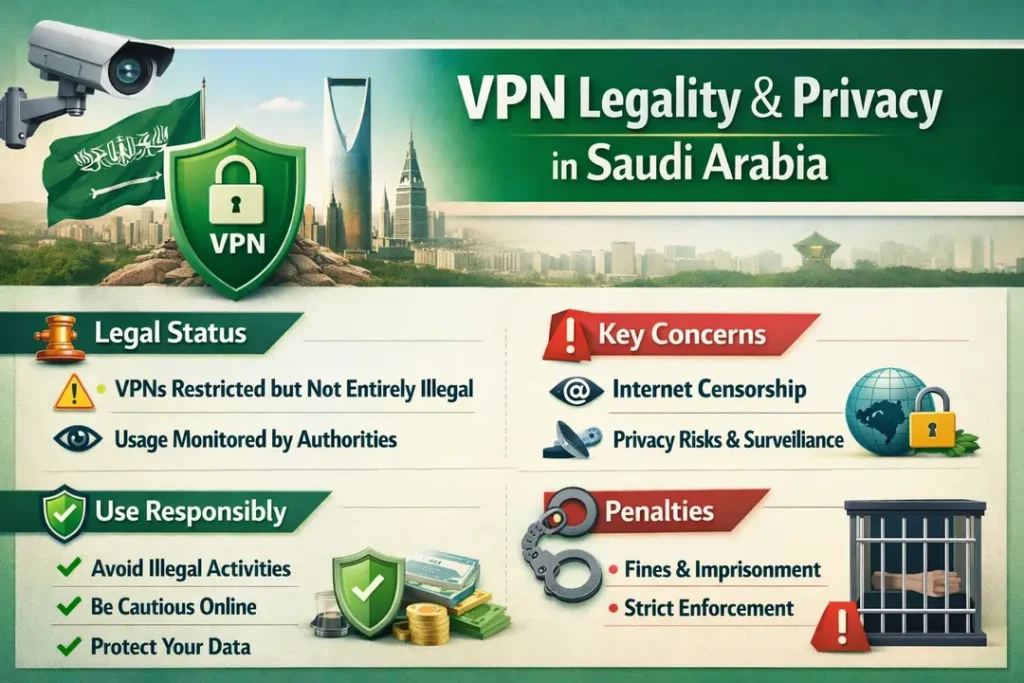
VPN Legality and Privacy in Saudi Arabia
Saudi Arabia does not have a publicly stated law that explicitly bans the use of VPNs by individuals.
However, the country enforces strict regulations on online activity,
and internet traffic is subject to extensive filtering and monitoring at the ISP level.
In practice, enforcement in Saudi Arabia focuses on how a VPN is used
rather than on VPN software itself.
Using a VPN for activities that violate local laws or access prohibited content
can lead to serious consequences,
while basic privacy or security use is far more common and less scrutinised.
Because of this, VPN use in Saudi Arabia exists in a high-oversight environment
rather than a simple legal ban.
This makes provider choice, configuration, and responsible usage critically important.
How Internet Monitoring Works in Saudi Arabia
Saudi Arabia operates one of the most advanced internet filtering systems in the Middle East.
This includes:
- ISP-level traffic inspection
- Blocking of known VPN servers and protocols
- Restrictions on VoIP and encrypted communication platforms
As a result, many VPNs are blocked not by law,
but by technical controls designed to identify and disrupt VPN traffic.
VPNs that rely on easily detectable protocols often fail to connect
or are throttled shortly after establishing a connection.
Why Privacy Protection Matters in Saudi Arabia
Privacy risks in Saudi Arabia are less about casual browsing
and more about protecting communications, credentials,
and sensitive personal or work-related data on monitored networks.
These risks are highest on:
- Mobile data networks
- Public and shared Wi-Fi
- Workplace or institutional connections
Using a poorly designed or free VPN in these environments
can increase risk rather than reduce it,
particularly if the service logs user activity
or fails to protect traffic during connection drops.
No-Logs Policies, Obfuscation, and Kill Switches
In Saudi Arabia, a strict no-logs policy is essential.
VPN providers that store connection logs, IP addresses,
or usage metadata create long-term privacy exposure
in a high-oversight environment.
Equally important is obfuscation or stealth technology,
which disguises VPN traffic as normal HTTPS traffic.
This significantly improves reliability on Saudi networks
and reduces the likelihood of VPN connections being blocked.
Finally, a kill switch is not optional.
If a VPN connection drops — which can happen when networks reset or filter traffic —
a kill switch prevents accidental IP exposure
until the secure connection is restored.
For broader context on VPN use in high-restriction environments,
see:
Best VPNs for Restricted Countries (2026)
.

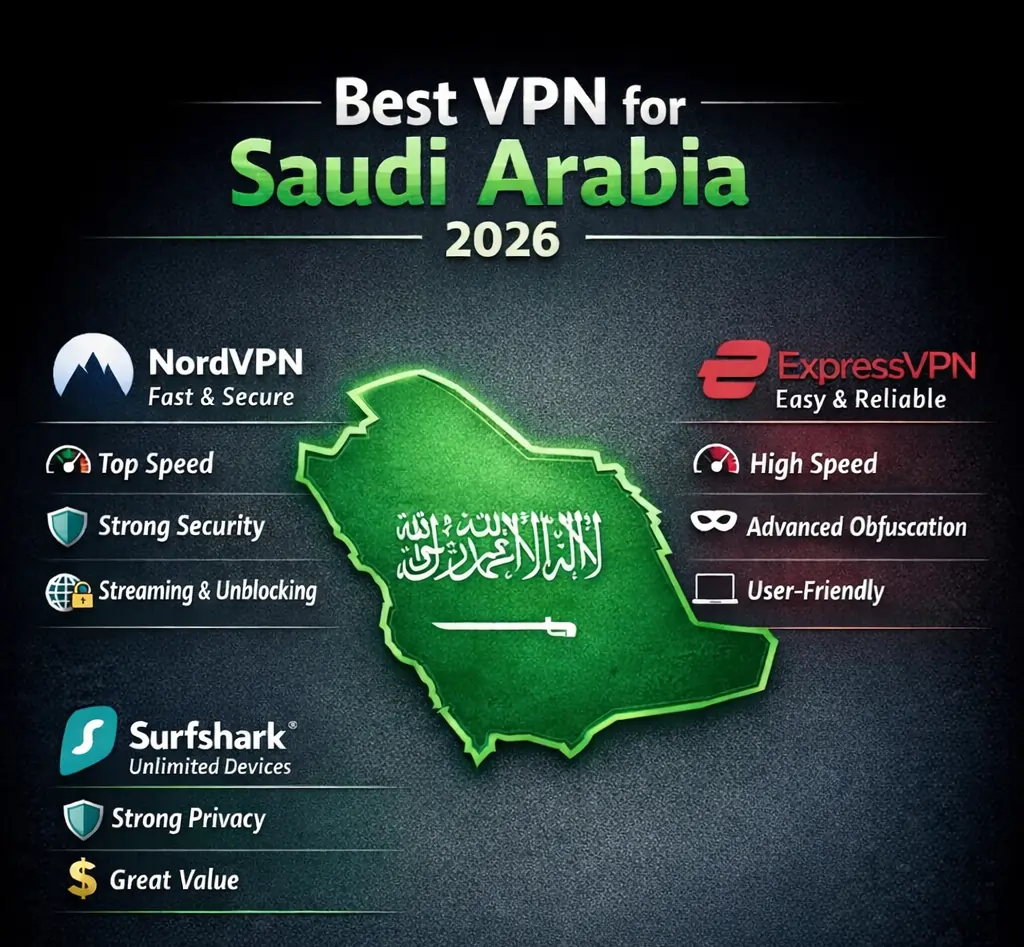
How to Choose the Best VPN for Saudi Arabia
Choosing a VPN for Saudi Arabia requires a different approach than selecting a VPN for unrestricted countries. The Kingdom operates a tightly controlled internet environment where VPN traffic is actively filtered, and many standard VPN protocols are blocked or throttled.
As a result, features that may be optional elsewhere become essential in Saudi Arabia. VPNs that lack stealth technology, strong privacy safeguards, or resilient infrastructure frequently fail to connect or suffer repeated disruptions.
A VPN suitable for Saudi Arabia must prioritise reliability on restricted networks, privacy protection, and traffic concealment over price, cosmetic features, or large streaming libraries.
Essential VPN Features for Saudi Arabia
| Feature | Why It Matters in Saudi Arabia |
|---|---|
| Obfuscation / Stealth Mode | Disguises VPN traffic as regular HTTPS traffic, making it harder for network filtering systems to detect and block VPN connections. This is one of the most important features for reliable use in Saudi Arabia. |
| Strict No-Logs Policy | Limits the amount of user data stored by the VPN provider. In a high-oversight environment, minimising logs reduces long-term privacy exposure. |
| Kill Switch | Prevents accidental IP exposure if the VPN connection drops, which can happen when networks reset or traffic is filtered. |
| Modern Encryption | Protects sensitive data such as messaging, work credentials, banking activity, and personal communications on monitored networks. |
| Reliable Server Network | Allows users to switch servers if specific locations become blocked, throttled, or congested. Resilience matters more than sheer server count. |
| Fast Nearby Servers | Improves speed and connection stability by reducing latency. Servers in Europe or nearby regions typically perform best for Saudi Arabia. |
Why Free VPNs Usually Fail in Saudi Arabia
Most free VPN services are not designed for restrictive environments. They typically lack obfuscation technology, rely on easily detected protocols, and operate on congested infrastructure.
As a result, free VPNs in Saudi Arabia are often blocked quickly, disconnect frequently, or expose users to privacy risks through logging or data monetisation.
By comparison, paid VPNs featured in guides such as Free VPN vs Paid VPN and Best No-Log VPNs invest in infrastructure specifically designed to operate on restricted networks.
Which VPN Providers Meet These Requirements?
In real-world testing, VPNs such as NordVPN, ExpressVPN, and Surfshark consistently meet the technical requirements outlined above. This is why they are frequently recommended for Saudi Arabia and other high-restriction environments.
Key takeaway: When choosing a VPN for Saudi Arabia, reliability and privacy protection matter far more than price or extra features. A VPN that connects consistently and protects user data is always the better long-term choice.
Best VPNs for Saudi Arabia (2026) – Comparison Overview
Not all VPN services are capable of operating reliably in Saudi Arabia. Due to aggressive network filtering, blocked VPN protocols, and active traffic inspection, VPNs used in the Kingdom must prioritise stealth technology, connection stability, and privacy protection over entertainment features or low pricing.
The VPN providers below were evaluated specifically for performance on restricted networks, including their ability to connect consistently, maintain stable sessions, and protect user data under Saudi Arabia’s internet controls.
| VPN Provider | Best For | Stability | No-Logs | Kill Switch | Obfuscation | Review |
|---|---|---|---|---|---|---|
| NordVPN | Best overall privacy & stealth | Excellent | Yes (audited) | Yes | Yes | Read review |
| ExpressVPN | Reliability & ease of use | Excellent | Yes (audited) | Yes | Yes | Read review |
| Surfshark | Best budget option | Good | Yes | Yes | Yes | Read review |
| IPVanish | Simple apps & nearby servers | Moderate | Yes | Yes | Limited | Read review |
| PureVPN | Flexible pricing | Moderate | Yes | Yes | Yes | Read review |
Best Overall VPN for Saudi Arabia – NordVPN
After evaluating VPN performance under Saudi Arabia’s real-world network conditions, NordVPN stands out as the best overall VPN for use in the Kingdom in 2026. It offers the strongest balance of privacy protection, stealth capabilities, and connection reliability on restricted networks.
Saudi Arabia’s internet controls actively filter VPN traffic, which causes many services to fail or disconnect frequently. NordVPN is particularly well suited to this environment because it combines advanced obfuscation technology with a strict, independently audited no-logs policy.
Why NordVPN Works Well in Saudi Arabia
- Obfuscated servers that disguise VPN traffic as regular HTTPS, improving connection success on filtered networks
- Independently audited no-logs policy, reducing long-term privacy exposure in a high-oversight environment
- Reliable kill switch that prevents IP leaks during connection drops or network resets
- Consistent performance across mobile data, home broadband, and shared networks
In practice, NordVPN maintains stable connections where many competing VPNs fail, particularly when VPN protocols are restricted or traffic inspection is active.
Who Should Choose NordVPN in Saudi Arabia?
- Users who prioritise privacy and data protection
- Professionals and remote workers accessing international services
- Users who rely heavily on mobile data or shared Wi-Fi
- Anyone looking for long-term, reliable VPN use in Saudi Arabia
For a detailed technical breakdown, including privacy audits, protocol support, and real-world testing results, see: NordVPN Review (2026).
Best VPN for Reliability in Saudi Arabia – ExpressVPN
For users who prioritise simplicity and consistent performance, ExpressVPN is the most reliable alternative to NordVPN for use in Saudi Arabia. It is particularly well suited to users who want a VPN that works with minimal configuration on restricted networks.
ExpressVPN uses automatic protocol selection, which allows the app to adapt quickly when certain VPN protocols are blocked or throttled. This makes it a strong choice for travellers, expats, and mobile-first users in the Kingdom.
- Automatic protocol selection for restricted networks
- Fast reconnection after temporary signal drops
- Strong encryption enabled by default
- Built-in kill switch to prevent traffic leaks
Best Budget VPN for Saudi Arabia – Surfshark
Surfshark is the best budget-friendly VPN option for Saudi Arabia in 2026. It offers essential privacy and stealth features at a lower price point than premium providers, making it suitable for everyday use.
Surfshark includes obfuscation and a reliable kill switch, which are critical for operating on Saudi Arabia’s restricted networks. However, it is slightly less resilient than NordVPN or ExpressVPN during periods of heavy filtering or congestion.
- Unlimited simultaneous device connections
- Stealth and obfuscation features
- Built-in kill switch and leak protection
Other VPNs That May Work in Saudi Arabia
IPVanish
IPVanish can be a reasonable option for users who prioritise speed and simple apps. When connected to nearby regions, it can deliver solid performance for basic browsing.
However, IPVanish offers more limited stealth capabilities, which can reduce reliability on heavily restricted networks compared to premium providers.
PureVPN
PureVPN offers flexible pricing and a wide range of server locations, making it appealing to cost-conscious users. It includes essential privacy features and can work reliably when configured correctly.
That said, its performance under aggressive filtering is less consistent than NordVPN or ExpressVPN, which is why it is better viewed as a secondary option.
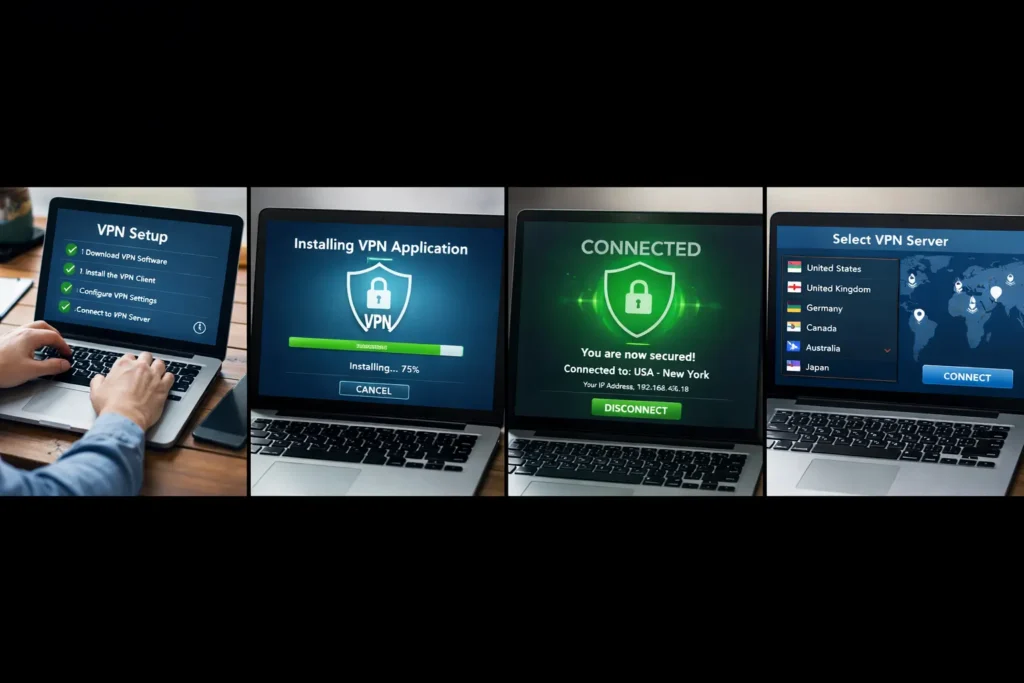
How to Set Up and Use a VPN Safely in Saudi Arabia
Using a VPN in Saudi Arabia requires more care than in unrestricted countries. Because VPN traffic is actively filtered, correct setup and configuration are essential for both reliability and privacy.
Step 1: Choose a Reputable VPN Provider
Avoid free or unknown VPN services. Instead, choose a paid provider with a strong privacy reputation, a strict no-logs policy, and proven performance on restricted networks.
Step 2: Install Only the Official VPN App
Always download VPN apps directly from the provider’s official website or a trusted app store. Avoid third-party APKs or modified apps, which can expose users to malware or data collection risks.
Step 3: Enable Critical Security Features
- Kill switch to prevent IP exposure if the VPN disconnects
- DNS leak protection to keep all traffic encrypted
- Obfuscation or stealth mode to disguise VPN traffic
These settings significantly reduce the risk of accidental data exposure on restricted or monitored networks.
Step 4: Choose an Appropriate Server Location
Nearby regions such as Europe or neighbouring Middle Eastern countries typically provide the best balance of speed and stability. If one server fails, switching locations is often enough to restore access.
Step 5: Verify the Connection
Before accessing sensitive accounts, confirm that your IP address has changed and that the VPN connection is stable.
Key takeaway: In Saudi Arabia, a VPN should be treated as a security tool. Correct setup and conservative use provide the best protection.
Best VPN Server Locations for Saudi Arabia
Server location choice has a major impact on VPN speed, stability, and reliability in Saudi Arabia. The best results usually come from regions that balance geographic proximity with strong infrastructure.
| Server Region | Why It Works Well | Best Use Case |
|---|---|---|
| Europe (Germany, Netherlands, UK) | Stable routing and high-capacity infrastructure | Work access, browsing, long sessions |
| Nearby Middle East (UAE, Turkey) | Lower latency due to proximity | Video calls, messaging, everyday use |
| Asia (Singapore, Japan) | Reliable fallback routes | Backup connections |
Servers in distant regions such as the Americas often introduce higher latency and less consistent performance and are best avoided for daily use.
Troubleshooting VPN Issues in Saudi Arabia
Most VPN issues in Saudi Arabia are caused by
network filtering,
blocked protocols,
or unstable routing rather than faulty apps.
VPN Will Not Connect
- Enable obfuscation or stealth mode
- Switch to a TCP-based protocol if available
- Change to a different nearby server
VPN Is Slow
- Switch to a closer server region
- Avoid peak local usage hours
- Reconnect to refresh the session
VPN Disconnects Unexpectedly
- Ensure the kill switch is enabled
- Switch to a more stable network if possible
- Update the VPN app
Key takeaway:
Temporary disruptions are common.
VPNs with strong infrastructure recover far faster
than free or low-quality services.

VPNs for Expats, Remote Workers, and Travellers in Saudi Arabia
VPN needs in Saudi Arabia vary significantly depending on how long you stay,
how you access the internet,
and what you use it for.
Expats, remote workers, and travellers face different challenges,
but all operate within a tightly controlled network environment
where reliability and privacy matter more than convenience features.
Best VPNs for Expats Living in Saudi Arabia
Expats living in Saudi Arabia often rely on the internet for long-term work,
secure communication with family abroad,
and access to international services.
Over time, issues such as routing instability,
shared office networks,
and ISP-level filtering become more noticeable.
For expats, the most important VPN qualities are
long-term reliability, audited no-logs policies, and consistent performance across multiple networks.
A VPN that works well on both home broadband and mobile data
reduces the need for constant troubleshooting.
For a deeper breakdown of VPNs suited for long-term overseas use, see:
Best VPNs for Expats (2026).
Best VPNs for Remote Workers in Saudi Arabia
Remote workers depend on VPNs to access cloud platforms,
company systems,
and international services securely.
In Saudi Arabia,
VPN interruptions can disrupt meetings,
file transfers,
and secure logins.
Remote workers should prioritise VPNs that offer:
- Stable connections during long work sessions
- Reliable performance on both Wi-Fi and mobile networks
- Strong encryption and dependable kill switches
- Minimal downtime when switching servers or networks
VPNs that perform well on restricted or monitored networks
are especially important for remote work.
Additional guidance is available here:
Best VPNs for Restricted Networks.
Best VPNs for Travellers Visiting Saudi Arabia
Travellers in Saudi Arabia frequently rely on hotel Wi-Fi,
airport networks,
and mobile data,
many of which are unsecured or heavily filtered.
These networks increase the risk of data exposure
if used without proper protection.
Travellers should focus on VPNs that are easy to use,
reconnect quickly after signal drops,
and work reliably on mobile devices
without requiring advanced configuration.
For VPNs designed specifically for frequent travel and mobile use, see:
Best VPNs for Travellers (2026).
Because public and hotel Wi-Fi are common attack vectors,
travellers may also find this guide useful:
Best VPN for Public Wi-Fi (2026).
Key takeaway:
Whether you are living in Saudi Arabia long term,
working remotely,
or visiting temporarily,
a VPN designed for restricted networks
provides essential privacy,
security,
and connection reliability.
Free VPNs vs Paid VPNs in Saudi Arabia
Free VPN services are rarely suitable for use in Saudi Arabia. Most lack the infrastructure and stealth technology required to operate reliably on restricted networks.
Limitations of Free VPNs
- Congested servers
- Weak or missing kill switches
- No obfuscation or stealth features
- Potential logging or data monetisation
Paid VPNs invest in stronger infrastructure, audited no-logs policies, and reliable leak protection, making them the only realistic option for regular VPN use in Saudi Arabia.
Frequently Asked Questions About VPNs in Saudi Arabia
Do VPNs actually work in Saudi Arabia?
Yes, VPNs can work reliably in Saudi Arabia,
but only if the provider is designed for restricted networks.
VPNs without obfuscation or stealth technology
are frequently blocked or disconnected.
Premium VPNs with traffic concealment
perform far more consistently in the Kingdom.
Is using a VPN legal in Saudi Arabia?
Saudi Arabia does not explicitly ban VPN software itself.
However, online activity is closely regulated,
and using a VPN to access prohibited content
or engage in illegal activity can result in serious consequences.
Responsible use for privacy and security is far more common
than enforcement against VPN tools alone.
Can expats and remote workers use a VPN in Saudi Arabia?
Yes. Many expats and remote workers use VPNs
to access international services,
company platforms,
and secure communications.
For long-term use,
VPNs with audited no-logs policies,
strong encryption,
and stable performance are essential.
Can I use a VPN on mobile data in Saudi Arabia?
Yes. A large proportion of internet access in Saudi Arabia
relies on mobile networks.
A suitable VPN must handle signal changes
and brief disconnects
without exposing the user’s real IP address.
This makes kill switches and reconnection handling critical.
Are free VPNs safe to use in Saudi Arabia?
Free VPNs are generally not safe or reliable in Saudi Arabia.
Most lack obfuscation,
operate on congested servers,
and may log or monetise user data.
On restricted networks,
these limitations can create real privacy and security risks.
Which VPN features matter most in Saudi Arabia?
The most important features are obfuscation or stealth mode,
a strict no-logs policy,
a reliable kill switch,
and proven performance on restricted networks.
Streaming features and cosmetic extras are secondary.
Final Verdict – Best VPN for Saudi Arabia (2026)
Saudi Arabia is one of the most restrictive VPN environments in the Middle East. Internet filtering, protocol blocking, and traffic inspection mean that many VPNs simply do not work reliably in the Kingdom.
As a result, the best VPN for Saudi Arabia in 2026 must prioritise stealth, privacy protection, and connection reliability over speed, pricing, or entertainment features.
- NordVPN is the best overall VPN for Saudi Arabia, offering advanced obfuscation, audited no-logs policies, and consistently stable performance on restricted networks.
- ExpressVPN is the best choice for users who value simplicity and reliability, particularly travellers and mobile-first users who want a VPN that works with minimal configuration.
- Surfshark is the strongest budget option, providing essential stealth and privacy features at a lower cost, though with slightly less resilience than premium providers.
No VPN eliminates responsibility. Users are always accountable for how a VPN is used and must comply with local laws and regulations. However, when chosen carefully and configured correctly, a high-quality VPN can significantly improve privacy, security, and access consistency in Saudi Arabia.
Bottom line: If you need a dependable VPN for Saudi Arabia in 2026, choose a reputable paid provider with stealth capabilities, set it up correctly, and use it conservatively. This approach offers the best balance of safety, performance, and peace of mind.
Related Middle East VPN Guides and Regional Hub
Middle East Country VPN Guides
| Country | VPN Guide |
|---|---|
| Saudi Arabia | Best VPN for Saudi Arabia (2026) |
| Iraq | Best VPN for Iraq (2026) |
| United Arab Emirates | Best VPN for UAE (2026) |
| Syria | Best VPN for Syria (2026) |
| Lebanon | Best VPN for Lebanon (2026) |
Regional VPN Hub
| Region | Hub Guide |
|---|---|
| Middle East | Best VPNs for the Middle East (2026) |