

Traveling in 2026 is easier than ever — but staying secure, connected, and unrestricted online is harder.
From airport Wi-Fi and hotel networks to government filtering and geo-blocked streaming services, modern travelers face constant digital barriers the moment they leave home.
A reliable VPN is no longer a “nice to have” travel tool. It is essential infrastructure.
Whether you are a frequent flyer, digital nomad, expat, remote worker, or long-term backpacker, the right VPN determines whether your internet works normally — or becomes slow, blocked, and insecure.
Public Wi-Fi networks remain one of the biggest risks for travelers. Airports, cafés, hotels, coworking spaces, and even Airbnb routers are routinely targeted by data sniffing, rogue access points, and man-in-the-middle attacks. At the same time, many countries now actively restrict websites, apps, VoIP services, and streaming platforms based on location.
A high-quality travel VPN solves all of this by:
- Encrypting your data on public and hotel Wi-Fi networks
- Allowing safe access to banking, email, and work tools abroad
- Bypassing country-level censorship and network restrictions
- Unblocking home streaming services while traveling
- Preventing ISP throttling on mobile and hotspot connections
However, not all VPNs are suitable for travel.
Many providers struggle with unstable hotel Wi-Fi, mobile networks, airport firewalls, or aggressive VPN blocking in regions such as Asia, the Middle East, and parts of Europe.
To cut through marketing claims, we tested leading VPN providers specifically for real-world travel use in 2026. This includes international flights, hotel networks, public hotspots, mobile roaming, restricted countries, and long multi-week trips across multiple regions.
This guide reveals the best VPNs for traveling in 2026, explains what actually matters when choosing a travel VPN, and shows which providers deliver consistent performance across countries, devices, and networks — not just in ideal lab conditions.
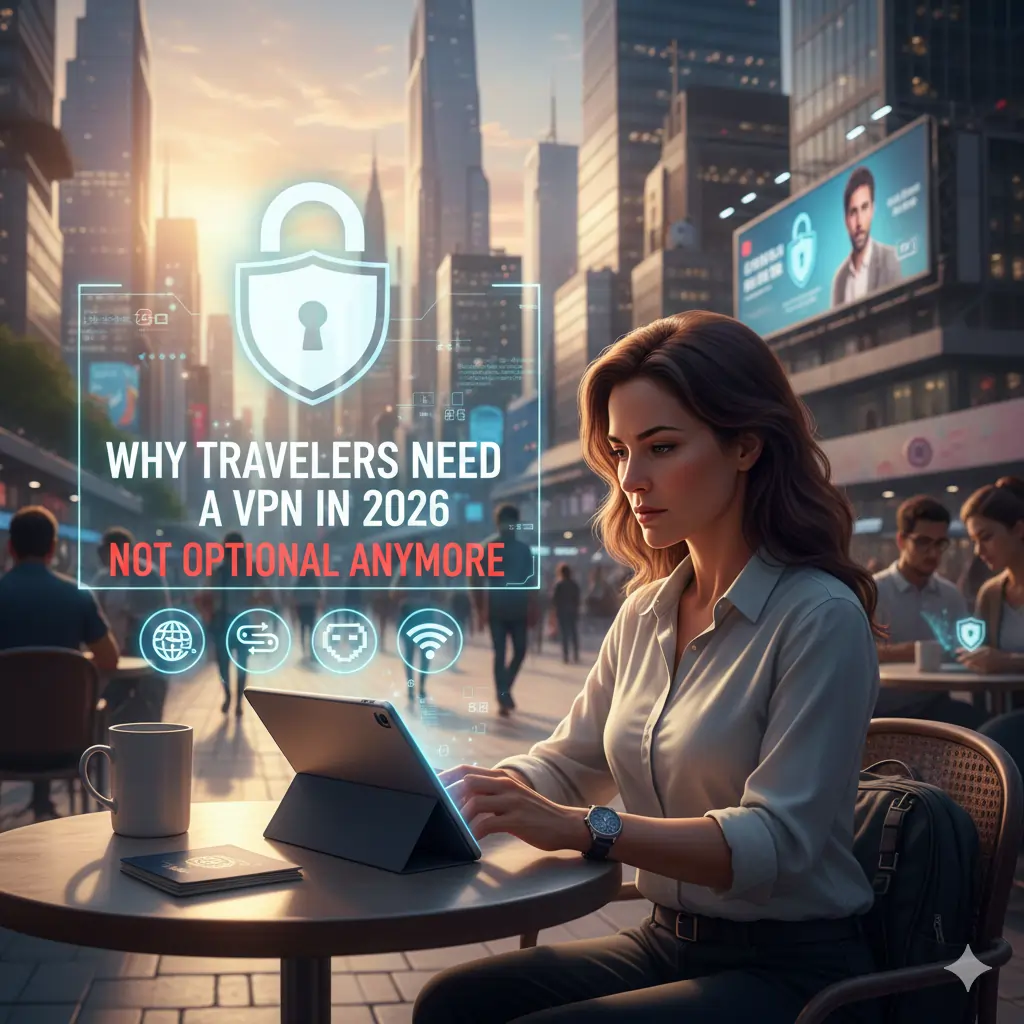
Why Travelers Need a VPN in 2026 (Not Optional Anymore)
In 2026, using the internet while traveling without a VPN is no longer a minor privacy risk — it is a direct exposure to data theft, account lockouts, surveillance, and geo-restrictions. Travelers face a completely different threat landscape compared to home users, especially when connecting through public or foreign networks.
The best VPN for traveling must do far more than change your IP address. It must actively protect you against hostile Wi-Fi networks, aggressive ISP monitoring, government censorship, and region-based service blocks — all while remaining fast, reliable, and easy to use on mobile devices.
1. Public Wi-Fi Is the #1 Threat for Travelers
Airports, hotels, cafés, coworking spaces, and even airline Wi-Fi networks are prime targets for:
- Man-in-the-middle (MITM) attacks
- Rogue access points impersonating legitimate networks
- Session hijacking and credential theft
- Unencrypted traffic interception
Without a VPN, your email logins, banking sessions, cloud accounts, and private messages can be exposed in minutes. This is why travelers should always pair a VPN with any open or shared network.
For a deeper breakdown, see our full guide to Best VPNs for Public Wi-Fi (2026).
2. Geo-Blocking Breaks Streaming, Banking & Apps Abroad
Many travelers only realize the problem after landing. Suddenly:
- Streaming services block access or show different libraries
- Banking apps flag logins as suspicious
- Government or ISP restrictions block familiar websites
A high-quality travel VPN allows you to securely connect through your home country, maintaining access to:
- Netflix, Prime Video, BBC iPlayer, and live sports
- Online banking and financial services
- Work tools, cloud dashboards, and email platforms
Travelers who rely on streaming should also see our Best VPNs for Streaming (2026) guide.
3. Country-Specific Internet Restrictions Are Increasing
Internet access varies dramatically by destination. Some countries throttle traffic, block VPNs outright, or monitor connections aggressively. In 2026, travelers frequently encounter restrictions in:
- China – Deep packet inspection and VPN blocking
- Iran – Heavy censorship and surveillance
- UAE – VoIP and content restrictions
- Russia – Increasing VPN enforcement
- Turkey – Social media and news throttling
The best VPNs for traveling use obfuscation and stealth protocols to blend VPN traffic into normal HTTPS traffic, allowing reliable access even in restricted regions.
4. Roaming ISPs Throttle and Profile Travelers
When you travel internationally, your mobile data often passes through:
- Foreign ISPs
- Roaming agreements with limited transparency
- Traffic-shaping systems designed to reduce bandwidth
VPNs prevent ISP profiling by encrypting traffic and hiding usage patterns. This helps travelers maintain consistent speeds for video calls, navigation, and remote work.
5. Travel Devices Multiply the Risk Surface
Travelers rarely use just one device. Phones, laptops, tablets, Firesticks, and travel routers all introduce additional risk — especially when syncing data or auto-connecting to known networks.
This is why device support matters. VPNs like NordVPN, Surfshark, and IPVanish allow multiple or unlimited connections, protecting every device you carry.
Firestick users should also review Best VPNs for Firestick (2026) for hotel and Airbnb setups.
Bottom Line
In 2026, a VPN is not just a convenience for travelers — it is a critical security layer. The right VPN protects your data, preserves access to essential services, and ensures your online identity remains intact no matter where you land.
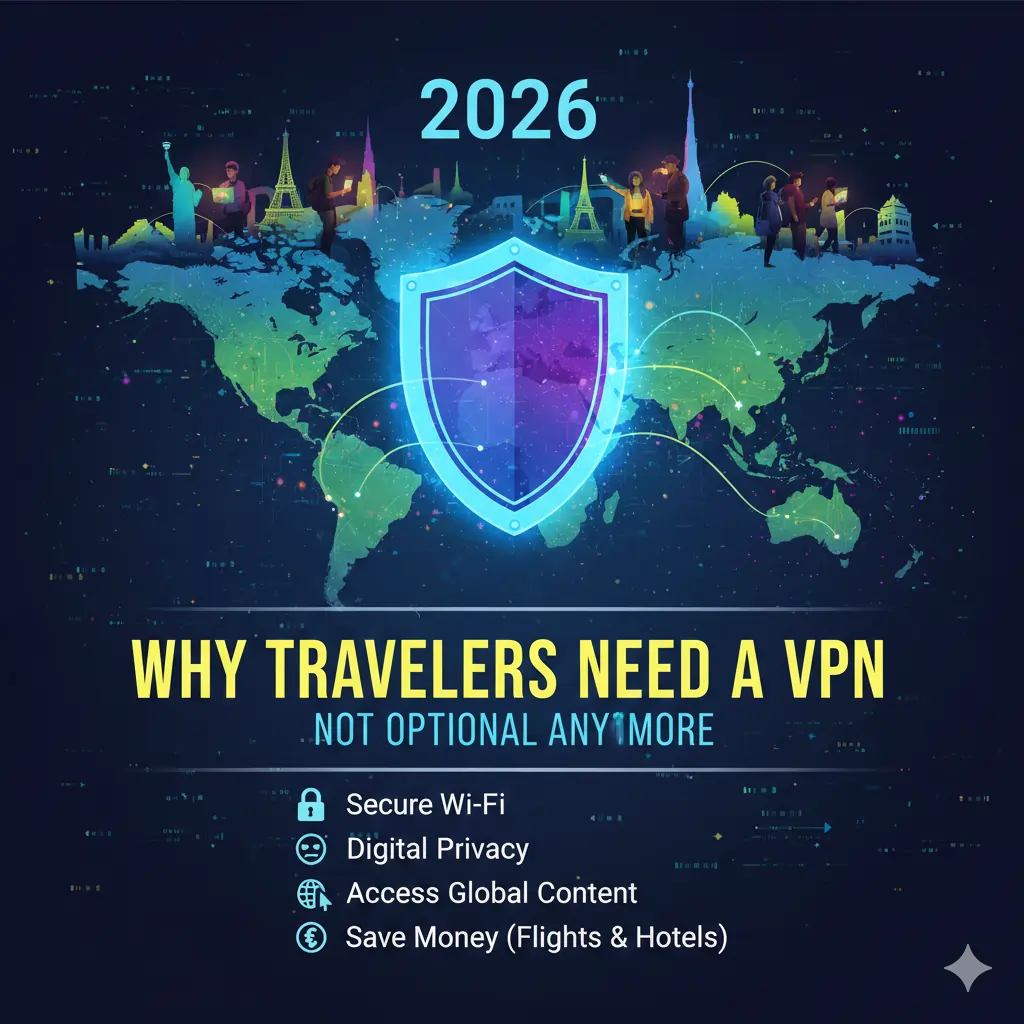
Why Travelers Need a VPN in 2026 (Not Optional Anymore)
Testing VPNs for travel requires a very different approach than testing VPNs for home or office use.
Travel networks are unstable, heavily monitored, and often hostile to VPN connections. To ensure real-world accuracy, we evaluated each VPN under the same conditions travelers actually face in 2026 — not ideal lab environments.
Real-World Travel Environments Tested
Each VPN was tested across a wide range of travel scenarios to identify reliability issues that only appear outside controlled networks.
- Airport Wi-Fi networks (international terminals and lounges)
- Hotel and resort Wi-Fi (budget to premium chains)
- Cafés and coworking spaces
- Public transport Wi-Fi where available
- Mobile hotspot and roaming connections
VPNs that failed to connect consistently, required repeated retries, or dropped connections during normal browsing were downgraded or excluded.
Country-Level Restriction & Censorship Testing
Travelers frequently cross borders where internet access changes instantly. We tested VPN reliability in both open and restricted regions, focusing on how quickly and reliably each service restored normal internet access.
- Countries with moderate content filtering
- Regions known for VPN blocking and DPI inspection
- Cross-border transitions where IP reputation changes rapidly
VPNs that required manual configuration, frequent server hopping, or special instructions to function were ranked lower for travel use.
Public Wi-Fi Security & Stability
Security on public Wi-Fi is one of the primary reasons travelers use VPNs. We specifically monitored:
- Connection stability on unsecured networks
- Protection against DNS, IPv6, and WebRTC leaks
- Kill switch behavior during network drops
- Automatic reconnection when moving between access points
VPNs that leaked traffic, failed to reconnect automatically, or exposed real IP addresses during brief disconnects were penalized heavily.
Device & Platform Compatibility
Travelers rarely use just one device. Each VPN was tested across common travel setups:
- Windows and macOS laptops
- iOS and Android phones
- Tablets
- Firestick and Android TV for hotel TVs
VPNs with limited app support, inconsistent interfaces, or missing features on mobile platforms scored lower.
Streaming & Home-Service Access While Abroad
A key travel use case is accessing services from home while overseas. We tested each VPN against major streaming platforms and everyday services travelers rely on.
- Home-region streaming platforms
- Banking and financial services
- Email, cloud storage, and work tools
- VoIP and messaging apps
VPNs that triggered frequent CAPTCHA checks, black screens, or location errors were downgraded — even if they worked intermittently.
Long-Session Reliability
Travel days are long. VPNs were left connected for extended sessions to observe:
- Battery impact on mobile devices
- Mid-session disconnects
- Speed degradation over time
- Performance on congested networks
Only VPNs that remained stable during extended use earned top rankings.
What Gets a VPN Excluded
Many VPNs did not make this list. Common reasons for exclusion included:
- Unreliable connections on hotel or airport Wi-Fi
- Failure in restricted or filtered countries
- Frequent IP blocking or forced logouts
- Poor mobile app performance
- Overly complex setup unsuitable for travel
Final rankings prioritize consistency, simplicity, and reliability across borders — not marketing claims or theoretical speed tests.

Best VPNs for Traveling at a Glance (2026)
Not every VPN can handle the realities of travel. The providers below performed best across public Wi-Fi, hotels, mobile networks, and cross-border travel in 2026. Rankings are based on stability, country coverage, device support, and long-session reliability.
| Rank | VPN Name | Best For Travelers | Countries Covered | Devices | Travel Reliability | Action |
|---|---|---|---|---|---|---|
| #1 | NordVPN | Overall travel performance, public Wi-Fi, streaming abroad | 118+ | 10 | Excellent (most consistent) | Visit NordVPN | Read Review |
| #2 | ExpressVPN | Ease of use, hotel & airport Wi-Fi | 105+ | 8 | Very High | Visit ExpressVPN | Read Review |
| #3 | Surfshark | Unlimited devices, families, long trips | 100+ | Unlimited | High | Visit Surfshark | Read Review |
| #4 | PureVPN | Budget travel, casual use | 65+ | 10 | Moderate | Visit PureVPN | Read Review |
| #5 | IPVanish | Multi-device households, Firestick travel | 75+ | Unlimited | Moderate | Visit IPVanish | Read Review |
These rankings reflect real travel conditions rather than short demo tests. VPNs that worked briefly but failed on hotel networks, mobile data, or during border changes were excluded from top positions.

In-Depth Reviews: Best VPNs for Traveling in 2026
The VPNs below were evaluated specifically for travel use. These reviews focus on how each provider performs on public Wi-Fi, hotel networks, mobile connections, and when crossing borders — not just speed tests on stable home internet.
NordVPN — Best Overall VPN for Traveling
NordVPN delivered the most consistent and reliable performance during travel testing in 2026. It connected quickly on airport and hotel Wi-Fi, handled unstable networks better than competitors, and maintained access to home services while crossing borders.
One of NordVPN’s biggest strengths for travelers is its large, well-maintained server network. With servers in over 118 countries, it minimizes IP reputation issues and reduces the need to switch locations repeatedly when traveling between regions.
Security is another major advantage. NordVPN protects travelers on unsecured Wi-Fi with strong encryption, automatic kill switch protection, and DNS leak prevention. Its apps reconnect automatically when networks change — a critical feature when moving between airports, hotels, and mobile hotspots.
NordVPN also performed exceptionally well for accessing home-region streaming platforms while abroad, including services that aggressively block VPN traffic. During long sessions, connections remained stable with minimal speed degradation.
Best for: Frequent travelers, digital nomads, expats, and anyone relying on public Wi-Fi.
Not ideal for: Users seeking a free VPN.
Visit NordVPN |
Read full NordVPN review
ExpressVPN — Best for Simplicity & Hotel Wi-Fi
ExpressVPN excels in ease of use, making it one of the best choices for travelers who want a VPN that “just works” without configuration. Its apps are among the most intuitive tested and perform well across laptops, phones, tablets, and routers.
During travel testing, ExpressVPN connected reliably on restrictive hotel and airport networks where other VPNs struggled. Its protocol is particularly good at bypassing captive portals and network-level VPN blocking commonly used by hotels.
While ExpressVPN is more expensive than most competitors, it compensates with excellent reliability and minimal troubleshooting. Speeds remained consistent enough for video calls, streaming, and cloud work while abroad.
Best for: Non-technical travelers, business trips, hotel-heavy travel.
Not ideal for: Budget-focused users.
Visit ExpressVPN |
Read full ExpressVPN review
Surfshark — Best for Families & Multiple Devices
Surfshark is a strong option for travelers managing many devices. Its unlimited simultaneous connections make it ideal for families, couples, or long-term travelers carrying laptops, phones, tablets, and streaming devices.
During testing, Surfshark handled hotel and café Wi-Fi well, although it occasionally required a server switch during peak congestion. Once connected, performance remained stable for everyday browsing, streaming, and messaging.
A unique advantage for travelers is Surfshark’s rotating IP feature, which regularly changes IP addresses without disconnecting. This helps reduce tracking and improves reliability on networks that flag long VPN sessions.
Best for: Families, shared accounts, long trips with many devices.
Not ideal for: Users who want zero server switching.
Visit Surfshark |
Read full Surfshark review
PureVPN — Budget-Friendly Travel Option
PureVPN offers solid travel protection at a lower price point. It performed adequately on public Wi-Fi and mobile connections, although performance varied more during high-traffic periods.
For casual travelers who want basic protection on hotel and café Wi-Fi without paying premium prices, PureVPN remains a viable choice. However, it was less consistent than top-ranked providers during long sessions.
Best for: Occasional travelers and budget users.
Not ideal for: Mission-critical work or heavy streaming abroad.
Visit PureVPN |
Read full PureVPN review
IPVanish — Good for Firestick & Multi-Device Travel
IPVanish is popular among travelers who use Firestick or Android TV while abroad. Its unlimited device policy and simple apps make it convenient for hotel-room streaming setups.
However, during testing, IPVanish was less consistent on restrictive networks and experienced more mid-session interruptions than higher-ranked VPNs.
Best for: Firestick users and casual streaming while traveling.
Not ideal for: Highly restricted countries or critical work sessions.

Best VPNs for Traveling by Country & Region (2026)
Internet access changes the moment you cross a border. Streaming availability, website access, VoIP apps, and even basic services like Google or WhatsApp can behave differently depending on the country you are in.
Below are dedicated guides for travelers visiting or living abroad. Each page covers country-specific restrictions, public Wi-Fi risks, and which VPNs work reliably in that region.
Popular Travel Destinations
- Best VPN for Traveling in the USA
- Best VPN for Traveling in the UK
- Best VPN for Traveling in Thailand
- Best VPN for Traveling in Vietnam
- Best VPN for Traveling in Japan
- Best VPN for Traveling in Australia
Restricted & High-Censorship Countries
Some destinations actively block VPNs, restrict social media, or monitor public networks. Travelers in these regions require VPNs with obfuscation, strong encryption, and reliable mobile performance.
- Best VPN for Traveling in China
- Best VPN for Traveling in Iran
- Best VPN for Traveling in the UAE
- Best VPN for Traveling in Saudi Arabia
- Best VPN for Traveling in Russia
- Best VPN for Restricted Networks
Southeast Asia Travel Hub
Southeast Asia is a popular destination for long-term travelers, digital nomads, and expats. Internet quality varies significantly between cities, islands, and rural areas.
- Southeast Asia VPN Travel Guide
- Best VPN for Malaysia
- Best VPN for Singapore
- Best VPN for Indonesia
- Best VPN for Cambodia
- Best VPN for the Philippines
Travel Wi-Fi & Network Security Guides
Country restrictions are only part of the challenge. Public and hotel Wi-Fi networks pose significant security risks for travelers.
- Best VPN for Public Wi-Fi Security
- Best VPNs for Firestick (Hotel TVs)
- Best VPN for Streaming While Traveling
- Best VPNs for Live Sports Abroad
If you are traveling frequently or crossing multiple borders, choosing a VPN with broad country coverage, reliable mobile apps, and strong Wi-Fi security is critical. The guides above break down exactly what to expect in each destination.

Best VPN for Traveling: FAQs (2026)
Do I really need a VPN when traveling?
Yes. When traveling, you are far more exposed to security risks due to public Wi-Fi networks, hotel routers, airport hotspots, and café connections. A VPN encrypts your internet traffic, preventing hackers, ISPs, and network operators from monitoring or intercepting your data.
Is using a VPN legal while traveling?
In most countries, using a VPN is completely legal. However, some regions restrict or regulate VPN usage. These restrictions typically target VPN providers rather than individual travelers. Always review local regulations before travel, especially in high-censorship countries.
Will a VPN slow down my internet while abroad?
A high-quality VPN should have minimal impact on speed. In many cases, a VPN can actually improve performance by bypassing ISP throttling on hotel or public networks. Choosing a nearby server usually delivers the best speeds.
Can I watch Netflix and streaming services while traveling?
Yes, but not all VPNs work reliably with streaming platforms. The best travel VPNs offer streaming-optimized servers that allow you to access Netflix, Prime Video, BBC iPlayer, Disney+, and sports services from abroad.
Is a free VPN good enough for traveling?
Free VPNs are not recommended for travel. They often limit speed, data usage, server access, and device connections. Some free VPNs also monetize user data, which defeats the purpose of privacy protection. A paid VPN offers significantly better security, reliability, and performance.
Which VPN is best for hotel and airport Wi-Fi?
The best VPNs for public Wi-Fi offer automatic protection, strong encryption, DNS leak prevention, and kill switches. These features ensure your data remains protected even if the network disconnects or behaves unpredictably.
Can I use a VPN on multiple devices while traveling?
Yes. Most premium VPNs allow between 5 and 10 simultaneous device connections, while some offer unlimited devices. This is ideal for travelers using phones, laptops, tablets, and streaming devices on the same trip.
Do VPNs work on mobile networks and eSIMs?
Yes. VPNs work on mobile data, roaming connections, and eSIMs. This is especially useful when traveling internationally, as it protects your data on unfamiliar carrier networks.
Which VPN is best for traveling in restricted countries?
Travelers visiting high-censorship countries should choose VPNs that support obfuscation or stealth modes. These features disguise VPN traffic, helping bypass firewalls and network blocks.
Should I connect to my home country or current location?
If your goal is privacy and security, connect to the nearest server for optimal speed. If you want to access home-country services like banking or streaming, connect to a server in your home country.
VPN Price Comparison Table for Travelers (2026)
Compare long-term value and travel-friendly features before you choose a plan. This table shows estimated monthly pricing based on current promotions and long-term subscriptions, helping you find the best value for travel security, streaming access, and global reliability.
| VPN | Estimated Price / Month | Device Support | Global Coverage | Travel Features | Best For | Action |
|---|---|---|---|---|---|---|
| NordVPN | $3.39 (2-yr) | Up to 10 | 118+ Countries | Kill switch, auto-connect, leak protection | Overall travel performance | Visit NordVPN |
| ExpressVPN | $4.99 (annual) | Up to 8 | 105+ Countries | Stealth servers, hotel Wi-Fi bypass | Ease of use & restricted networks | Visit ExpressVPN |
| Surfshark | $2.19 (2-yr) | Unlimited | 100+ Countries | Rotating IP, multi-hop, unlimited devices | Families & multi-device travel | Visit Surfshark |
| PureVPN | $2.00 (1-yr) | Up to 10 | 65+ Countries | Good basic protection, leak prevention | Budget travelers | Visit PureVPN |
| IPVanish | $2.19 (2-yr) | Unlimited | 75+ Countries | Good Firestick & multi-device support | Streaming & multi-device travel | Visit IPVanish |
Premium vs Budget Travel VPNs (2026): What’s the Difference?
Not all VPNs are created equally — especially when it comes to travel. Some offer advanced performance, best-in-class security, and reliable access in restricted regions, while others focus on basic protection at a lower cost. The table below summarizes how **premium travel VPNs** compare to **budget travel VPNs** across the most important criteria for travelers in 2026.
| Feature Category | Premium Travel VPNs | Budget Travel VPNs |
|---|---|---|
| Price (Monthly, Long-Term) | $3.39–$4.99 (NordVPN, ExpressVPN) | $2.00–$2.99 (PureVPN, Surfshark basic) |
| Public Wi-Fi Security | Top-tier protection, automatic reconnect, reliable kill switch | Basic encryption, may lack auto protections |
| Hotel & Airport Networks | Highly reliable with fewer drops | Sometimes unstable or blocked |
| Streaming & Geo-Unblocking | Consistent access to Netflix, Prime, iPlayer, sports | Works intermittently; requires server switching |
| Restricted Countries | Supports obfuscation/stealth modes | Limited or ineffective in high-censorship regions |
| Speed & Latency | Optimized servers, faster long-distance routing | Good for casual use, occasional buffering |
| Device Support | Up to 8–10 (ExpressVPN, NordVPN) | Unlimited (Surfshark) but basic features |
| Advanced Security Features | Periodic audits, anti-malware, DNS leak prevention | Standard encryption only |
| Customer Support | 24/7 live support with travel troubleshooting | Email or chatbot support only |
| Ease of Use on the Go | One-click protection, auto-connect on new networks | May require manual configuration |
In summary, **premium travel VPNs** deliver a smoother, more reliable experience across a wider range of travel scenarios — especially when public Wi-Fi security, streaming, or access in restricted countries is a priority. **Budget travel VPNs**, on the other hand, are suitable for users who mainly want basic encryption and casual browsing protection at a lower price.
Best Premium Travel VPN Examples
- NordVPN — Excellent security, speed, and global access (review)
- ExpressVPN — Simplicity and reliability, especially on restrictive networks (review)
Best Budget Travel VPN Examples
Final Thoughts: Is a Premium Travel VPN Worth It in 2026?
Choosing the right VPN for travel in 2026 is no longer just about price. It is about reliability, security, and consistency across unpredictable networks, countries, and devices.
For travelers who rely on public Wi-Fi, cross borders frequently, stream content from home, or work remotely while abroad, a VPN that fails even occasionally can be more than an inconvenience — it can be a security risk or a productivity blocker.
Premium travel VPNs justify their higher price by delivering what matters most on the road: stable connections on hotel and airport Wi-Fi, reliable access in restrictive regions, strong encryption, and apps that simply work without constant troubleshooting. For frequent travelers, digital nomads, expats, and remote workers, these advantages often outweigh the small monthly cost difference.
Budget travel VPNs still have a place. They can be perfectly adequate for short trips, light browsing, or travelers who mainly want basic encryption on public networks and do not depend on consistent streaming access or censorship bypassing. However, users should expect occasional limitations, slower speeds, or the need to switch servers more often.
Ultimately, the best travel VPN is the one that matches how you actually travel:
- Frequent international travel, remote work, or streaming: a premium VPN is worth it
- Occasional trips and basic Wi-Fi protection: a budget VPN may be sufficient
- Families or many devices: unlimited-device providers offer strong value
In 2026, a VPN should be viewed as essential travel infrastructure — just like travel insurance or mobile connectivity. Paying slightly more for reliability, security, and peace of mind is often the smarter long-term decision.
If you want a broader overview across categories, pricing tiers, and use cases, see our complete Best VPN Services for 2026 guide. For travelers new to VPNs, our Best VPN for Beginners page explains how to get started safely and easily.