

Finding the best VPN for Suriname in 2026 is less about bypassing heavy censorship and more about achieving stable connections, improved privacy, and reliable access to international services. Suriname has a relatively open internet, but limited infrastructure and international routing constraints can lead to inconsistent speeds, higher latency, and reduced reliability — especially on mobile networks.
Whether you live in Suriname, are visiting temporarily, or need access to Surinamese or foreign services from abroad, a properly configured VPN can help secure your connection, prevent ISP-level monitoring, and unlock content that may otherwise be unavailable or unreliable locally.
In this guide, we rank the best VPNs for Suriname based on real-world testing, focusing on speed consistency, privacy protection, streaming access, and mobile network stability. Every recommendation is evaluated for how well it performs on Suriname’s unique internet infrastructure.

Why You Need a VPN in Suriname
Using a VPN in Suriname is less about bypassing censorship and more about improving privacy, connection reliability, and access to international services. The country operates on a relatively small and bandwidth-constrained internet infrastructure.
While Suriname generally maintains open internet access, users often experience unstable connections. In addition, peak-hour slowdowns and inconsistent performance are common when accessing overseas platforms.
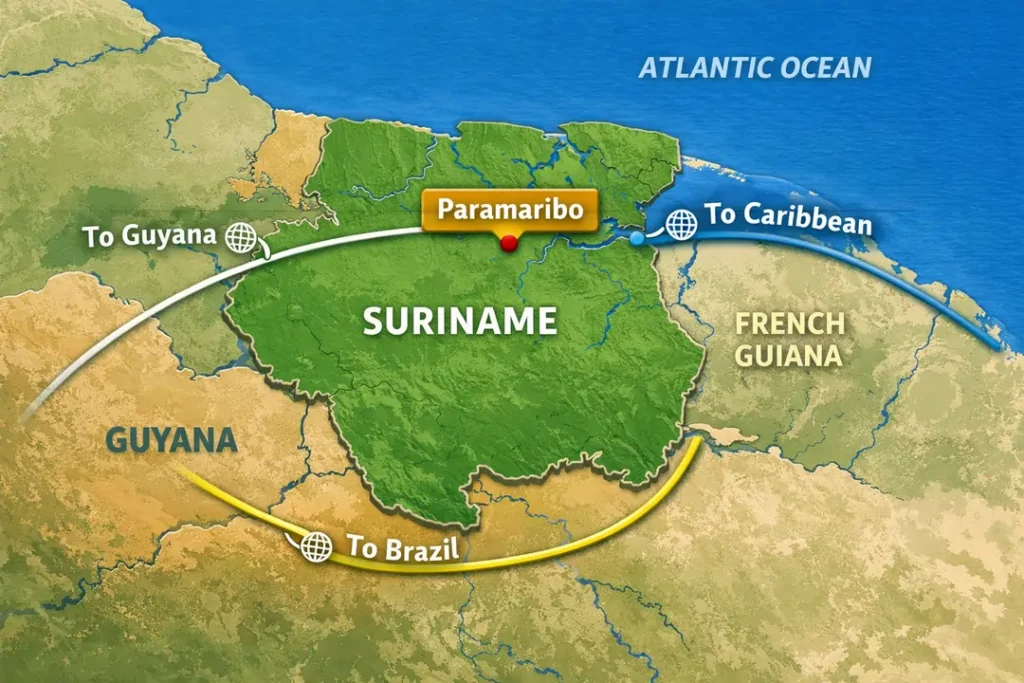
A significant portion of Suriname’s internet traffic is routed internationally. Most connections pass through Brazil or Caribbean hubs. As a result, busy periods can introduce higher latency and packet loss.
However, a properly configured VPN can help stabilise connections. It does this by encrypting traffic and reducing exposure to inefficient or congested routing paths.
In practice, VPNs are commonly used in Suriname to:
- Protect online privacy from ISP-level traffic inspection
- Secure public Wi-Fi networks in hotels, cafés, and airports
- Access overseas services for work, banking, or travel
- Maintain more consistent connections on mobile data networks
If you’re new to VPNs or want a clearer understanding of how they work, our complete guide explaining what a VPN is covers the fundamentals.
Likewise, mobile users may benefit from insights in our mobile VPN performance and battery optimisation guide , which is particularly relevant in Suriname’s mobile-heavy internet environment.
Internet Privacy & Censorship in Suriname (2026)
Suriname does not operate a national internet firewall. It also does not routinely block political websites, social media platforms, or international news outlets. Compared to many other regions, the internet in Suriname remains relatively open.
However, a lack of overt censorship does not automatically translate into strong online privacy protections. Suriname does not currently enforce comprehensive nationwide data-retention or digital privacy regulations comparable to those found in more heavily regulated jurisdictions.
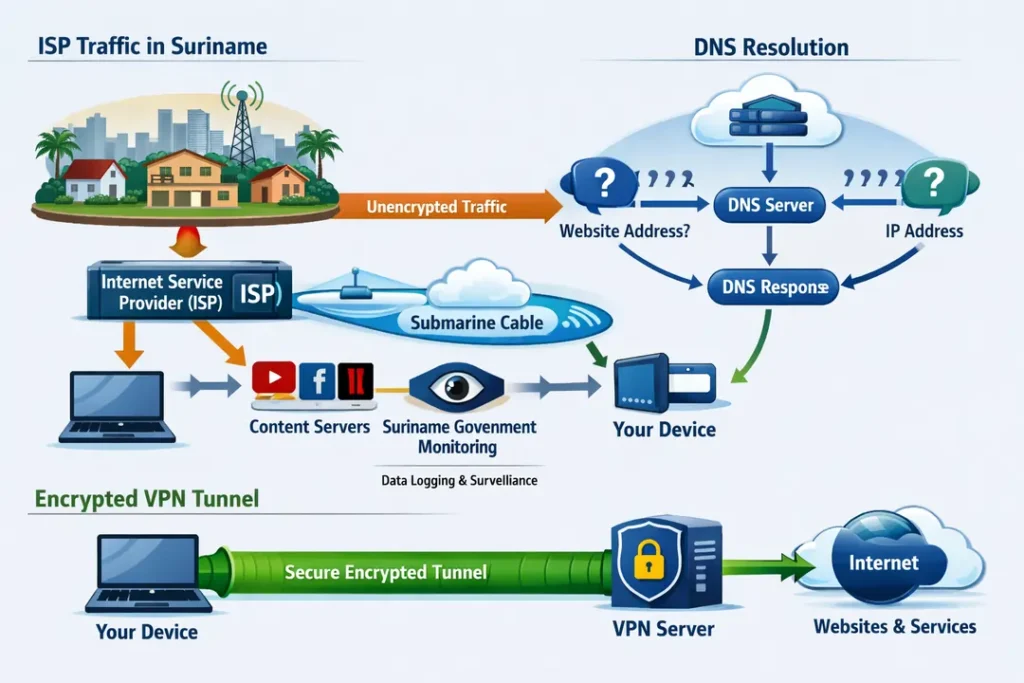
Internet service providers may still collect connection metadata for operational and network management purposes. In particular, mobile networks often rely on traffic optimisation techniques, DNS filtering, and carrier-grade NAT to manage limited international bandwidth and maintain network stability.
While Suriname itself is not considered a high-risk censorship country, its internet environment shares some characteristics with countries highlighted in this global analysis of where VPN use is commonly necessary . This is especially true when it comes to ISP-level visibility and infrastructure constraints.
From a technical perspective, VPNs help reduce these risks by encrypting internet traffic and securing DNS requests. As a result, user activity is far less visible at the network level.
Our gold-standard VPN testing methodology explains how encryption strength, protocol choice, and leak prevention are evaluated when assessing real-world privacy on constrained networks like those found in Suriname.
Overall, VPN use in Suriname is not about bypassing censorship. Instead, it is about maintaining a reasonable expectation of online privacy on networks that prioritise efficiency and traffic management over confidentiality.
How We Tested VPNs for Suriname
Testing VPNs for Suriname requires a different approach than testing in large, well-connected markets. Local infrastructure is limited, and international routing plays a much bigger role.
Because of this, real-world VPN performance depends far more on stability, latency consistency, and protocol efficiency than on raw server counts or advertised speeds.
Our evaluation process follows the same principles outlined in our gold-standard VPN testing methodology . However, we place additional emphasis on mobile network behaviour and long-distance routing reliability, which are critical factors for users in Suriname.
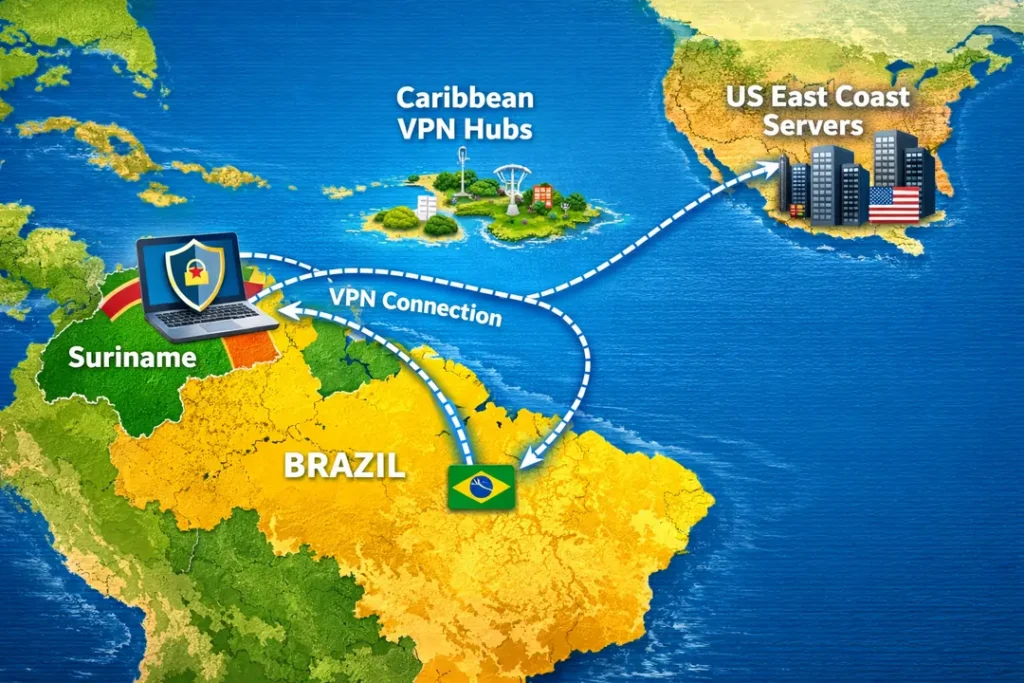
Each VPN was tested under conditions that reflect how people actually connect in Suriname. These conditions included mobile data usage, peak evening congestion, and international traffic routed through Brazil, Caribbean hubs, and North American gateways.
Our testing criteria included:
- Connection stability on mobile and fixed-line networks
- Latency consistency during peak usage hours
- Protocol performance over long-distance routes
- DNS and IP leak protection
- Reliability when reconnecting after brief signal drops
To ensure transparency and repeatability, performance results were benchmarked against the same standards used in our 2026 VPN test results . In addition, findings were cross-referenced with data from our independent lab-tested VPN audits .
Rather than publishing unrealistic headline speed numbers, our recommendations focus on real-world usability. In other words, we assess whether a VPN remains stable, responsive, and reliable enough for everyday use on Suriname’s network conditions.
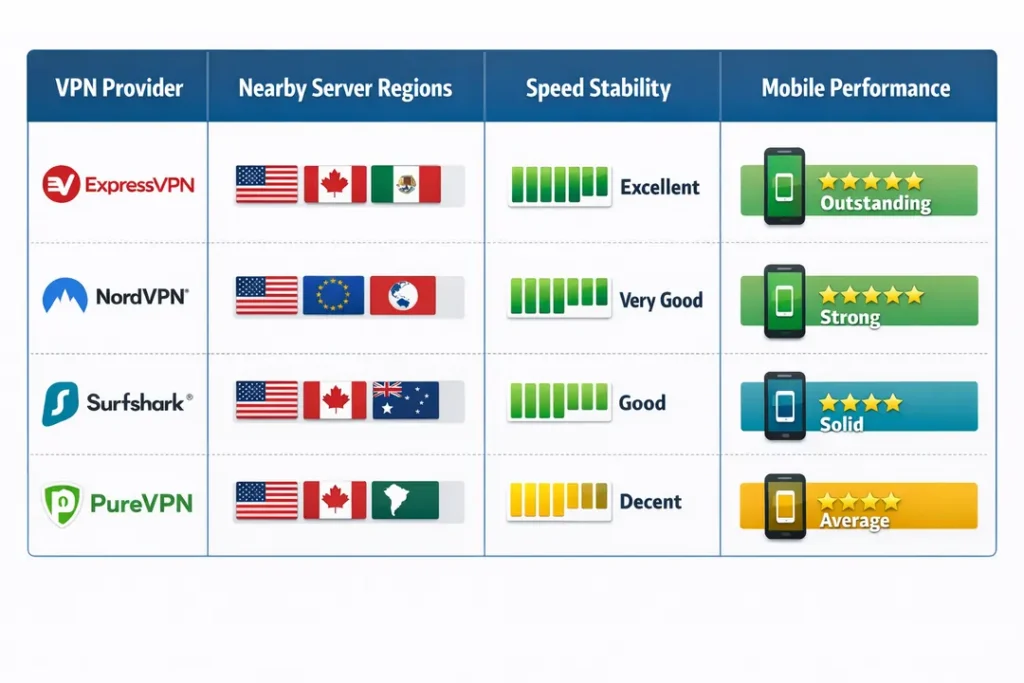
Best VPNs for Suriname (2026)
After evaluating VPN performance under Suriname’s network conditions, the following providers stood out for their ability to maintain stable connections and handle long-distance routing efficiently.
Because Suriname has limited local infrastructure, these recommendations prioritise connection consistency and real-world usability rather than raw server counts or marketing claims.
ExpressVPN – Best Overall VPN for Suriname
Read the full ExpressVPN review
ExpressVPN delivers the most consistent performance for users in Suriname. In particular, it performs well on mobile data connections where signal quality and routing paths can fluctuate.
Its lightweight protocol design helps reduce packet loss. As a result, encrypted tunnels remain stable even during peak congestion periods.
- Strong routing performance to nearby international hubs
- Very stable connections on mobile networks
- Reliable privacy and security features
- Consistent access to international services
NordVPN – Best VPN for Streaming and Speed
NordVPN performs particularly well for users who want fast international access. It is also a strong choice for reliable streaming performance from Suriname.
Its modern protocol implementation helps optimise long-distance speeds. At the same time, strong security standards are maintained.
- Good balance of speed and stability
- Reliable access to major streaming platforms
- Strong performance on desktop and mobile devices
- Well-developed apps across platforms
Surfshark – Best Budget-Friendly VPN for Suriname
Read the full Surfshark review
Surfshark is a solid option for users in Suriname who want modern encryption at a lower cost. It is particularly attractive for households with multiple devices.
While performance can vary during peak hours, overall reliability remains good. This is especially true when connecting to nearby servers.
- Affordable long-term pricing
- Unlimited device connections
- Modern security features
- Easy-to-use applications
PureVPN – Flexible Privacy-Focused Alternative
PureVPN offers a wide range of configuration options and competitive pricing. Therefore, it appeals to users who want more control over their VPN setup.
Performance depends on server selection. However, it remains a viable option for privacy-focused users in Suriname.
- Broad global server coverage
- Strong encryption and privacy tools
- Flexible configuration options
- Competitive pricing plans
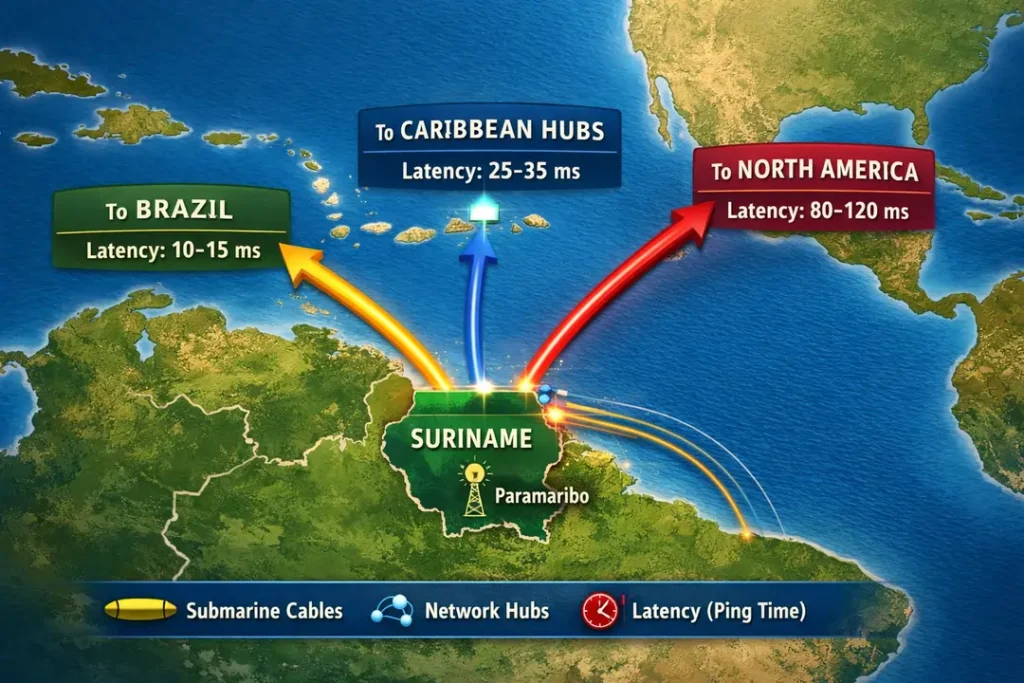
VPN Speed & Performance in Suriname
VPN speed performance in Suriname is shaped primarily by international routing distance and network congestion. Local internet bandwidth plays a much smaller role.
Because Suriname relies heavily on overseas transit routes, latency and packet loss can increase noticeably during peak usage hours. As a result, connection stability often matters more than headline speed figures.
In real-world use, most VPN traffic from Suriname is routed through Brazil, Caribbean hubs, or North American gateways before reaching international services. While this routing is unavoidable, VPN protocol efficiency plays a major role in whether performance remains usable or degrades significantly.
Modern VPN protocols are designed to minimise overhead and recover quickly from unstable connections. Our analysis of WireGuard, OpenVPN, and IKEv2 protocols explains why lightweight protocols tend to perform better over long-distance routes like those commonly used in Suriname.
Users often assume that a VPN will always reduce internet speed. However, this is not always the case.
On congested networks, a VPN can sometimes improve consistency by avoiding inefficient routing paths. This behaviour is explained in our guide on why VPN connections slow down and how protocol choice affects real-world performance.
To achieve the best possible VPN speeds in Suriname, users should:
- Select server locations geographically close to the Caribbean or Brazil
- Use modern, lightweight VPN protocols where available
- Avoid enabling unnecessary security features that add overhead
- Expect slower performance during evening peak hours
Overall, VPN speed in Suriname is best judged by stability and responsiveness rather than raw download numbers. A VPN that maintains consistent performance under fluctuating network conditions will deliver a far better everyday experience than one that only performs well under ideal conditions.


Streaming With a VPN in Suriname
Streaming availability in Suriname is more limited than in North America or Europe. Many platforms offer smaller content libraries or restrict access entirely based on location.
Because of this, a VPN is commonly used to access a wider range of films, series, and live events. This is done by connecting through servers in other countries.
In practice, users in Suriname most often connect to servers in the United States or Europe. However, streaming success depends on more than location alone.
IP reputation, server congestion, and VPN detection systems all play a role. As a result, some VPN connections work reliably while others are frequently blocked.
Our broader analysis of the best VPNs for streaming explains why certain VPNs consistently work with major platforms. This is especially relevant in regions like Suriname, where users rely almost entirely on international servers.
Netflix is one of the most commonly accessed platforms using a VPN in Suriname. Depending on the server location, users may be able to access different regional libraries.
Our guide to using a VPN with Netflix breaks down which regions are typically the most reliable. It also explains common issues users may encounter.
VPNs are also widely used in Suriname to access other international streaming services and devices. For users watching on TVs or media players, compatibility is particularly important.
Our recommendations for VPNs that work well with Fire TV and streaming devices highlight the importance of stable long-distance connections and reliable app support.
For the best streaming experience when using a VPN in Suriname, users should:
- Connect to servers close to the streaming service’s home region
- Switch servers if a platform stops loading or displays an error
- Avoid peak local hours when international routing is congested
- Ensure the VPN app supports the device being used for streaming
While a VPN cannot guarantee uninterrupted access to every streaming platform at all times, choosing a service optimised for streaming and configuring it correctly can significantly improve access and reliability from Suriname.
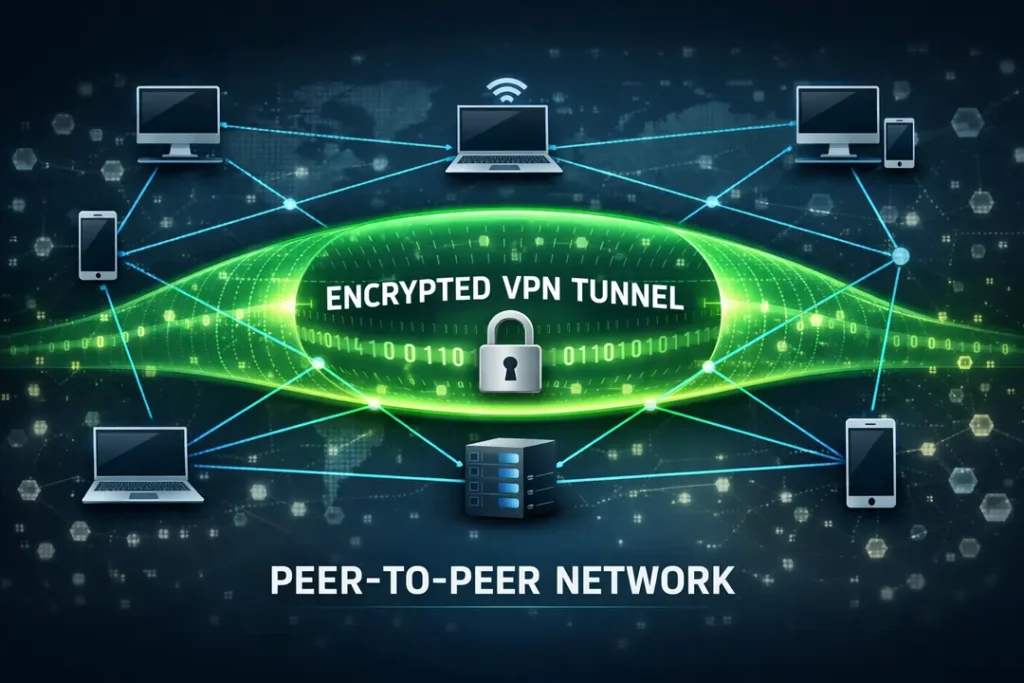
Torrenting & P2P Use in Suriname
Torrenting and peer-to-peer (P2P) file sharing in Suriname exists in a legal gray area. There is limited public information about aggressive enforcement.
However, internet service providers are still capable of monitoring unencrypted traffic. This is especially true on international routes where bandwidth is constrained.
Because much of Suriname’s internet traffic is routed through overseas hubs, P2P activity can be more visible to network operators than in larger markets. As a result, privacy and traffic encryption become especially important.
This is particularly relevant for users who rely on torrenting for legitimate purposes. Examples include downloading open-source software or large public datasets.
Our in-depth guide on VPNs that support torrenting safely explains which technical features matter most for P2P use. These include kill switches, DNS leak protection, and clear policies around activity logging.
One common misconception is that any VPN automatically makes torrenting safe. In reality, free or poorly configured VPNs can introduce additional risks.
These risks may include IP leaks and unwanted traffic exposure. Our comparison of free VPNs versus paid VPN services outlines why paid services generally offer stronger protections for sustained P2P activity.
Users experiencing connection drops or stalled downloads may also encounter general VPN configuration issues. In these cases, basic troubleshooting can often restore stability.
Our VPN troubleshooting guide covers common problems such as unstable tunnels, protocol mismatches, and DNS-related errors.
Overall, using a VPN for torrenting in Suriname is less about speed. Instead, it is about maintaining consistent encryption and connection stability.
Users should ensure their VPN is correctly configured before engaging in any P2P activity. Doing so significantly reduces avoidable privacy and reliability risks.
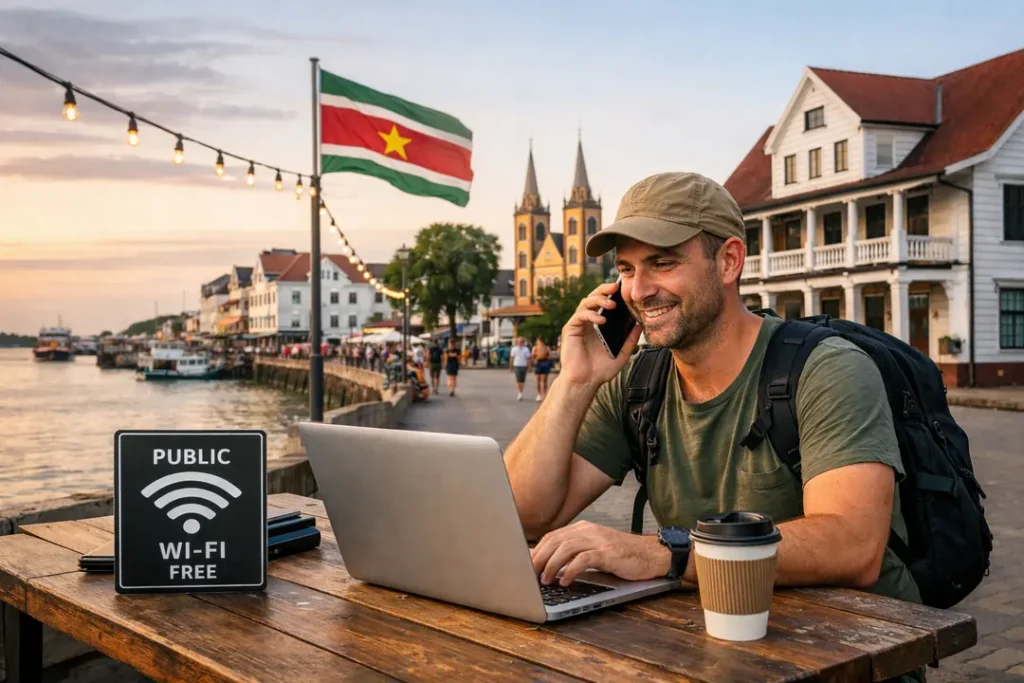
Best VPN for Travelers & Expats in Suriname
Travelers and expats in Suriname often rely on public or semi-public internet connections. These include hotel Wi-Fi, cafés, coworking spaces, and mobile data networks.
While these connections are generally accessible, they are not always secure or reliable. For this reason, using a VPN is an important precaution.
A VPN helps protect sensitive activity such as online banking, work logins, and email access. It does this by encrypting traffic on unsecured networks.
This is particularly relevant for visitors who need to maintain access to services from their home country while staying in Suriname.
For a broader overview of how VPNs are used while moving between countries, our guide to VPNs for travelling explains common use cases. These include airport Wi-Fi, hotel networks, and cross-border access to online services.
Expats living in Suriname for extended periods often use a VPN to maintain consistent access to overseas platforms. Common examples include work tools, streaming services, and communication apps.
Our analysis of VPNs designed for expats highlights the importance of long-term stability, device compatibility, and reliable international routing.
Because mobile internet plays a central role in everyday connectivity in Suriname, battery efficiency and background performance are also important considerations.
As a result, mobile users may find our mobile VPN battery optimisation guide useful when choosing and configuring a VPN for daily use.
For travelers and expats alike, the most effective VPN setup in Suriname is one that balances security, stability, and ease of use. This ensures protection without adding unnecessary complexity to everyday internet access.
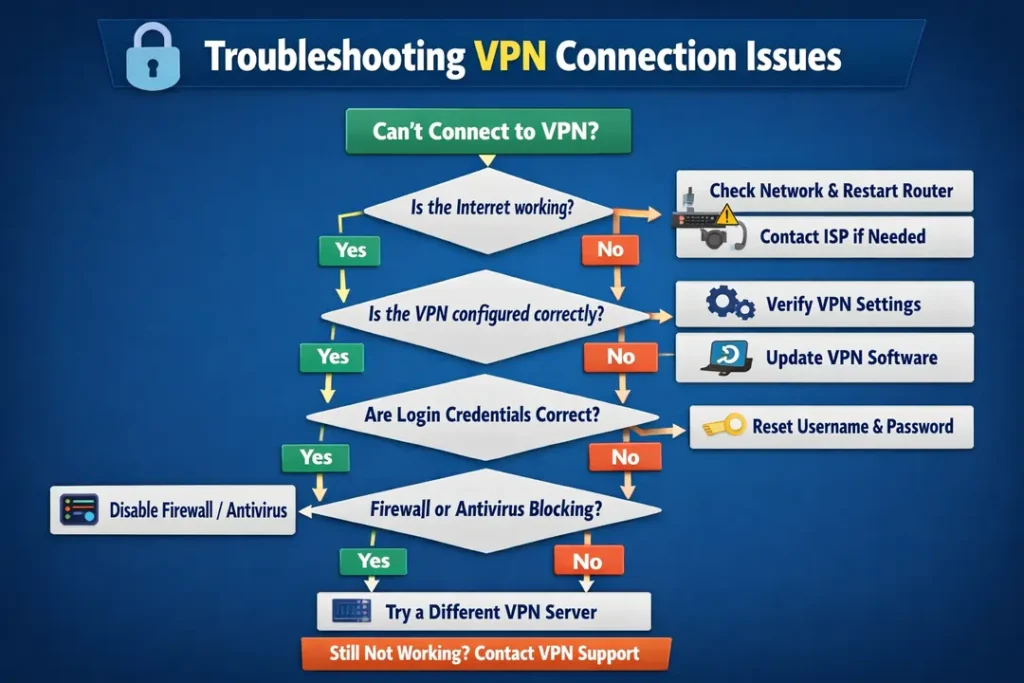
Common VPN Problems in Suriname (And How to Fix Them)
VPN users in Suriname may occasionally encounter connection issues. These are often caused by international routing congestion, mobile network instability, or incorrect configuration.
In most cases, these problems are technical rather than intentional blocking. For this reason, many issues can be resolved with simple adjustments.
One of the most common problems is a VPN connecting successfully but providing little or no internet access. This issue is often related to protocol mismatches or DNS resolution problems on mobile networks.
Switching to a different protocol or server location can usually restore connectivity. In addition, restarting the VPN app may help re-establish a stable tunnel.
Another frequent problem is repeated disconnections. This occurs most often on mobile data connections where signal strength fluctuates.
In these situations, adjusting VPN settings to prioritise stability over speed can help reduce dropouts. This is especially effective during periods of poor network quality.
Users who experience slow speeds while connected to a VPN should also consider network congestion. International routes can amplify performance issues during peak usage hours.
Our professional VPN troubleshooting guide outlines practical steps for diagnosing speed drops, latency spikes, and unstable tunnels.
In some cases, problems may stem from outdated apps or device-level network settings rather than the VPN itself. Therefore, ensuring the VPN application is up to date and restarting the device can resolve many intermittent issues.
While VPN issues can be frustrating, most problems encountered in Suriname are manageable. Understanding how VPNs interact with mobile and international networks is key to maintaining a stable and secure connection.
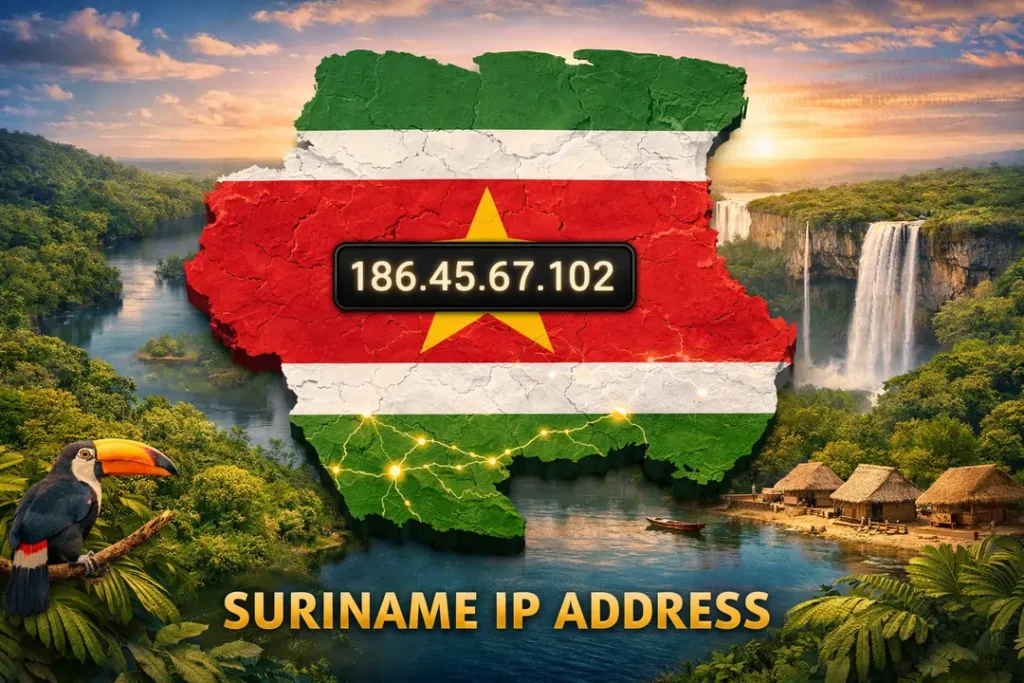
Suriname IP Address: What It Is & Why It Matters
A Suriname IP address identifies your internet connection as originating from within Suriname. Websites and online services use IP addresses to determine a user’s geographic location.
Because of this, your IP address can affect access to content, pricing, language settings, and security checks.
When you connect to the internet normally, your IP address is assigned by your local internet service provider. As a result, it can reveal your approximate location.
Using a VPN allows you to change or mask this IP address. In some cases, the VPN replaces it with one from another country. In other cases, it retains a local Suriname IP while encrypting your traffic.
There are several practical benefits to using a VPN with respect to your IP address in Suriname:
- Improved privacy: A VPN hides your real IP address from websites and third parties. This helps reduce tracking and location-based profiling.
- Secure access to local services: Keeping a Suriname IP can be useful when accessing local websites or services that restrict users outside the country.
- Protection on public networks: Masking your IP helps prevent exposure when using public Wi-Fi in hotels, cafés, or airports.
- Reduced targeting and throttling: Some traffic management systems rely on IP identification. A VPN can help minimise this by encrypting traffic.
For users outside Suriname, accessing services that expect a Suriname-based IP may require connecting through servers that route traffic appropriately.
Meanwhile, users inside the country may change IP locations to access international platforms. At the same time, their online activity remains private.
Overall, understanding how IP addresses work is essential. Knowing how a VPN changes or protects them helps maintain privacy, security, and reliable access to online services in and outside Suriname.
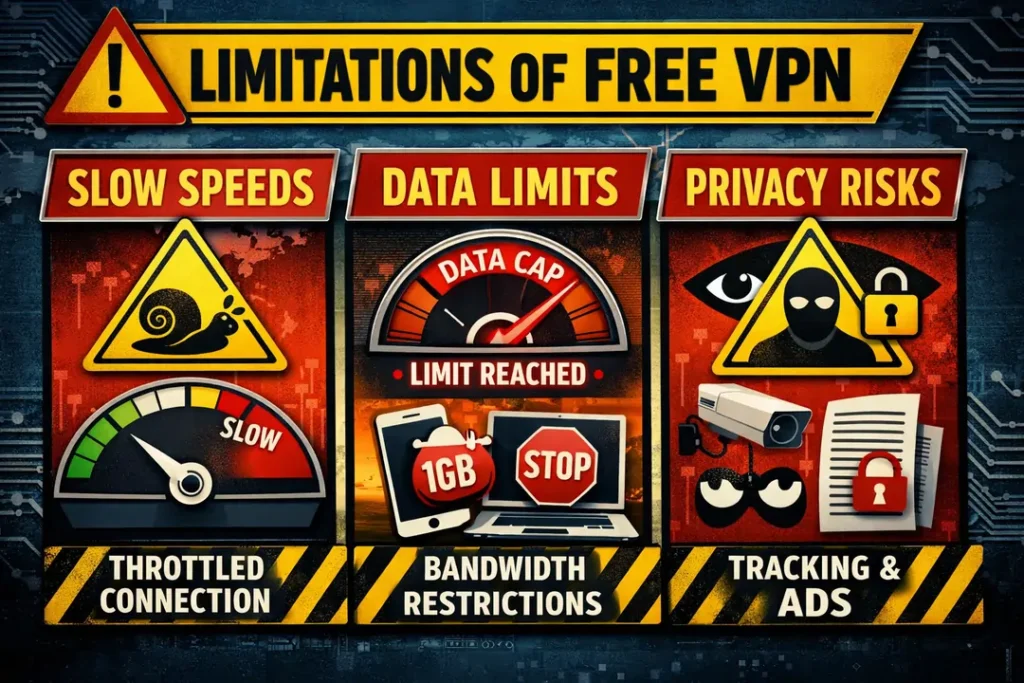
Free VPNs in Suriname: What You Should Know
Free VPNs may seem appealing in Suriname. This is especially true for users who want basic privacy without paying for a subscription.
In practice, however, free VPN services tend to perform poorly. Suriname’s bandwidth-constrained and mobile-heavy internet infrastructure amplifies these weaknesses.
Most free VPNs impose strict data caps, speed limits, or restricted server access. When combined with long-distance international routing, these limitations often lead to slow speeds, unstable connections, and frequent dropouts.
Privacy is another major concern. Many free VPNs rely on advertising, data collection, or unclear logging practices to sustain their operations.
Our comparison of free VPNs versus paid VPN services explains why paid VPNs generally provide stronger privacy protections. They also deliver more consistent performance.
While not every free VPN is unsafe, choosing one requires caution. For this reason, users should understand the minimum standards a free service must meet.
Our guide to free VPNs that aren’t scams outlines what to look for before trusting a no-cost VPN service.
Some VPN services should be avoided entirely due to poor security practices or misleading claims. Our regularly updated list of VPNs to avoid in 2026 highlights warning signs that are especially relevant in smaller markets like Suriname.
For users in Suriname, free VPNs are usually suitable only for very limited, short-term use. Overall, a properly configured paid VPN offers better privacy, stronger reliability, and more dependable access to international services.
FAQs: VPN Use in Suriname
Is using a VPN legal in Suriname?
Yes. Using a VPN is legal in Suriname. There are currently no laws that restrict or prohibit VPN usage for personal privacy, security, or access to online services. VPNs are commonly used by residents, travelers, and businesses without legal issues.
Why do people in Suriname use a VPN?
Most people use a VPN in Suriname to improve privacy, secure public Wi-Fi connections, and access international services more reliably. VPNs are also used to reduce exposure to ISP-level monitoring and to stabilise connections during periods of network congestion.
Do VPNs work on mobile networks in Suriname?
Yes, VPNs generally work on mobile networks in Suriname. However, mobile connections can be unstable at times, so VPNs that prioritise connection resilience and fast reconnection tend to perform better than those optimised only for raw speed.
Will a VPN slow down my internet connection in Suriname?
A VPN can add some overhead, but in Suriname the bigger factor is international routing congestion. In some cases, a VPN can actually improve connection consistency by avoiding inefficient or overloaded network paths, especially during peak hours.
Can I use a VPN for online banking in Suriname?
Yes, a VPN can be used for online banking. That said, some banks may flag logins from foreign IP addresses as a security precaution. If this happens, temporarily disconnecting the VPN usually resolves the issue.
Do I need a VPN if I’m only visiting Suriname?
Travelers often benefit from using a VPN in Suriname to secure hotel and café Wi-Fi, access services from their home country, and protect personal data while on unfamiliar networks.
Are free VPNs safe to use in Suriname?
Free VPNs can work for very limited use, but they often come with data limits, slower speeds, and weaker privacy protections. For regular use or sensitive activity, a paid VPN is generally the safer and more reliable option in Suriname.
Final Verdict: Best VPN for Suriname
The best VPN for Suriname is one that prioritises connection stability, strong encryption, and reliable international routing rather than flashy features or inflated speed claims. Because Suriname relies heavily on overseas network routes and mobile connectivity, consistency matters far more than peak performance.
A high-quality VPN can significantly improve everyday internet use in Suriname by stabilising connections during congestion, securing public and mobile networks, and protecting online activity from unnecessary exposure. This is especially important for users who rely on international services for work, banking, streaming, or communication.
While free VPNs may be tempting, they are rarely suitable for Suriname’s network conditions and often introduce additional privacy or reliability risks. For regular use, a properly configured paid VPN offers better security, fewer interruptions, and a more dependable experience.
Whether you live in Suriname, are visiting temporarily, or need stable access to services from abroad, a VPN should be viewed as a practical tool for privacy and network reliability. Choosing a service designed to handle long-distance routing and mobile networks will deliver the best results in real-world use.
Regional VPN Guides: South America
If you’re travelling across South America or comparing VPN performance between neighbouring countries, these regional guides provide country-specific insights into internet conditions, privacy expectations, and real-world VPN reliability.
For a continent-wide overview covering infrastructure, routing challenges, and VPN performance trends, see our dedicated South America hub:
You may also find these nearby country guides useful:
- Best VPN for Brazil
- Best VPN for Venezuela
- Best VPNs for Colombia
- Best VPN for Guyana
- Best VPN for Peru
Each country guide focuses on local network conditions, legal considerations, and which VPN features matter most in that specific environment.