


South America VPN Hub — Why This Region Requires a Different Approach
South America is one of the most misunderstood regions in VPN coverage. It is routinely treated as a single market, despite having some of the widest real-world variance in infrastructure, routing behaviour, and privacy expectations of any continent.
A VPN configuration that feels stable and predictable in Chile or Uruguay can behave very differently in Brazil, Bolivia, or Venezuela. These differences are not edge cases — they are structural.
The problem with most “best VPN for South America” advice is that it assumes consistent routing, uniform ISP behaviour, and similar risk profiles across borders. None of those assumptions hold true here.
This hub exists to do what generic VPN roundups cannot: frame South America as a regional connectivity problem, then break it down into country-level realities where practical decisions are actually made.
Three forces shape VPN performance across South America more than provider feature lists:
- Infrastructure variance: Countries with modern fibre and strong peering coexist alongside mo

How Internet Access Actually Varies Across South America
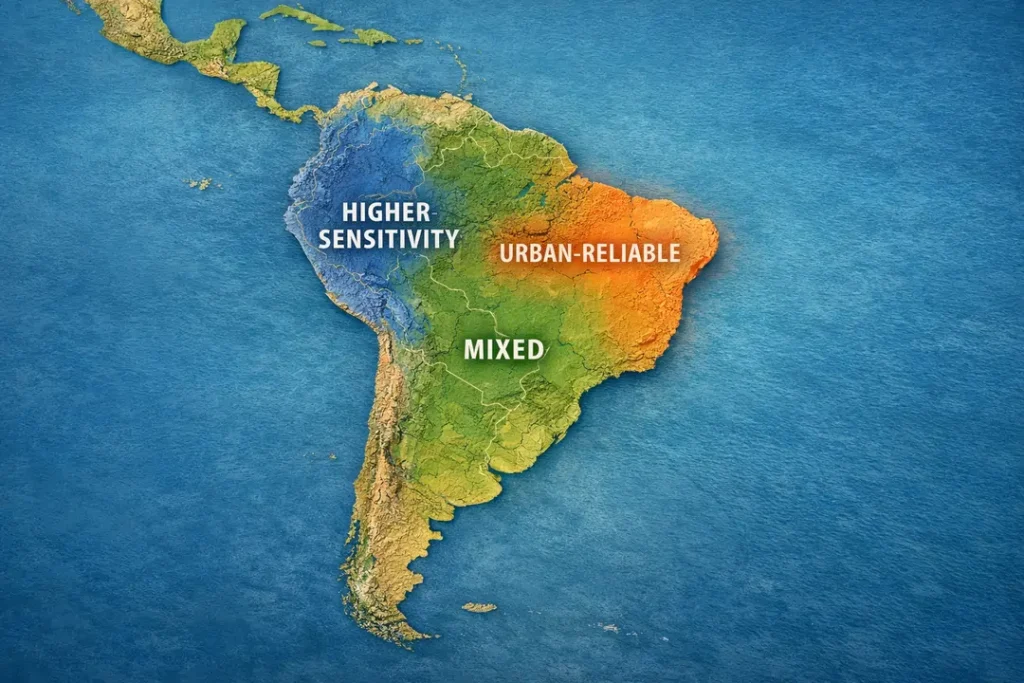
South American internet access does not fail in a single way — it varies by
country, by city, and often by ISP.
For VPN users, these differences determine whether a connection feels seamless
or fragile.
Based on infrastructure maturity, congestion behaviour, and cross-border routing
consistency, South American countries broadly fall into three connectivity profiles.
These are not rankings — they are operational realities.
Urban-Reliable / Developed Networks
These environments feature modern fibre deployment, stable mobile networks,
and relatively predictable routing inside major urban areas.
VPN performance here is close to what users expect in Europe or parts of North America.
- Typical countries:
Chile,
Uruguay,
Argentina (urban) - VPN focus: Speed consistency, protocol efficiency
- Common use cases: Streaming, remote work, everyday privacy
The limitation is reach. Outside major cities, performance can degrade rapidly,
particularly on regional broadband and older mobile infrastructure.
Mixed / Variable Infrastructure
These countries combine strong metropolitan backbones with
congestion-prone regional networks and inconsistent ISP routing.
VPN performance here depends far more on resilience
than raw throughput.
- Typical countries:
Brazil,
Colombia,
Peru,
Ecuador - VPN focus: Congestion handling, routing flexibility
- Common use cases: Mobile data, travel, public Wi-Fi
In these environments, a VPN that handles packet loss and fluctuating latency
will outperform faster services that lack routing intelligence.
Higher-Sensitivity / Restricted Environments
These environments face infrastructure limitations, economic pressure,
or heightened scrutiny of network traffic.
VPN usage here prioritises privacy and continuity over performance.
- Typical countries:
Venezuela,
Bolivia (partial) - VPN focus: Encryption strength, metadata protection
- Common use cases: Privacy-first access, reliable connectivity
In these countries, legality does not equal safety.
How a VPN behaves under network pressure matters more than headline features.
These three profiles explain why regional VPN recommendations often fail.
The next section focuses on VPNs that scale across borders
before narrowing into country-specific guidance.
Best VPNs for South America (Regional Shortlist)
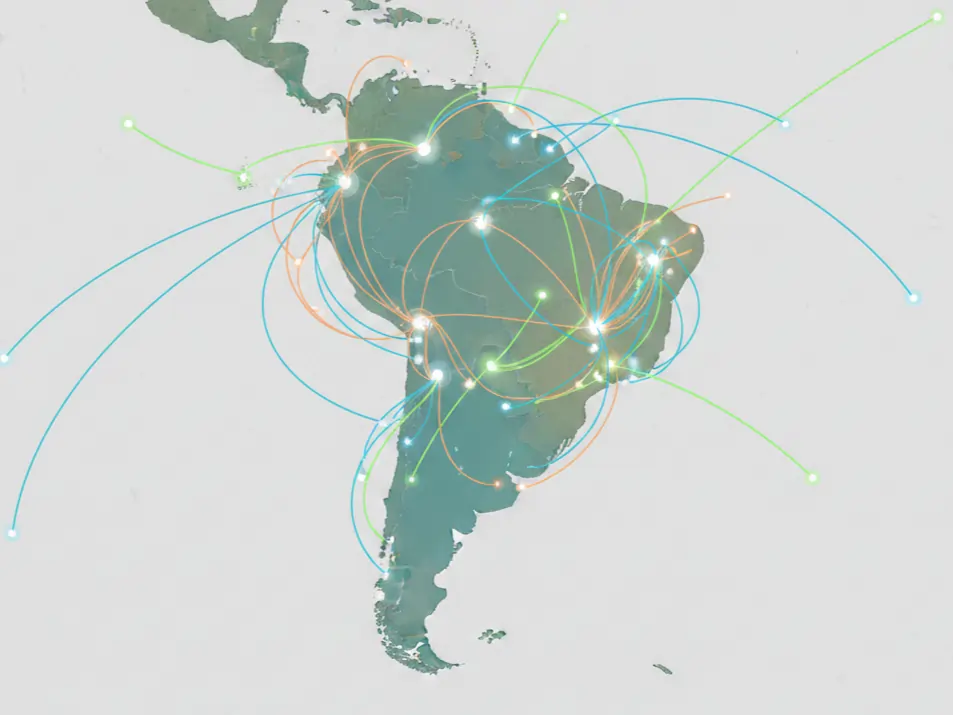
This shortlist identifies VPN providers that scale reliably across South America. It is not a country-by-country ranking and it does not assume uniform infrastructure. The focus here is cross-border performance — how a VPN behaves when networks, ISPs, and routing paths change between countries.
In South America, VPN performance is shaped less by advertised speeds and more by routing intelligence, congestion handling, and protocol resilience. Providers that perform well in one country but fail to adapt across borders are filtered out at this stage.
All providers listed below have been evaluated using comparative testing, real-world routing scenarios, and audited methodology. For full transparency, see the VPN comparison table and lab-tested audit overview.
| VPN | Why it scales regionally | Cross-border reliability | Best suited for |
|---|---|---|---|
| ExpressVPN | Strong routing control, consistent protocol behaviour, and resilience when ISPs or connection types change mid-session. | Excellent | Frequent travellers, expats, border crossings |
| NordVPN | Large global network with strong WireGuard implementation, offering reliable performance across major South American corridors. | Very good | Remote work, streaming, balanced everyday use |
| Surfshark | Cost-efficient scaling with solid mobile performance and flexible multi-device support across changing networks. | Good | Longer stays, mobile-first users, value-focused setups |
This shortlist reflects regional survivability, not perfection. Performance will still vary depending on country, city, ISP, and time of day. That variation is addressed in the country-specific guides linked below.
For deeper performance context and how these providers compare under controlled conditions, refer to the gold-standard testing methodology and 2026 performance test results.
The next section breaks down how VPNs are actually used across South America — from border crossings and mobile SIM changes to remote work and streaming — before narrowing into country-level recommendations.
How VPNs Are Actually Used Across South America
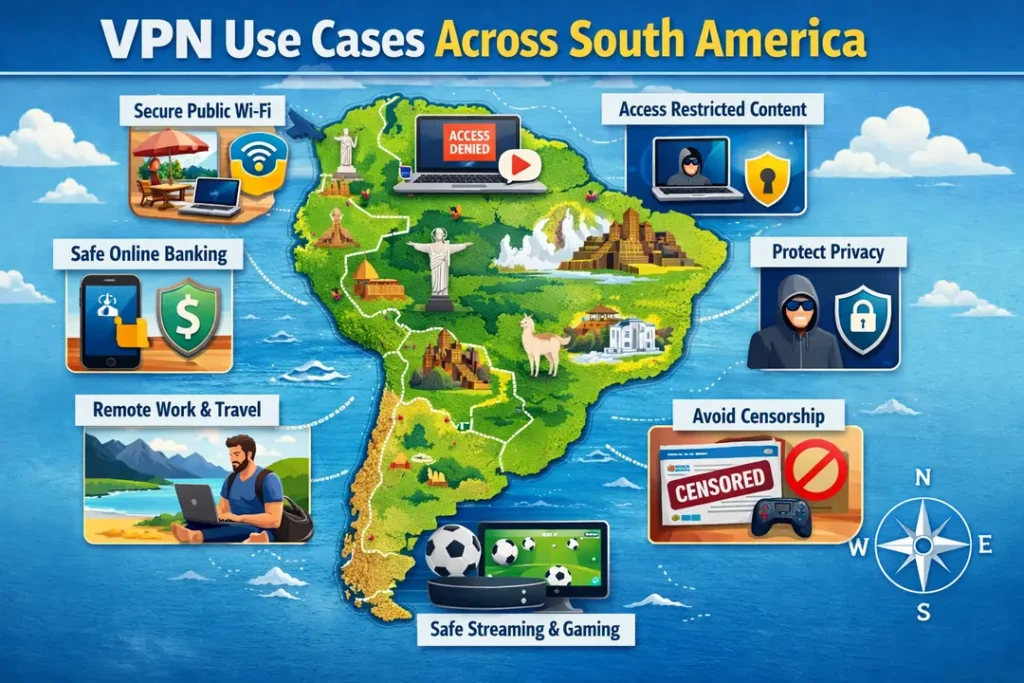
VPN usage across South America is shaped less by ideology and more by practical connectivity realities. Travel patterns, mobile-first access, shared networks, and uneven infrastructure define how and why VPNs are used day to day.
This section focuses on real use cases rather than abstract feature lists, highlighting where VPNs provide meaningful value across the region.
Travel and Border Crossings
South America is one of the few regions where crossing a border can materially change how your internet connection behaves. SIM replacements, differing ISP routing policies, and inconsistent roaming agreements regularly disrupt access.
VPNs are commonly used to:
- Maintain access to banking and email services while switching SIM cards
- Stabilise connections on hotel and airport Wi-Fi networks
- Avoid sudden geo-based service restrictions when crossing borders
For users moving frequently between countries, consistency matters more than peak speed. This is why cross-border reliability is prioritised in the regional VPN shortlist.
Practical travel considerations are covered in more detail in the VPNs for travelling guide.
Remote Work and Expats
Remote workers and expats represent a large share of VPN users in South America. While major cities often provide adequate baseline connectivity, performance can vary sharply by ISP, neighbourhood, and time of day.
VPNs are typically used to:
- Secure access to cloud tools and internal work platforms
- Improve connection stability on shared or congested networks
- Maintain access to financial services tied to home countries
Expectations need to be realistic. VPNs cannot compensate for weak infrastructure, and in some cases they can introduce additional latency. Understanding why VPNs slow down helps avoid poor protocol choices and misconfiguration.
Users working long-term from the region should also review the best VPNs for expats guide and the fastest VPNs overview for performance context.
Streaming and Entertainment
Streaming behaviour across South America is highly fragmented. Content libraries vary by country and platform, while performance differences between urban and regional networks remain significant.
VPNs are most effective for streaming when:
- Users are based in urban areas with stable broadband connections
- Viewing takes place outside peak evening congestion windows
- The VPN has reliable access to the required streaming region
In rural or mobile-first environments, streaming reliability drops sharply, even when using a high-quality VPN. This is why streaming expectations differ substantially between countries such as Chile and Venezuela, and why country-specific guidance matters.
For platform-specific limitations and access considerations, see the streaming VPN overview or the dedicated Netflix VPN guide.
These use cases reinforce a consistent theme across South America: VPNs deliver the best results when they are selected and configured for local conditions. The next section addresses privacy, legality, and realistic expectations around VPN use across different countries in the region.
Privacy, Legality, and Realistic Expectations Across South America
VPNs are generally legal across South America, but legality alone does not determine how VPNs are used — or how much privacy they actually provide. Everyday expectations vary widely depending on infrastructure quality, shared network usage, and local enforcement culture.
One of the most common mistakes users make is assuming that a legal VPN automatically guarantees privacy. In South America, that assumption often breaks down in practice.
VPN Legality: Broadly Permitted, Locally Interpreted
In most South American countries, there are no explicit laws banning VPN usage. Businesses, remote workers, and individuals routinely use VPNs for legitimate purposes such as securing connections, accessing work tools, or protecting data on public Wi-Fi.
However, legality does not imply uniform treatment. Enforcement priorities, ISP behaviour, and network monitoring practices differ by country, and sometimes by provider.
This is particularly relevant in environments where infrastructure is limited or politically sensitive. In those cases, VPN usage tends to be more cautious, even when it is not formally restricted.
Shared Networks and Everyday Privacy
Shared networks are common throughout South America. Apartment buildings, co-working spaces, cafés, and hotels often rely on shared broadband connections with minimal segmentation.
In these environments, VPNs are primarily used to:
- Prevent local network snooping
- Protect credentials and session data
- Reduce exposure on poorly secured Wi-Fi networks
Understanding what a VPN actually does — and what it does not do — is essential for setting realistic expectations, especially when using public or shared infrastructure.
Free VPNs, Paid VPNs, and Regional Risk
Free VPN usage is widespread in parts of South America, often driven by cost sensitivity and mobile-first access. Unfortunately, this is also where the privacy trade-offs are most severe.
Many free VPN services rely on aggressive logging, injected advertising, or opaque data-sharing practices. In regions where privacy expectations already vary, these risks are amplified.
This is why understanding the difference between free and paid VPNs — and knowing which free services are not outright scams — is particularly important for users in South America. A dedicated breakdown is available in the free VPN safety guide.
Protocols, Metadata, and Practical Privacy
In higher-sensitivity environments, privacy depends less on brand names and more on how a VPN handles metadata, connection drops, and protocol behaviour.
Choosing the right protocol can significantly affect both reliability and exposure. Users operating in constrained or sensitive networks should pay close attention to protocol behaviour rather than default settings.
For a deeper explanation of how different protocols behave, see the VPN protocol comparison guide and the overview of protocols suited to restricted environments.
Privacy expectations across South America are shaped by context. This is why the following section focuses on country-level guidance, where infrastructure, enforcement posture, and everyday usage patterns can be addressed directly.
South America VPN Country Guides
While this hub explains how VPNs behave across South America as a region, real-world decisions are made at the country level. Infrastructure quality, ISP behaviour, privacy expectations, and everyday usage patterns vary enough that country-specific guidance is essential.
The guides below break down VPN usage by country, focusing on local connectivity conditions rather than generic recommendations. Each page covers internet reliability, legality tone, everyday VPN use, streaming expectations, and practical troubleshooting.
| Country | Connectivity profile | Typical VPN use case | Guide |
|---|---|---|---|
| Brazil | Large, mixed infrastructure with significant urban–regional variance | Stability, congestion handling, streaming access | View guide |
| Argentina | Strong urban networks with weaker regional consistency | Expats, financial access, everyday privacy | View guide |
| Chile | Stable, modern infrastructure with good international routing | Streaming, remote work, low-latency access | View guide |
| Colombia | Improving urban networks with variable regional performance | Mobile data security, public Wi-Fi use | View guide |
| Peru | Mixed broadband quality, mobile-first outside major cities | Reliability, congestion management | View guide |
| Ecuador | Moderate infrastructure with regional drop-offs | Secure everyday use, travel connectivity | View guide |
| Uruguay | Consistently strong urban connectivity | Speed consistency, streaming | View guide |
| Paraguay | Limited infrastructure outside major population centres | Privacy, stable cross-border routing | View guide |
| Bolivia | Partial infrastructure with higher variability | Cautious VPN usage, reliability | View guide |
| Venezuela | High-sensitivity environment with unstable access | Privacy-first access, connection continuity | View guide |
| Guyana | Small market with limited local routing options | Secure access to international services | View guide |
| Suriname | Regionally constrained networks with limited peering | Stability, cross-border access | View guide |
If you are travelling between countries or experiencing inconsistent VPN behaviour, the next section addresses common issues such as congestion, network switching, and blocked connections.
Troubleshooting VPN Issues While Traveling in South America
VPN issues in South America are rarely random. Most problems stem from predictable factors such as network switching, congestion, ISP behaviour, or restrictive Wi-Fi configurations.
Understanding these patterns makes troubleshooting far more effective than repeatedly changing providers or assuming the VPN itself is broken.
Border Crossings and SIM Changes
Switching countries often means switching SIM cards, mobile networks, and routing paths simultaneously. This can disrupt existing VPN tunnels or cause sudden drops in performance.
Common symptoms include failed connections, unusually high latency, or services behaving as if the VPN is disconnected.
In most cases, reconnecting the VPN after the network change and allowing it to establish a fresh tunnel resolves the issue. Persistent problems usually indicate protocol mismatch rather than account or device faults.
Congestion and Time-of-Day Slowdowns
Evening congestion is a recurring issue across much of South America, particularly in mixed-infrastructure countries. VPN performance may degrade sharply during peak hours even if baseline speeds appear acceptable earlier in the day.
When this happens, slower but more resilient protocols often outperform those optimised for peak throughput. This is not a VPN failure — it is a response to unstable network conditions.
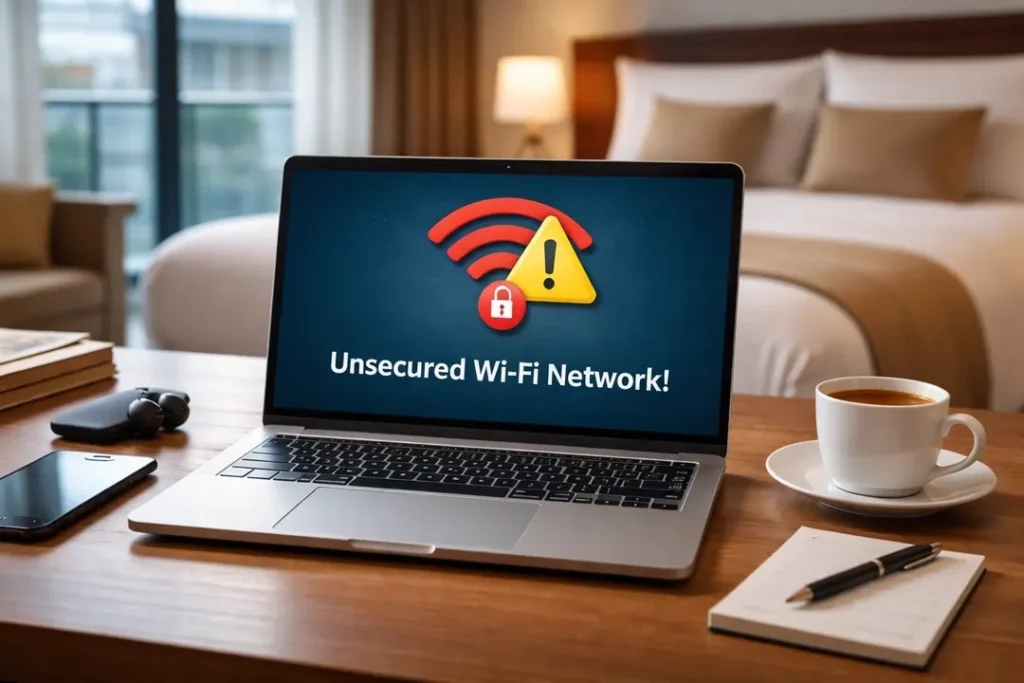
Hotel and Apartment Wi-Fi Restrictions
Many hotels, serviced apartments, and shared buildings apply aggressive firewall rules or bandwidth shaping. VPN traffic may be throttled, deprioritised, or blocked entirely.
These environments commonly interfere with default VPN settings. Switching protocols or reconnecting after authentication often restores access without further intervention.
Streaming Access Failures
Streaming issues are frequently misattributed to VPN quality. In reality, they are more often caused by regional licensing differences, ISP congestion, or limited local bandwidth.
Streaming reliability varies widely by country and city. This is why performance that feels stable in one location may break down completely in another, even when using the same VPN and device.
When to Escalate Troubleshooting
If issues persist across multiple networks and locations, deeper configuration review may be required. This includes protocol selection, DNS handling, and device-level interference.
A structured diagnostic approach is outlined in the VPN troubleshooting guide, which covers advanced scenarios without relying on guesswork.
With troubleshooting covered, the final section summarises why this hub exists and how to use it effectively alongside the country-specific guides.
Final Thoughts: How to Use This Hub Effectively
South America does not reward one-size-fits-all VPN advice. Infrastructure quality, routing behaviour, privacy expectations, and everyday usage patterns vary enough that regional shortcuts consistently lead to poor outcomes.
This hub exists to establish the regional context — explaining why VPN performance changes across borders, which providers scale reliably, and how common use cases differ throughout the continent. It is not designed to replace local guidance.
If you are choosing a VPN for a specific country, the most important step is to move into the country-specific guide. Those pages address local infrastructure conditions, legality tone, realistic streaming expectations, and practical troubleshooting in far greater detail.
Use this page to understand the landscape. Use the country guides to make decisions. That separation is intentional — and it is what makes the information here reliable rather than generic.