

North America is one of the most digitally developed regions in the world, but that does not mean VPN needs are uniform across the United States, Canada, and Mexico. Each country operates under different privacy laws, data retention policies, and online access norms.
In this region, VPN use is driven less by basic connectivity and more by privacy expectations, surveillance frameworks, streaming restrictions, and cross-border access. A setup that works well in the United States may not be optimal for Canada, and travel between the two can introduce unexpected access or policy differences.
Mexico adds a different dimension altogether. While internet access is widely available, public Wi-Fi usage, travel connectivity, and shared networks play a much larger role in everyday online activity.
This North America hub provides a regional overview and directs you to country-specific guides that reflect how VPN use actually works on the ground — whether you’re based in one country, moving between borders, or relying on multiple networks for work, travel, or streaming.

How VPN Needs Differ Across North America
Although the United States, Canada, and Mexico share geographic proximity and high levels of internet access, VPN usage across North America is shaped by very different legal frameworks, online ecosystems, and day-to-day connectivity habits.
Understanding these differences is essential. A VPN setup that works well in one country may be inefficient, unnecessary, or even disruptive in another.
United States — Surveillance, Streaming & Scale
The United States has one of the most developed digital ecosystems in the world, but it also operates under extensive data collection and surveillance frameworks. VPN use here is driven primarily by privacy protection, streaming access, and performance on large-scale networks.
- High demand for access to international and regional streaming libraries
- Privacy concerns related to data retention and online tracking
- Heavy use of VPNs on home broadband, corporate networks, and mobile data
VPNs that perform best in the US tend to prioritise speed, low latency, and reliable access to streaming platforms.
Country guide: Best VPN for the USA (2026)
Canada — Privacy Expectations & Compliance
Canada offers stable internet access and generally stronger consumer privacy protections than the US. VPN use is common among privacy-conscious users, remote workers, and travelers who frequently move between Canada and the United States.
- Greater emphasis on privacy and data handling
- Cross-border access to US-based services
- Consistent performance on urban broadband and mobile networks
In Canada, VPN choice often focuses less on bypassing restrictions and more on maintaining privacy while accessing international platforms and services.
Country guide: Best VPN for Canada (2026)
Mexico — Travel, Public Wi-Fi & Mixed Use
Mexico introduces a different set of VPN requirements. While internet access is widely available, public and shared Wi-Fi plays a much larger role for travelers, digital nomads, and short-term residents.
- Heavy reliance on hotel, café, and apartment Wi-Fi
- Variable performance depending on location and congestion
- VPN use focused on security, stability, and safe access to accounts
VPNs used in Mexico benefit from fast reconnection, strong encryption on public networks, and reliable routing to nearby international servers.
Country guide: Best VPNs for Mexico (2026)
These differences explain why there is no single “best VPN” for North America as a whole. Instead, the most effective approach is to combine regional awareness with country-specific guidance.
If you’re unsure how VPNs work at a fundamental level or how different setups affect performance, our complete VPN guide and free vs paid VPN breakdown provide useful background before diving deeper.
Best VPNs for North America
VPN use across North America is driven by three dominant factors: large-scale surveillance frameworks, aggressive streaming platform detection, and frequent cross-border movement between the United States, Canada, and Mexico.
The VPNs that perform best in this region are not necessarily the fastest on paper, but the most reliable across:
- High-bandwidth US and Canadian networks
- Streaming services with advanced VPN blocking
- Corporate, hotel, and shared Wi-Fi environments
- Cross-border travel and SIM switching
The following providers consistently deliver strong real-world results across North America.
| VPN | Best For in North America | Strengths | Link |
|---|---|---|---|
| ExpressVPN | Streaming, speed & simplicity | Excellent US/Canada performance, very reliable streaming access | Visit ExpressVPN |
| NordVPN | Privacy & advanced control | Strong security tools, excellent speeds, flexible configuration | Visit NordVPN |
| Surfshark | Best value for households | Unlimited devices, good US performance at lower cost | Visit Surfshark |
| IPVanish | US-centric users & Kodi | Strong US server presence, unlimited connections | Visit IPVanish |
| PureVPN | Budget users needing global reach | Large server network, flexible pricing options | Visit PureVPN |
Why These VPNs Work Best in North America
North America places unique pressure on VPN providers. Streaming platforms aggressively block VPN traffic, corporate networks often restrict encrypted connections, and cross-border users expect stable access without reconfiguration.
The providers listed above perform well because they combine:
- Large, well-maintained server fleets in the US and Canada
- Fast reconnection when switching between Wi-Fi and mobile data
- Proven ability to access major streaming platforms
- Apps that work reliably on restrictive or managed networks
Rather than relying on a single “best VPN” recommendation, this regional shortlist focuses on providers that scale well across the entire North American environment.
For deeper provider analysis and benchmarks:
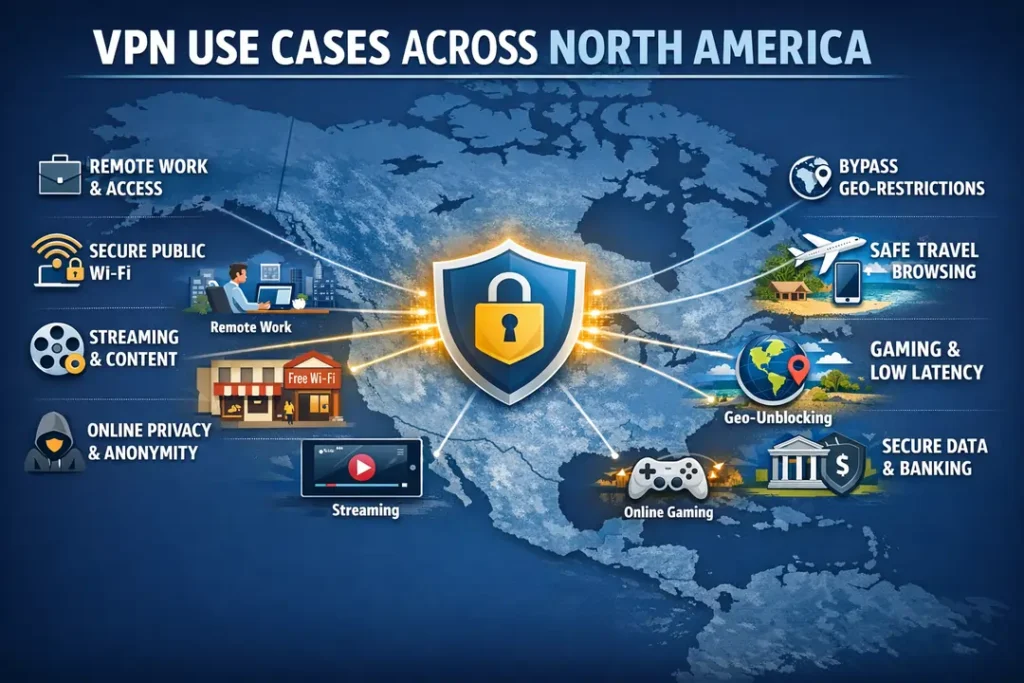
VPN Use Cases Across North America
VPN use in North America is shaped less by internet availability and more by how people connect, what they access, and where they move. Travel between highly developed networks, platform-level restrictions, and differing privacy expectations all influence how VPNs are used across the region.
The most common VPN use cases fall into three clear categories.
Travel & Cross-Border Access
Travel within North America often involves moving between airports, hotels, short-term rentals, and mobile networks. While connectivity is generally strong, these networks are shared by default and prioritise access over privacy.
- Securing personal accounts on hotel and airport Wi-Fi
- Maintaining access to home services while crossing borders
- Reducing exposure when switching SIMs or roaming
VPNs used for travel in North America benefit from fast reconnection, reliable US and Canadian servers, and stable apps that handle frequent network changes.
Useful guides:
Remote Work, Corporate Networks & Privacy
North America has one of the highest concentrations of remote workers and corporate VPN usage in the world. Many users operate on managed office networks, shared workspaces, or employer-controlled systems.
- Protecting work traffic on shared or semi-public networks
- Avoiding conflicts between personal VPNs and corporate policies
- Maintaining consistent access to cloud platforms and tools
In these environments, VPN choice often prioritises reliability and compatibility over aggressive configuration or experimental features.
Country-specific guidance:
- USA — privacy, surveillance, and performance at scale
- Canada — privacy expectations and compliance
- Mexico — secure access on shared networks
Streaming, Sports & Platform Restrictions
Streaming is one of the most common reasons people use VPNs in North America. Licensing differences, regional blackouts, and platform-specific restrictions often limit access even within the same country.
- Accessing regional or international streaming libraries
- Avoiding sports blackout restrictions
- Maintaining consistent access while traveling
Because major platforms actively detect VPN traffic, reliable access depends heavily on provider quality and server maintenance.
Related streaming guides:
For best results, match your VPN choice to how you actually use the internet — whether that’s travel, work, or entertainment — then refine it further using the country-specific guides linked throughout this hub.

Privacy, Surveillance & Legal Expectations in North America
VPN use in North America is shaped less by censorship and more by differences in privacy law, data retention practices, and institutional access to online activity. While internet access is broadly open across the region, expectations around privacy vary significantly between countries.
United States — Extensive Data Collection & Platform Tracking
The United States operates under broad surveillance and data collection frameworks. Internet service providers, platforms, and advertisers collect large volumes of user data, often for commercial, security, or analytical purposes.
VPNs are commonly used in the US to reduce tracking, protect browsing activity on shared networks, and limit exposure to data profiling rather than to bypass content restrictions.
Related analysis: Countries Where VPN Privacy Matters Most
Canada — Stronger Privacy Protections, Shared Infrastructure
Canada generally offers stronger consumer privacy protections than the US, but this does not eliminate data retention or monitoring entirely. ISPs may still log connection metadata, and shared or managed networks operate under their own policies.
VPN use in Canada is common among privacy-conscious users, remote workers, and travelers who frequently move between Canadian and US services.
Background reading: What Is a VPN? How Encryption Protects Data
Mexico — Legal Use, Practical Privacy Considerations
VPNs are legal in Mexico and widely used, particularly by travelers and remote workers. Privacy risks are more often associated with public and shared Wi-Fi than with government-level monitoring.
Using a VPN in Mexico is primarily a practical security measure — encrypting traffic on hotel, café, and apartment networks — rather than a response to restrictive internet policy.
What This Means in Practice
Across North America, VPNs are legal and widely accepted. Their role is to:
- Encrypt traffic on shared or managed networks
- Reduce exposure to tracking and data profiling
- Protect work, financial, and personal accounts
Because legal frameworks and data practices differ by country, choosing a VPN without understanding local expectations can lead to over- or under-estimating your privacy needs.
How we assess privacy & security:
North America VPN Country Guides
Although North America is a highly developed region, VPN requirements differ meaningfully between the United States, Canada, and Mexico. Local privacy laws, data practices, network usage patterns, and travel behaviour all influence how VPNs are used in practice.
Use the table below to access detailed, country-specific guides based on real-world conditions rather than generic recommendations.
| Country | Connectivity Profile | Primary VPN Use Case | Guide |
|---|---|---|---|
| United States | Highly developed, large-scale networks | Privacy, streaming access, performance | View USA VPN Guide |
| Canada | Stable urban connectivity | Privacy protection & cross-border access | View Canada VPN Guide |
| Mexico | Mixed use, travel-heavy networks | Public Wi-Fi security & stability | View Mexico VPN Guide |
If you’re traveling between countries or unsure which guide applies best to your situation, start with the regional recommendations above, then use the country pages for deeper, location-specific guidance.
Troubleshooting VPN Issues in North America
VPN issues in North America are rarely caused by poor internet access. Instead, most problems arise from platform restrictions, managed networks, or conflicts between personal VPNs and workplace or hotel systems.
Because the region relies heavily on high-speed broadband, corporate infrastructure, and platform-level controls, troubleshooting VPN issues here requires a different approach than in developing regions.
If Streaming Services Detect or Block Your VPN
Major North American streaming platforms actively identify and restrict VPN traffic.
- Switch to a different server in the same country rather than changing regions
- Restart the VPN before opening the streaming app or website
- Clear browser or app cache to remove stored location data
If issues persist, the limitation is usually platform-side rather than a connection failure.
Related: Why VPNs Can Affect Streaming Performance
If Your VPN Won’t Connect on Hotel or Airport Wi-Fi
Many North American hotels, airports, and conference venues use managed networks that restrict encrypted traffic.
- Complete any Wi-Fi login or splash page before enabling the VPN
- Switch VPN protocols and reconnect
- Try a nearby US or Canadian server rather than an international one
In tightly managed environments, mobile data may provide a more reliable fallback.
If a Corporate Network Blocks Your VPN
Some workplace networks restrict personal VPN usage or flag encrypted traffic.
- Disconnect from the corporate VPN before enabling a personal VPN
- Use split tunneling if available to avoid conflicts
- Reconnect only after leaving managed networks
Always follow employer IT policies when using VPNs on work devices.
If Your VPN Disconnects When Switching Networks
Frequent switching between Wi-Fi and mobile data is common when traveling across North America.
- Enable auto-reconnect in the VPN app
- Disable aggressive battery or background restrictions
- Restart the VPN after changing networks or locations
Most VPN issues in North America can be resolved with small configuration changes rather than changing providers.
For structured diagnostics: VPN Troubleshooting Pro Guide (2026)
Final Thoughts: Choosing the Right VPN for North America
North America is one of the most digitally advanced regions in the world, but that does not make VPN decisions simple. Differences in privacy law, platform enforcement, and everyday network use mean that VPN requirements vary significantly between the United States, Canada, and Mexico.
In the United States, VPN use is shaped by large-scale data collection, aggressive streaming restrictions, and performance demands on high-bandwidth networks. In Canada, privacy expectations and cross-border access play a larger role. In Mexico, VPNs are often used as a practical security tool on shared and travel-heavy networks.
This is why a single, generic “best VPN for North America” recommendation is rarely accurate. The most effective approach is to understand how the region works as a whole, then apply country-specific guidance based on where you are and how you connect.
How to use this hub effectively:
- Use the regional shortlist to identify VPNs that scale well across North America
- Refer to the country guides for legal context, performance expectations, and local usage patterns
- Match your VPN choice to your primary use case — travel, remote work, streaming, or privacy
All recommendations on this page are based on independent testing, real-world usage analysis, and transparent evaluation standards rather than marketing claims.
If you are unsure where to begin, start with the guide for the country you spend the most time in:
From there, use this North America hub as a reference point when traveling, working across borders, or adjusting your VPN setup for different networks and platforms.
Further reading: