
Honduras presents a very different internet environment compared to much of Central America. Connectivity quality is highly dependent on location, network type, and time of day, with noticeable differences between major cities, secondary towns, and transit-heavy areas.
In urban centers, broadband and mobile data are generally usable for everyday browsing, streaming, and communication. Outside these areas, users often rely more heavily on mobile connections or shared Wi-Fi networks, where congestion and instability are common.
As a result, VPN use in Honduras is less about bypassing restrictions and more about maintaining privacy, connection stability, and consistent access to online services on networks that are frequently shared or poorly segmented.
For travelers, expats, and remote workers, a reliable VPN helps secure data on public or semi-public networks, reduce exposure to traffic monitoring, and ensure dependable access to international platforms when local connectivity fluctuates.

Internet Conditions in Honduras
Internet conditions in Honduras vary more than in most Central American countries. Performance depends heavily on location, network type, and congestion, with noticeable differences between major cities, secondary towns, and transport or commercial hubs.
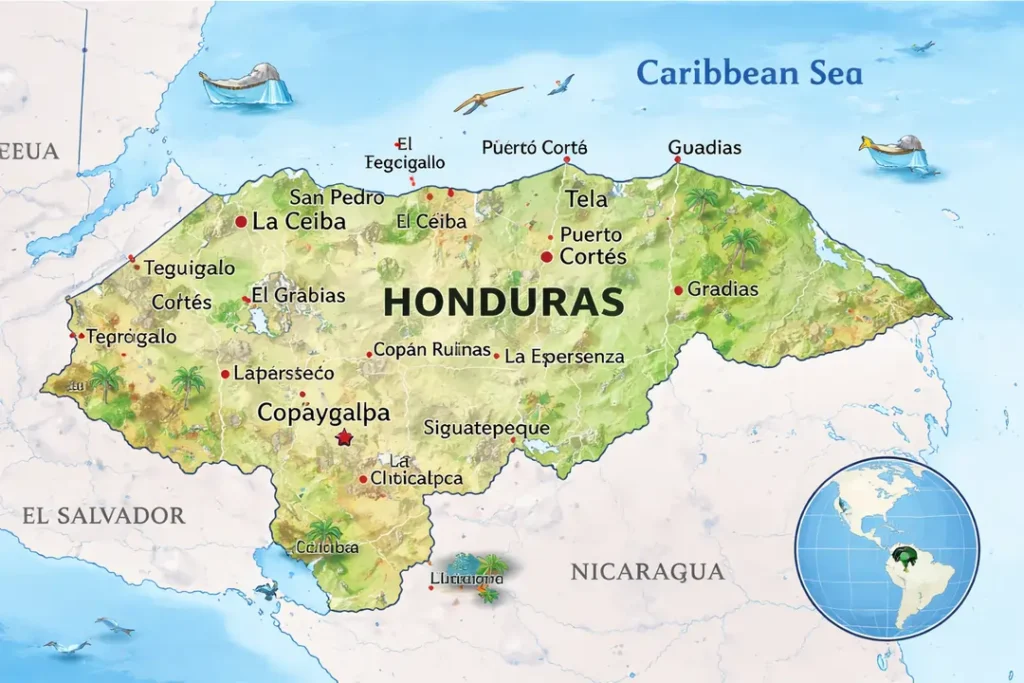
In cities such as Tegucigalpa and San Pedro Sula, fixed broadband and mobile LTE connections are generally sufficient for everyday browsing, messaging, and standard streaming. However, speeds and stability can fluctuate significantly during peak hours due to shared infrastructure and uneven capacity.
- Urban areas: Usable broadband and mobile data, congestion at peak times
- Secondary towns: Slower speeds, heavier reliance on mobile networks
- Shared Wi-Fi: Common in hotels, cafés, apartments, and offices
- Network consistency: Varies by provider and neighborhood
Many users in Honduras experience short interruptions, inconsistent latency, or throttling-like behavior on shared networks. These issues are usually caused by congestion or traffic management rather than deliberate service restrictions.
VPN performance in Honduras is therefore influenced more by routing efficiency and protocol choice than by headline speed ratings. Providers with optimized regional routing and modern protocols tend to deliver noticeably more stable connections, especially on mobile data and shared Wi-Fi.
Related: For a practical breakdown of how different VPNs compare under real-world conditions, see our VPN comparison table and our analysis of why VPN speeds vary.
Is Using a VPN Legal in Honduras?
Yes. Using a VPN in Honduras is legal. There are no laws that prohibit personal or commercial VPN use, and VPN services are widely accessible to residents, businesses, and visitors.
Honduras does not operate a nationwide internet censorship system, and there is no public record of individuals being penalized solely for using a VPN for normal activities such as browsing, communication, streaming, or remote work.
- VPN legality: Legal
- Restrictions: None for personal use
- Observed enforcement: No known cases against everyday VPN users
As in many countries, internet service providers may retain basic connection metadata for operational or regulatory reasons. Public and semi-public Wi-Fi networks—such as those in hotels, cafés, offices, and shared housing—often log activity to manage bandwidth and security.
For this reason, VPNs in Honduras are most commonly used as a practical privacy and security measure, not as a tool for bypassing censorship or accessing prohibited content.
Related: If you want a clearer understanding of how VPNs work in everyday situations, see our complete VPN guide and our breakdown of free vs paid VPNs and why the difference matters.

Best VPNs for Honduras
Honduras places different demands on a VPN than many neighboring countries. Connection quality can fluctuate by location and time of day, shared networks are common, and routing inefficiencies often cause instability rather than outright speed limitations.
The best VPNs for Honduras are therefore those that prioritize connection recovery, efficient routing, and consistent performance on mixed-quality networks — not just raw benchmark speeds.
| VPN | Why It Performs Well in Honduras | Connection Stability | Streaming Access |
|---|---|---|---|
| NordVPN | Strong routing & recovery on unstable networks | Excellent | Very good |
| ExpressVPN | Consistent performance on shared Wi-Fi | Very good | Very good |
| Surfshark | Good flexibility at lower cost | Good | Good |
NordVPN — Best Overall VPN for Honduras
NordVPN performs particularly well in Honduras due to its ability to maintain stable connections on inconsistent networks. Its modern protocol implementation and intelligent routing help reduce packet loss and reconnect quickly when signal quality drops.
This makes it well suited to urban shared Wi-Fi, mobile data connections, and environments where congestion causes frequent micro-interruptions.
Pros
- Excellent stability on congested or fluctuating networks
- Efficient modern protocols improve routing reliability
- Strong privacy and security features
Cons
- Interface may feel complex for first-time VPN users
- Best performance requires light configuration
Best for: Expats, remote workers, and users who need consistent performance across varying networks.
Full review: NordVPN Review (2026)
ExpressVPN — Best for Simplicity & Reliability
ExpressVPN is a strong choice for users in Honduras who want stable connections without manual configuration. Its apps are optimized to handle unstable Wi-Fi gracefully and reconnect quickly when networks change.
This makes ExpressVPN especially useful in hotels, cafés, offices, and other shared environments where users may not control the network.
Pros
- Very consistent performance on shared Wi-Fi
- Fast reconnections after brief dropouts
- Extremely simple apps across devices
Cons
- Higher price than most competitors
- Limited advanced tuning options
Best for: Travelers and users who prioritize ease of use and reliability.
Full review: ExpressVPN Review (2026)
Surfshark — Best Budget VPN for Honduras
Surfshark offers solid performance for its price and is well suited to users who need to protect multiple devices while keeping costs down.
While it does not handle congestion as smoothly as NordVPN or ExpressVPN, it remains a capable option for browsing, streaming, and general use on reasonably stable connections.
Pros
- Unlimited simultaneous device connections
- Affordable long-term pricing
- Simple apps for mobile and desktop
Cons
- Performance can fluctuate on heavily congested networks
- Less resilient to packet loss than premium options
Best for: Budget-conscious users, families, and casual VPN use.
Full review: Surfshark VPN Review


Streaming Access in Honduras
Streaming access in Honduras is influenced by regional licensing restrictions and variable network performance. By default, many streaming platforms provide limited local libraries, and performance can fluctuate depending on congestion, time of day, and whether the connection is shared.
A reliable VPN allows users in Honduras to access international streaming libraries by routing traffic through servers in other countries, most commonly the United States. Results depend on server quality, network stability, and local bandwidth availability.
- Netflix: Access to US and select international libraries
- Disney+: US catalog available with compatible servers
- Amazon Prime Video: Region switching generally supported
- Live sports platforms: Access varies by provider and server location
Because many users stream on shared residential or hotel Wi-Fi, buffering and resolution drops are most often caused by local congestion rather than VPN blocking. Evening hours tend to be the most inconsistent.
For more consistent streaming results in Honduras:
- Use nearby US-based servers instead of distant regions
- Avoid peak evening hours on shared networks
- Prefer wired or private Wi-Fi connections when available
Related streaming guidance:
If a streaming service fails to load or detects the wrong region, the issue is usually related to server selection or cached location data rather than the VPN itself.

Gaming, Latency & Performance in Honduras
Online gaming performance in Honduras is best described as variable and environment-dependent. While casual multiplayer gaming is generally possible on stable connections, competitive or latency-sensitive gaming is inconsistent due to distance from game servers and local network congestion.
Most major game servers used by players in Honduras are located in North America. As a result, higher baseline latency compared to US-based players is normal, even on otherwise stable connections.
- Best server regions: US East Coast
- Casual gaming: Generally playable on good broadband or mobile data
- Competitive gaming: Inconsistent due to latency and congestion
A VPN can sometimes improve connection stability by optimizing routing and reducing packet loss on congested or poorly managed networks. However, it cannot overcome physical distance to game servers or compensate for unstable local infrastructure.
For the most reliable gaming experience in Honduras:
- Use nearby North American VPN servers
- Avoid peak evening hours on shared networks
- Prefer wired or private connections over public Wi-Fi
Related gaming guidance:
In practice, VPNs in Honduras are most useful for improving connection consistency and security during gaming sessions rather than achieving ultra-low latency.
VPN Troubleshooting in Honduras
VPN issues in Honduras are most commonly caused by unstable local networks, congestion, or restrictive shared Wi-Fi settings rather than problems with the VPN service itself. Understanding the source of the issue usually resolves problems quickly.
If Your VPN Disconnects or Fails to Stay Connected
This is often caused by fluctuating signal quality or network interruptions.
- Switch to a nearby US-based server instead of distant regions
- Change to a modern, lightweight VPN protocol
- Disable battery or data-saving modes that restrict background connections
If Internet Speeds Drop Significantly When Using a VPN
Speed drops are usually the result of congestion or routing inefficiencies.
- Avoid peak evening hours on shared residential or hotel networks
- Pause background updates, cloud backups, and streaming on other devices
- Reconnect to a different server in the same region
If the VPN Will Not Connect on Hotel or Office Wi-Fi
Some shared networks restrict encrypted traffic by default.
- Complete any captive portal login before enabling the VPN
- Switch VPN protocols and retry the connection
- Temporarily use mobile data if Wi-Fi restrictions persist
If Streaming or Banking Sites Fail to Load
This is usually related to cached location data or unstable routing.
- Clear browser or app cache and cookies
- Restart the VPN before opening the website or app
- Try a different server within the same country
In most cases, adjusting server location or protocol resolves VPN issues without changing providers. For deeper diagnostics and structured troubleshooting steps, see our VPN Troubleshooting Pro Guide (2026).
Travel & Public Wi-Fi Risks in Honduras
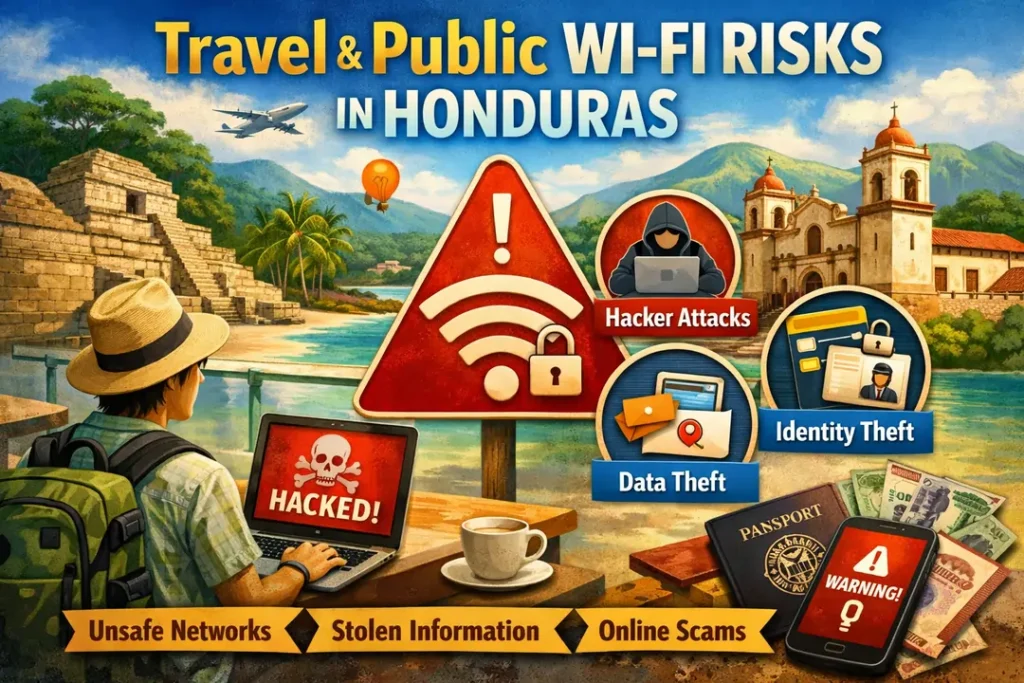
Public Wi-Fi is widely used across Honduras, particularly in hotels, cafés, shopping centers, offices, and transport hubs. For travelers and short-term visitors, shared networks are often the most convenient — and sometimes the only — way to get online.
These networks are typically designed for accessibility rather than security. Most risks are passive rather than targeted and stem from shared access points, minimal network segmentation, and basic activity logging by network operators.
- Open or weakly secured hotel and café Wi-Fi
- Shared office and apartment networks
- Public Wi-Fi used for email, messaging, and financial access
Using a VPN on public Wi-Fi encrypts your internet traffic, preventing other users on the same network from viewing or intercepting data. This is particularly important when accessing personal accounts, work platforms, or online banking services.
Many travelers in Honduras switch between Wi-Fi and mobile data depending on availability. In these situations, VPNs that reconnect quickly and maintain stable sessions are noticeably more effective than those optimized only for peak speeds.
Related guidance for travelers:

Privacy, Surveillance & Data Retention in Honduras
Honduras does not operate a comprehensive internet censorship system, and there is no public evidence of routine surveillance targeting everyday users. Most online activity—such as browsing, messaging, and streaming—occurs without interference.
As in many countries, internet service providers may retain basic connection metadata for operational or regulatory purposes. Public and semi-public networks, including those in hotels, offices, and cafés, often log activity to manage bandwidth and security.
This does not imply active monitoring of individuals, but it does mean that privacy is not guaranteed by default on shared networks. For this reason, VPNs are commonly used in Honduras as a practical measure to encrypt traffic and reduce exposure to passive data collection.
For travelers, expats, and remote workers, VPN use is typically about protecting credentials, work tools, and personal accounts on mixed-quality networks rather than bypassing restrictions.
All VPN recommendations on Trusted VPN Reviews are based on independent testing, audit reviews, and transparent evaluation standards.
How we assess VPN privacy and security:
- Gold-Standard VPN Testing Methodology
- Lab-Tested VPN Audits & Authority Review (2026)
- VPN Lab Methodology Transparency Report (2026)
This approach ensures that VPNs recommended for use in Honduras meet clear standards for logging practices, encryption, and long-term reliability.
Getting a Honduras IP Address
A Honduras IP address allows you to appear online as if you are located within the country. This is useful when accessing local services, region-specific websites, or platforms that restrict content based on geographic location.
Common reasons users look for a Honduras IP address include:
- Accessing local banking, utility, or government portals while abroad
- Maintaining consistent access to Honduran-based accounts when traveling
- Testing how websites or services appear to users inside Honduras
The most reliable way to obtain a Honduras IP address is through a reputable VPN provider with servers in the country. A VPN assigns a local IP while encrypting your connection, helping protect data from interception on shared or unstable networks.
Free proxy services and unofficial IP tools are not recommended, as they are often unstable, heavily logged, or shared by large numbers of users.
Note: Some local or financial platforms may request additional verification when accessed through a VPN. This is a standard security measure and not a connection error.
FAQs – VPN Use in Honduras
Are VPNs legal in Honduras?
Yes. VPN use is legal in Honduras, and there are no laws restricting personal or commercial VPN services.
Is VPN use common in Honduras?
Yes. VPNs are widely used by businesses, remote workers, travelers, and expats—particularly on shared or unstable networks.
Does Honduras block websites or online platforms?
No. Honduras does not operate a nationwide censorship system. Most access issues are related to congestion, routing problems, or network instability rather than blocking.
Should I use a VPN on hotel or café Wi-Fi?
Yes. Shared Wi-Fi networks in Honduras are rarely segmented per user. A VPN encrypts your traffic and protects personal accounts, work tools, and financial access.
Can a VPN help with banking and work platforms?
Yes. Many users rely on VPNs to maintain stable access to international banking, email, and cloud services when local connections fluctuate.
Will a VPN improve internet speeds in Honduras?
A VPN cannot increase raw bandwidth, but it can improve stability in some cases by avoiding poorly routed or congested network paths.
How Honduras Compares Within Central America
Honduras differs from much of Central America due to its uneven infrastructure and variable network quality. VPN requirements here tend to focus on stability and recovery rather than raw speed.
| Location | Network Profile | Privacy Environment | Guide |
|---|---|---|---|
| Central America (Regional) | Mixed | Varies by country | Central America VPN Hub |
| Honduras | Highly variable, shared infrastructure | Moderate | Current Page |
| Guatemala | Urban–rural split | Moderate | Guatemala VPN Guide |
| Belize | Tourism-heavy, shared networks | Strong | Belize VPN Guide |
| El Salvador | Improving urban networks | Moderate | El Salvador VPN Guide |
| Nicaragua | Inconsistent access | More sensitive | Nicaragua VPN Guide |
Practical VPN Resources for Travelers & Expats
- Best VPNs for Travel & Border Transitions
- Best VPNs for Beginners
- Free vs Paid VPNs — Real-World Risks
- Advanced VPN Troubleshooting Guide
Final Analysis: Do You Need a VPN in Honduras?
Honduras does not impose widespread internet restrictions, and most users browse freely. However, the country’s uneven infrastructure and heavy reliance on shared networks mean privacy and stability are not guaranteed by default.
For travelers and short-term visitors, a VPN is a sensible security layer on hotel, café, and office Wi-Fi. For expats and remote workers, it becomes a practical necessity for maintaining consistent access to work platforms, financial services, and cloud tools.
The most effective VPNs in Honduras are not those advertising extreme speeds, but those that handle congestion well, reconnect quickly after interruptions, and maintain stability across mixed-quality networks.
This guide is part of our broader Central America VPN analysis, built on independent testing, real-world usage data, and transparent evaluation standards rather than marketing claims.
For cross-country comparisons, see our Best VPNs of 2026 and verified VPN test results.