
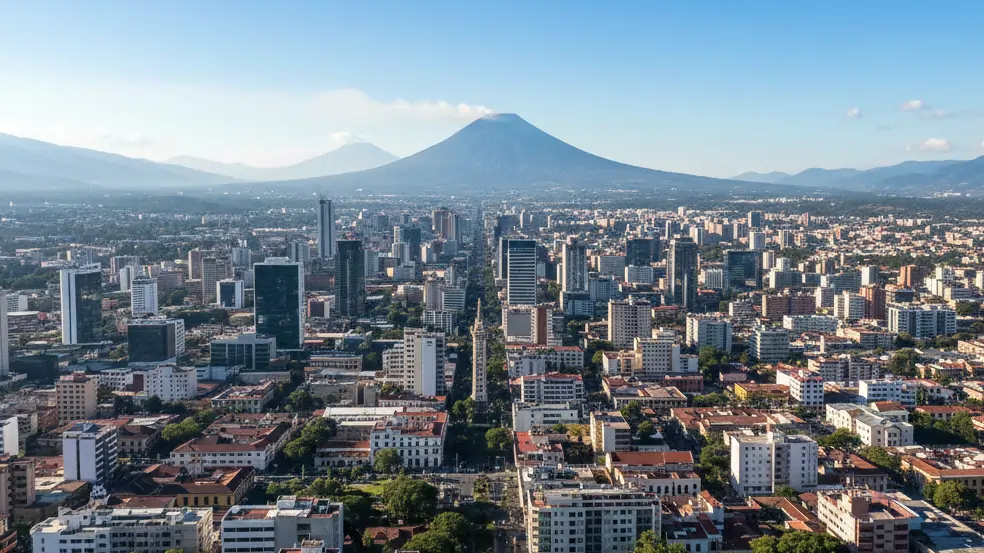
Guatemala has one of the most diverse internet environments in Central America. While major cities such as Guatemala City offer stable broadband and mobile connectivity, internet quality and reliability can vary significantly outside urban centers.
Public Wi-Fi is widely used in hotels, cafés, shopping centers, and shared accommodations, particularly by travelers and remote workers. At the same time, privacy standards and network security practices are inconsistent, and internet service providers may retain basic connection data.
Using a reliable VPN in Guatemala helps protect personal data on shared networks, maintain stable access to international services, and reduce exposure to monitoring when browsing, streaming, or working online.

Internet Conditions in Guatemala
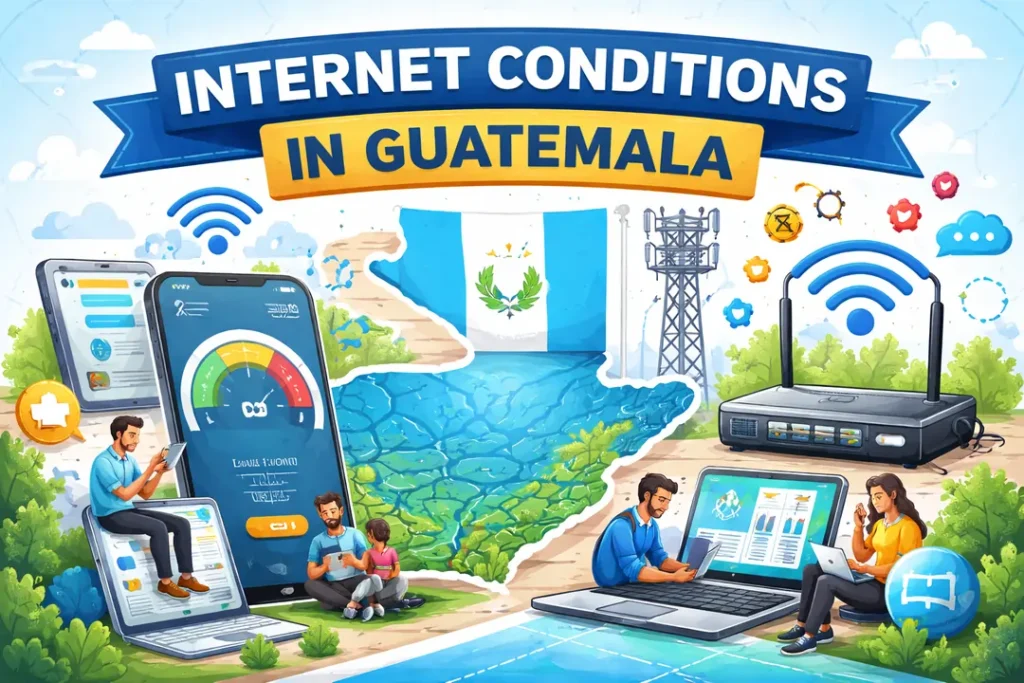
Internet connectivity in Guatemala is strongest in major urban areas, particularly Guatemala City, where broadband and mobile networks are generally reliable. Outside large cities, performance can vary significantly depending on location, infrastructure investment, and network congestion.
- Major ISPs: Claro Guatemala, Tigo Guatemala
- Urban connectivity: Stable broadband and mobile data
- Mobile usage: Common nationwide, performance varies
- Rural areas: Slower speeds and higher latency
Shared networks in hotels, apartment buildings, and cafés can experience congestion during peak hours. This often affects video calls, cloud access, and streaming quality, and is frequently mistaken for VPN-related slowdown.
In practice, VPN performance in Guatemala depends on efficient routing and protocol choice rather than raw connection speed. Providers with optimized regional and North American servers tend to deliver the most consistent results.
Related: To understand how different VPNs compare in real-world performance and features, see our VPN comparison table and our plain-language guide explaining how VPNs work in everyday use.
Is Using a VPN Legal in Guatemala?
Yes — using a VPN in Guatemala is legal. There are no laws that prohibit personal or commercial VPN use, and VPN services are widely available to residents, businesses, and visitors.
Guatemala does not operate a censorship-heavy internet environment, and there is no record of enforcement actions against individuals for using VPN software for everyday activities such as browsing, communication, or streaming.
- VPN legality: Legal
- Restrictions: None for personal use
- Enforcement history: No known cases against VPN users
As in many countries, internet service providers may retain basic connection metadata, and public Wi-Fi operators often log activity for operational reasons. For this reason, VPNs are commonly used in Guatemala as a practical privacy and security tool rather than a method of bypassing restrictions.
Related: If you’re new to VPNs or want a clearer overview of how they work in everyday situations, see our complete guide to what a VPN is and our breakdown of free vs paid VPNs and why the difference matters.
Best VPNs for Guatemala
The best VPNs for Guatemala combine reliable regional routing, strong privacy protections, and consistent performance across mixed networks. This matters because connectivity quality can vary widely between urban centers and smaller towns.
| VPN | Best For | Stability | Streaming | Privacy |
|---|---|---|---|---|
| NordVPN | Overall balance | Very good | Very good | Strict no-logs |
| ExpressVPN | Ease & consistency | Excellent | Very good | Strong privacy |
| Surfshark | Value & flexibility | Good | Good | No-logs |
NordVPN — Best Overall VPN for Guatemala
NordVPN offers the strongest balance of performance, security features, and reliability for users in Guatemala, particularly when connecting to nearby North American servers.
- Strengths: Fast regional routing, advanced security tools, strong privacy posture
- Weaknesses: Interface can feel feature-heavy on older devices
Everyday use: Performs well on home broadband, mobile data, and shared apartment networks.
Streaming: Reliable access to major international platforms.
Full review: NordVPN Review (2026)
ExpressVPN — Best for Simplicity & Reliability
ExpressVPN is a strong choice for users who value ease of use and consistent performance across different networks, including hotels and public Wi-Fi.
| Ease of use | Excellent (very beginner-friendly) |
| Connection stability | Very high |
| Price | Higher than average |
Travel & mobility: Quick connections and reliable reconnection when networks change.
Full review: ExpressVPN Review (2026)
Surfshark — Best Budget VPN for Guatemala
Surfshark is a cost-effective option for users who want broad device coverage and straightforward apps without a high monthly cost.
- Unlimited simultaneous device connections
- Affordable long-term plans
- Lightweight apps suitable for travel
Performance note: Generally stable for browsing and streaming; peak-hour congestion can affect speeds.
Full review: Surfshark VPN Review
Comparison: If you’re deciding between providers, see our comparison of NordVPN vs ExpressVPN (2026).


Streaming Access in Guatemala
Streaming availability in Guatemala is more limited than in the United States and parts of Europe, with many platforms providing regional libraries by default. Performance can also vary depending on local network conditions and congestion.
A reliable VPN allows users in Guatemala to access international streaming libraries by connecting through servers in other countries, most commonly the United States. Results depend on server selection, time of day, and the quality of the underlying connection.
- Netflix: Access to US and select international libraries
- Disney+: US catalog available with compatible servers
- Prime Video: Region switching supported
- Sports streaming: Access depends on platform and server location
For best results, users should prioritize nearby servers and avoid peak evening hours on shared networks. Buffering and resolution drops are usually caused by local bandwidth constraints rather than VPN blocking.
Related streaming resources:
If a streaming service remains inaccessible, the issue is usually related to server choice or cached location data. Practical fixes are covered in the troubleshooting section below.

Gaming, Latency & Performance in Guatemala
Online gaming performance in Guatemala is generally stable in urban areas with solid broadband or mobile connections, but latency can vary depending on server location, local congestion, and network quality.
Most multiplayer game servers used by players in Guatemala are located in North America. As a result, ping is typically higher than for players physically located in the US, but remains playable for many popular titles.
- Best server locations: US East Coast
- Urban connections: Suitable for most online games
- Rural connections: Higher latency and occasional instability
A VPN can help improve routing stability and reduce packet loss in some cases, especially on congested or shared networks. However, it cannot eliminate distance-based latency. Choosing lightweight, modern protocols is essential for gaming performance.
Related gaming resources:
- Best VPNs for Console Gaming (2026)
- Best VPNs for FPS Games
- Best VPNs for Android (Gaming & Performance)
For the best experience, gamers should avoid peak evening hours, use wired connections where possible, and minimize background network activity before switching VPN providers.
VPN Troubleshooting in Guatemala
VPN connectivity issues in Guatemala are most commonly caused by shared networks, congestion, or restrictive Wi-Fi configurations rather than problems with the VPN service itself. Understanding the underlying cause usually resolves issues quickly.
If Your VPN Won’t Connect or Keeps Dropping
This is most often caused by unstable Wi-Fi or aggressive network filtering.
- Connect to a nearby US-based server rather than distant regions
- Switch to a lightweight, modern VPN protocol
- Complete any captive portal login before enabling the VPN
If Speeds Are Much Slower Than Expected
Slowdowns are typically caused by congestion on shared networks rather than VPN throttling.
- Avoid peak evening hours on hotel or apartment Wi-Fi
- Move closer to the router or access point
- Pause cloud backups, updates, and background downloads
If Streaming Services Fail to Load or Detect Location
This usually indicates cached location data or an overloaded server.
- Clear browser cookies and cached location information
- Switch to a different server in the same country
- Restart the VPN app before opening the streaming platform
If the VPN Is Blocked on Hotel or Café Wi-Fi
Some shared networks restrict encrypted traffic by default.
- Change the VPN protocol and reconnect
- Enable automatic reconnect and the kill switch
- Switch temporarily to mobile data if restrictions persist
In most cases, these issues are resolved by adjusting server location or protocol rather than changing VPN providers. For advanced diagnostics and step-by-step troubleshooting, see our VPN Troubleshooting Pro Guide (2026).
Travel & Public Wi-Fi Risks in Guatemala
Public Wi-Fi is widely used across Guatemala, particularly in hotels, hostels, cafés, co-working spaces, airports, and bus terminals. For travelers and short-term visitors, shared networks are often the primary way of getting online.
While convenient, these networks rarely offer strong security controls. Most risks are passive rather than targeted and stem from unencrypted traffic, shared access points, and basic activity logging by network operators.
- Open or weakly secured café and hostel Wi-Fi
- Shared hotel and apartment networks
- Public networks used for email, messaging, and cloud access
Using a VPN on public Wi-Fi encrypts your internet traffic, preventing other users on the same network from intercepting data or monitoring activity. This is particularly important when accessing personal accounts, work tools, or financial services.
Many travelers in Guatemala rely on mobile data as a fallback when Wi-Fi is unstable. In these cases, VPN efficiency and battery impact can matter just as much as raw speed.
Related guidance for travelers:
Privacy, Surveillance & Data Retention in Guatemala
Guatemala does not operate a censorship-heavy internet environment, and there is no public evidence of systematic surveillance targeting everyday internet users. Most people use the internet without interference when browsing, communicating, or accessing international services.
As in many countries, internet service providers may retain basic connection metadata for operational or compliance purposes. Public Wi-Fi networks, including those in hotels and cafés, often log activity to manage usage and security.
While this does not mean online activity is actively monitored, it does mean privacy is not guaranteed by default. VPNs are therefore commonly used in Guatemala as a precautionary tool to encrypt traffic and prevent passive observation by network operators or third parties.
For travelers, remote workers, and long-term visitors, VPN use is typically about protecting personal data on shared networks rather than bypassing restrictions or censorship.
All VPN recommendations on Trusted VPN Reviews are based on independent testing, audit reviews, and transparent evaluation criteria.
How we evaluate VPN privacy and security:
- Gold-Standard VPN Testing Methodology
- Lab-Tested VPN Audits & Authority Review (2026)
- VPN Lab Methodology Transparency Report (2026)
This ensures that VPNs recommended for use in Guatemala meet clear standards for logging policies, encryption practices, and long-term reliability.
Getting a Guatemala IP Address
A Guatemala IP address allows you to appear online as if you are located within the country. This can be useful when accessing local services, region-specific websites, or platforms that restrict access based on geographic location.
Common reasons users look for a Guatemala IP address include:
- Accessing local banking, utility, or government portals while abroad
- Maintaining consistent access to accounts when traveling
- Testing how websites or services appear to users in Guatemala
The safest and most reliable way to obtain a Guatemala IP address is through a reputable VPN provider. A VPN assigns you a local IP while encrypting your connection, helping protect your data from interception or logging.
Free proxy services and unofficial IP tools are not recommended, as they are often unstable, heavily logged, or shared by large numbers of users.
Note: Some local or financial services may request additional verification when accessed through a VPN. This is a standard security measure and not an error.
FAQs – VPN Use in Guatemala
Are VPNs legal in Guatemala?
Yes. VPN use is legal in Guatemala, and there are no laws restricting personal or commercial VPN services.
Why do travelers use VPNs in Guatemala?
Travelers commonly use VPNs to secure connections on public Wi-Fi, protect personal accounts, and maintain access to international services while moving between cities.
Is a VPN necessary for everyday browsing?
Not strictly, but it is recommended on shared or unsecured networks. VPNs are typically used as a precaution to protect data rather than to bypass restrictions.
Will a VPN affect internet speeds in Guatemala?
Minor speed changes are possible, but most slowdowns are caused by local congestion. Using nearby servers and modern protocols usually delivers stable performance.
Can a VPN help with streaming access?
Yes. A reliable VPN allows access to international streaming libraries, subject to local network conditions and server selection.
Do expats and remote workers use VPNs in Guatemala?
Yes. VPNs are widely used by expats and remote workers to secure work tools, email, cloud services, and financial access on shared networks.
VPN Conditions Across Central America
Internet reliability, privacy expectations, and access conditions vary across Central America. If you’re traveling or working across borders, understanding these differences helps you configure your VPN appropriately.
| Location | Internet Reliability | Privacy Environment | Guide |
|---|---|---|---|
| Central America (Regional) | Mixed | Varies by country | View Regional Hub |
| Guatemala | Moderate | Moderate | Current Page |
| Belize | Moderate | Strong | View Guide |
| Honduras | Variable | Moderate | View Guide |
| El Salvador | Moderate | Moderate | View Guide |
| Nicaragua | Variable | More Sensitive | View Guide |
Helpful VPN Guidance for Travelers & Expats
- Best VPNs for Travel & Border Crossings
- Best VPNs for Beginners
- Free vs Paid VPNs – What to Know
- VPN Troubleshooting on Hotels & Public Wi-Fi
Final Thoughts
Guatemala offers generally reliable internet access in major cities, with more variable performance outside urban areas. Public Wi-Fi is widely used, particularly by travelers and remote workers.
While Guatemala does not present elevated censorship or surveillance risks, privacy is not guaranteed on shared networks. VPNs are therefore commonly used as a practical security measure rather than a response to restrictions.
A reputable VPN helps protect personal data, maintain stable access to international services, and reduce exposure to passive monitoring on public or shared connections.
This guide is part of our broader Central America coverage, designed to help users understand how internet conditions and VPN needs differ across the region.
All recommendations are based on independent testing, privacy audits, and transparent evaluation standards. For broader comparisons, see our Best VPNs of 2026 and independent VPN test results.