

El Salvador has one of the most rapidly evolving digital environments in Central America. Internet connectivity is strongest in urban areas, where broadband and mobile data support everyday activities such as streaming, online banking, and remote work with increasing reliability.
Outside major cities, network quality can still vary, but overall infrastructure investment and mobile coverage have improved noticeably in recent years. Public Wi-Fi is widely available in cafés, offices, shopping centers, and shared accommodations, particularly in urban and commercial zones.
VPN use in El Salvador is primarily about protecting privacy on shared networks, maintaining consistent access to international services, and reducing exposure to traffic monitoring rather than bypassing widespread restrictions.
For travelers, expats, and remote workers, a reliable VPN provides an additional layer of security and stability when switching between home broadband, public Wi-Fi, and mobile data.

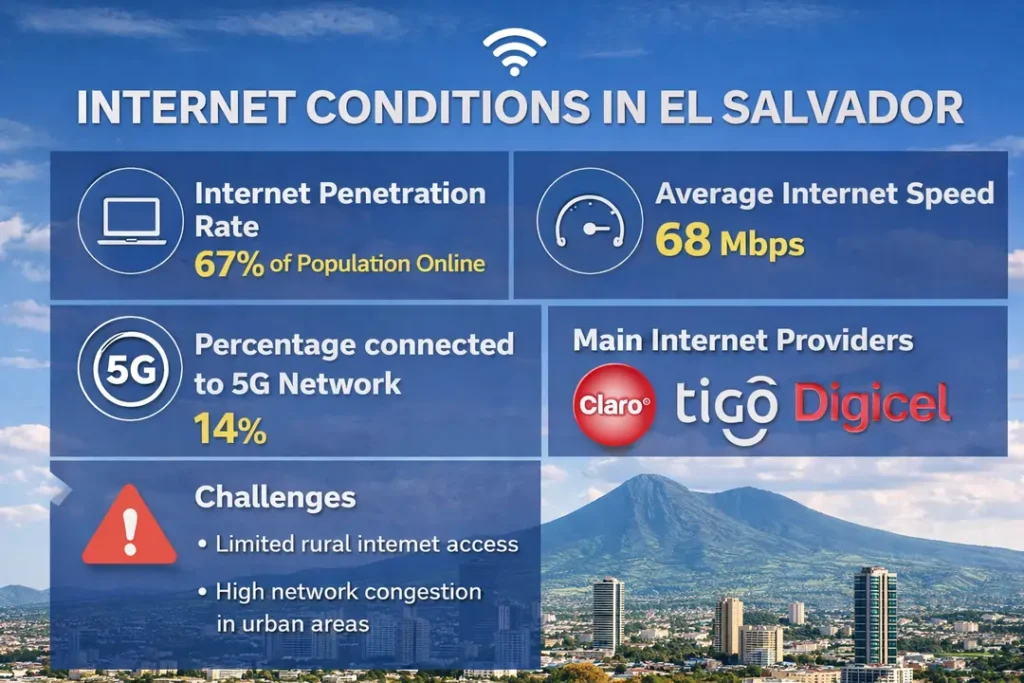
Internet Conditions in El Salvador
Internet use in El Salvador is largely shaped by where and how people connect rather than whether access exists at all. In urban areas, connectivity supports most modern online activity, while consistency — not availability — is the main variable users notice.
Home broadband, office networks, and mobile data in cities are generally capable of handling streaming, video calls, and cloud-based work. Public Wi-Fi is also common, but like most shared networks, performance can fluctuate during busy periods.
Rather than experiencing frequent outages, users are more likely to encounter:
- Evening congestion on shared residential or café Wi-Fi
- Variable latency on mobile data during peak hours
- Inconsistent performance between different neighborhoods
This makes El Salvador different from countries where connectivity is unreliable by default. Here, VPN performance is usually determined by routing efficiency and server selection rather than basic network instability.
VPNs that use modern protocols and maintain efficient regional routing tend to perform consistently across home broadband, public Wi-Fi, and mobile data — particularly when connecting to nearby servers.
Related: To see how leading VPNs compare across everyday use cases, view our VPN comparison table or read our breakdown of why VPN performance can vary even on fast connections.
VPN Legality & Everyday Use in El Salvador
Using a VPN in El Salvador is legal. There are no laws that prohibit individuals or businesses from using VPN services, and VPN software is freely available through standard app stores and providers.
In everyday practice, VPNs are used openly by remote workers, businesses, travelers, and privacy-conscious users. Their use is not treated as unusual, nor is it associated with restricted or prohibited online activity.
El Salvador does not operate a nationwide internet censorship system. Access issues are far more likely to stem from network congestion, service instability, or platform-side regional policies than from government-level blocking.
Where VPNs are most commonly used is on shared or semi-public networks — such as cafés, co-working spaces, offices, and apartment buildings — where traffic is visible by default and network policies are outside the user’s control.
In this context, VPNs function as a privacy and consistency layer, encrypting traffic and reducing exposure to logging or traffic management rather than bypassing restrictions.
Related reading: If you want a clearer breakdown of how VPNs work in normal, non-technical terms, see our VPN explained guide and our analysis of free vs paid VPNs and why reliability matters.
Best VPNs for El Salvador
El Salvador’s improving internet infrastructure changes what matters most when choosing a VPN. In urban areas, connections are generally stable enough that raw recovery features matter less than consistent speeds, low latency, and reliable access to international services.
The best VPNs for El Salvador are those that perform well on stable broadband and mobile networks, handle peak-hour congestion smoothly, and deliver predictable results without extensive configuration.
| VPN | Why It Works Well in El Salvador | Urban Performance | Streaming Access |
|---|---|---|---|
| ExpressVPN | Consistent speeds and low latency in cities | Excellent | Very good |
| NordVPN | Strong balance of speed, privacy, and flexibility | Very good | Very good |
| Surfshark | Good performance at lower cost | Good | Good |
ExpressVPN — Best Overall VPN for El Salvador
ExpressVPN performs particularly well in El Salvador because it maintains fast, consistent connections on already-stable networks. Its routing prioritizes low latency and smooth throughput, which is noticeable when streaming, video calling, or working online in urban environments.
Unlike environments where VPNs must constantly recover from poor connectivity, ExpressVPN in El Salvador benefits from its ability to stay fast and predictable during peak usage periods.
Pros
- Excellent speeds on urban broadband and mobile data
- Low latency for video calls and interactive apps
- Very simple apps with minimal setup
Cons
- Higher price than most competitors
- Limited advanced tuning for power users
Best for: Users who want fast, stable performance with zero configuration.
Full review: ExpressVPN Review (2026)
NordVPN — Best Balance of Performance & Control
NordVPN is a strong alternative for users in El Salvador who want more configurability while still benefiting from good speeds and reliable access to international services.
On stable connections, NordVPN delivers excellent throughput and offers more granular control over protocols and security features, which appeals to experienced users and remote workers.
Pros
- Very good speeds on stable networks
- Advanced privacy and security features
- Reliable streaming performance
Cons
- Interface can feel busy for beginners
- Optimal performance may require light configuration
Best for: Remote workers and users who want flexibility without sacrificing speed.
Full review: NordVPN Review (2026)
Surfshark — Best Budget VPN for El Salvador
Surfshark offers good everyday performance at a lower price point and works well on El Salvador’s urban networks for browsing, streaming, and general use.
While it does not match the consistency of ExpressVPN or NordVPN during peak hours, it remains a practical choice for users who want solid performance without premium pricing.
Pros
- Affordable long-term plans
- Unlimited device connections
- Simple apps across platforms
Cons
- Performance can dip slightly during peak congestion
- Less consistent latency for real-time applications
Best for: Budget-conscious users and households with multiple devices.
Full review: Surfshark VPN Review

Streaming Access in El Salvador
Streaming access in El Salvador is generally more reliable than in several neighboring Central American countries, particularly in urban areas where broadband and mobile networks are more consistent.
Local streaming libraries are limited by regional licensing, but a quality VPN allows users to access international catalogs by connecting through servers in other countries, most commonly the United States.
- Netflix: Stable access to US and select international libraries
- Disney+: US catalog available with compatible servers
- Amazon Prime Video: Region switching generally works well
- Live sports platforms: Performance depends on time of day and server choice
Because many users stream from home broadband rather than heavily shared tourist Wi-Fi, buffering and resolution drops are less frequent than in more tourism-dependent environments. That said, congestion during evening peak hours can still affect shared apartment or café networks.
For the best streaming experience in El Salvador:
- Use nearby US-based servers for lower latency
- Stream during off-peak hours when possible
- Prefer home or private Wi-Fi over busy public networks
Related streaming guides:
If a streaming app fails to load or shows the wrong region, the issue is usually related to cached location data or server selection rather than VPN blocking.

Gaming, Latency & Performance in El Salvador
Gaming performance in El Salvador is generally workable for casual and semi-competitive play, particularly in urban areas with stable broadband or strong mobile data. Compared to neighboring countries with more uneven infrastructure, connections here tend to be more predictable.
Most online games accessed from El Salvador connect to servers in North America. While latency is higher than for players located in the United States, it is often consistent enough for popular multiplayer titles, cooperative play, and ranked modes that are tolerant of moderate ping.
- Best server regions: US East Coast
- Casual & ranked play: Generally stable on good connections
- High-stakes competitive play: Possible, but latency-sensitive
A VPN can help in specific situations by improving routing stability or reducing packet loss on congested networks. However, it cannot eliminate the physical distance to game servers, and results will vary by provider and time of day.
For smoother gaming sessions in El Salvador:
- Connect to nearby North American VPN servers
- Avoid peak evening hours on shared networks
- Use wired or private Wi-Fi where available
Related gaming resources:
In practice, VPNs in El Salvador are most useful for maintaining consistent connections during gaming rather than achieving ultra-low latency.
VPN Troubleshooting in El Salvador
Most VPN issues in El Salvador are not caused by poor infrastructure, but by congestion, shared connections, or device-level conflicts. In cities, networks are generally stable, which makes troubleshooting more predictable than in countries with widespread instability.
If Your VPN Connects but Feels Slower Than Expected
This is usually related to peak-hour congestion rather than VPN malfunction.
- Switch to a nearby US-based server instead of distant regions
- Reconnect during off-peak hours if using shared apartment or café Wi-Fi
- Change VPN protocol to one optimized for speed and stability
If the VPN Drops When Switching Between Wi-Fi and Mobile Data
Urban users often move between networks throughout the day.
- Enable auto-reconnect in the VPN app
- Disable aggressive battery or background-data restrictions
- Restart the VPN after switching networks
If Streaming or Work Platforms Fail to Load
This is commonly caused by cached location data or temporary routing issues.
- Clear browser or app cache and retry
- Switch to another server in the same country
- Restart the VPN before opening the service
If a Public or Office Network Blocks VPN Traffic
Some managed networks limit encrypted connections.
- Complete any captive portal login before enabling the VPN
- Switch VPN protocols and reconnect
- Use mobile data temporarily if restrictions persist
Because El Salvador’s connectivity is generally stable, VPN issues are often resolved with small adjustments rather than provider changes. For structured, advanced fixes, see our VPN Troubleshooting Pro Guide (2026).
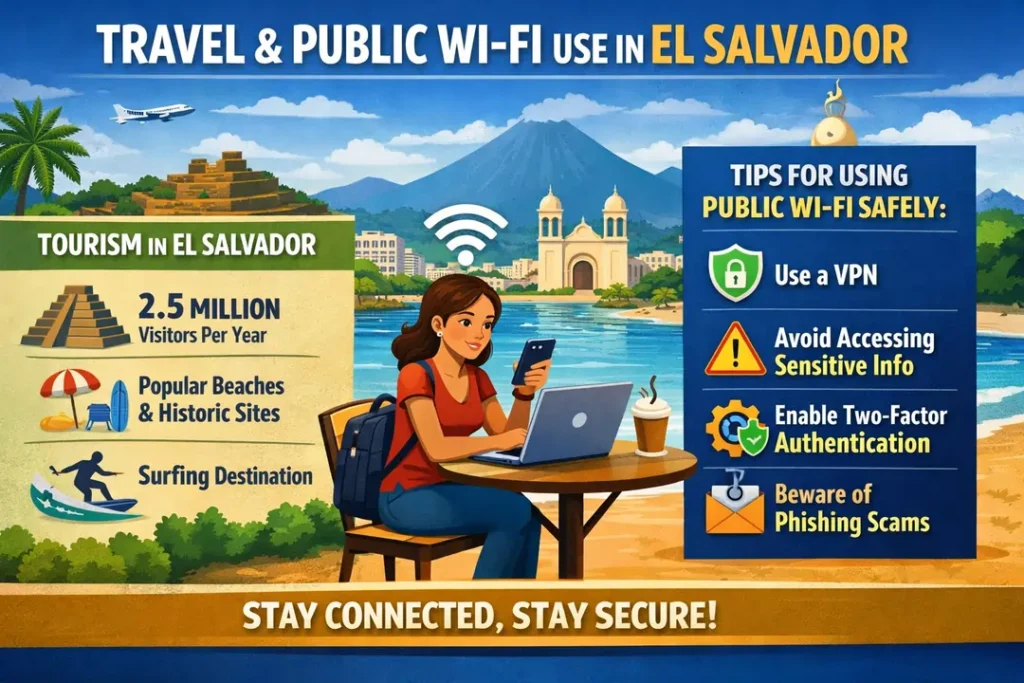
Travel & Public Wi-Fi Use in El Salvador
Public Wi-Fi in El Salvador is widely used and generally reliable in urban areas, particularly in cafés, shopping centres, offices, co-working spaces, and short-term accommodations. For travelers and visitors, shared networks are a routine part of everyday connectivity rather than a last resort.
While access is convenient, most public and semi-public networks prioritise availability over privacy. Traffic on these networks is typically visible by default to network operators and, in some cases, to other users on the same access point.
Common situations where travelers rely on public Wi-Fi include:
- Working from cafés or co-working spaces
- Accessing email, messaging, and cloud services while mobile
- Using shared apartment or hotel networks
Using a VPN on public Wi-Fi encrypts your connection and reduces exposure to passive monitoring or logging. This is particularly relevant when accessing personal accounts, work platforms, or financial services while traveling.
Because mobile data coverage is relatively strong in cities, many users alternate between Wi-Fi and mobile connections throughout the day. VPNs that reconnect quickly and handle network switching smoothly are especially effective in these environments.
Helpful resources for travelers:
Privacy, Data Handling & Online Expectations in El Salvador
El Salvador does not operate a broad internet censorship framework, and there is no public evidence of routine surveillance aimed at everyday internet users. Most people browse, communicate, and stream online without interference.
As in many countries, internet service providers may retain basic connection data for operational or compliance purposes. Public and semi-public networks — including those in cafés, offices, co-working spaces, and apartment buildings — often log activity to manage bandwidth and network security.
This does not suggest active monitoring of individuals, but it does mean that privacy is not guaranteed by default on shared networks. VPNs are therefore commonly used as a precautionary tool to encrypt traffic and reduce exposure to passive data collection.
For remote workers and frequent travelers, VPN use in El Salvador is primarily about maintaining control over personal data when switching between home broadband, public Wi-Fi, and mobile networks.
All VPN recommendations on Trusted VPN Reviews are grounded in independent testing and transparent evaluation criteria.
How we assess VPN privacy and security:
- Gold-Standard VPN Testing Methodology
- Lab-Tested VPN Audits & Authority Review (2026)
- VPN Lab Methodology Transparency Report (2026)
This ensures VPNs recommended for El Salvador meet clear standards for logging practices, encryption, and long-term reliability.
Getting an El Salvador IP Address
An El Salvador IP address allows you to appear online as if you are connecting from within the country. This is useful for accessing local services, region-specific websites, or maintaining continuity with Salvadoran accounts while traveling.
Common reasons people seek an El Salvador IP include:
- Accessing local banking, utilities, or government portals from abroad
- Keeping consistent access to Salvadoran services when traveling
- Testing how websites or apps behave for users inside El Salvador
The most reliable way to obtain an El Salvador IP address is through a reputable VPN provider that operates servers in the country. A VPN assigns a local IP while encrypting your connection, which is especially useful on public or shared networks.
Free proxies and unofficial IP tools are not recommended, as they are often unstable, heavily logged, or shared by large numbers of users.
Note: Some financial or account-based services may request additional verification when accessed via a VPN. This is a normal security measure rather than a connection error.

FAQs – VPN Use in El Salvador
Are VPNs legal in El Salvador?
Yes. VPN use is legal in El Salvador, and there are no restrictions on personal or commercial VPN services.
Is VPN use common in El Salvador?
Yes. VPNs are widely used by remote workers, businesses, travelers, and privacy-conscious users, particularly in urban areas where public and shared networks are common.
Does El Salvador block websites or online platforms?
No. El Salvador does not operate a nationwide internet censorship system. Access issues are typically caused by network congestion, platform-level regional policies, or local connectivity conditions.
Should I use a VPN on public Wi-Fi in El Salvador?
Yes. While public Wi-Fi is generally reliable in cities, it is not private by default. A VPN encrypts your traffic and protects personal accounts, work tools, and financial access.
Can a VPN help with streaming and international services?
Yes. A VPN allows access to international streaming libraries and online services by routing traffic through servers in other countries, subject to local bandwidth and congestion.
Is a VPN useful for expats and long-term residents?
Yes. Expats and remote workers commonly use VPNs to maintain consistent access to banking, cloud platforms, and international services when switching between networks.
How El Salvador Compares Within Central America
El Salvador stands out in Central America for its relatively strong urban connectivity and improving digital infrastructure. VPN use here focuses more on privacy, consistency, and access rather than compensating for widespread instability.
| Location | Connectivity Profile | Privacy Environment | Guide |
|---|---|---|---|
| Central America (Regional) | Mixed | Varies by country | Central America VPN Hub |
| El Salvador | Urban-reliable, improving infrastructure | Moderate | Current Page |
| Guatemala | Urban–rural divide | Moderate | Guatemala VPN Guide |
| Honduras | Highly variable, shared infrastructure | Moderate | Honduras VPN Guide |
| Belize | Tourism-heavy, shared networks | Strong | Belize VPN Guide |
| Nicaragua | Inconsistent access | More sensitive | Nicaragua VPN Guide |
Useful VPN Resources for Travelers & Expats
- Best VPNs for Travel & Border Crossings
- Best VPNs for Beginners
- Free vs Paid VPNs — What Actually Matters
- Advanced VPN Troubleshooting Guide
Final Analysis: Do You Need a VPN in El Salvador?
El Salvador offers one of the more reliable urban internet environments in Central America, and most users can browse, stream, and work online without major disruption.
However, reliability does not automatically equal privacy. Public and shared networks remain common, and data is not encrypted by default. For this reason, VPNs are widely used as a practical privacy and consistency tool rather than a necessity driven by restrictions.
For travelers and remote workers, a VPN helps secure connections across cafés, apartments, offices, and mobile networks. For long-term residents, it provides predictable access to international services and online accounts.
The most suitable VPNs for El Salvador are those that deliver consistent speeds, low latency on stable connections, and reliable access to global services without excessive configuration.
This guide is part of our wider Central America VPN analysis, based on independent testing, real-world usage data, and transparent evaluation standards. For broader comparisons, see our Best VPNs of 2026 and verified VPN test results.