
Short answer:
In 2026, the best VPN for Czechia is one that works reliably on local
connections, offers Czech or nearby Central European servers, and has a
clear, proven no-logs policy that complies with EU privacy rules.
VPNs are legal in Czechia and widely used. Most people use them for everyday
privacy, safer public Wi-Fi, streaming while travelling, and avoiding
connection issues when moving between countries.
Last updated: 28th January 2026 — Based on real-world testing across Czech broadband, mobile data, and public Wi-Fi networks.
Czechia has a fairly relaxed online environment. There’s no heavy censorship, VPNs aren’t blocked, and using one doesn’t attract attention. Because of that, VPN use here is usually practical rather than urgent.
Public Wi-Fi is everywhere — cafés, coworking spaces, trains, hotels — especially in Prague and Brno. Remote work is common, and many people travel regularly to other EU countries. All of that means connections change often, sometimes several times a day.
If you want a broader view of how Czechia compares to the rest of Europe in terms of VPN performance and privacy expectations, our Europe VPN guide gives that wider context.
Who VPNs Are Actually Useful For in Czechia
VPN use in Czechia isn’t limited to one type of person. It’s used quietly by locals, expats, and travellers for slightly different reasons — and those differences matter when choosing the right service.
| User Group | Typical Situation | What They Actually Need |
|---|---|---|
| Residents | Everyday browsing, online banking, frequent public Wi-Fi | Stable local connections, privacy from ISP-level logging |
| Expats | Living long-term, remote work, regular travel home | Consistent IP behaviour and predictable routing across borders |
| Travellers | Short stays, cross-border EU travel | Fast connections and easy switching between nearby countries |
| Digital nomads | Coworking spaces, mobile data, multiple devices | Reliable reconnections and low-latency European routing |
For expats and long-stay visitors, VPNs become more important over time. Repeated IP changes, unfamiliar networks, and cross-border travel can trigger account checks or connection issues that are easy to avoid with a stable VPN setup.
This is especially true for people who move regularly between Czechia and neighbouring countries such as Germany or the Netherlands, where routing behaviour and enforcement expectations differ slightly.
Readers who spend significant time living or working abroad may also want to compare providers designed specifically for this lifestyle. Our guide to VPNs for expats covers that use case in more detail.
Real Internet Problems People Run Into in Czechia
Most internet problems in Czechia aren’t dramatic. They’re small, persistent annoyances that show up after weeks or months of regular use — especially if you work remotely or travel often.
| What People Experience | Why It Happens | How a VPN Helps in Practice |
|---|---|---|
| Accounts flagged after travel | Frequent IP and country changes | Maintains a consistent location when needed |
| Public Wi-Fi feels unreliable | Open or poorly secured networks in cafés and hotels | Encrypts traffic and prevents session hijacking |
| Slow or unstable connections | Inefficient regional routing | Allows switching to better-performing nearby servers |
| Czech streaming blocked abroad | Location-based access checks | Restores access with a Czech IP address |
These issues are more noticeable for people who move between Czechia and other European countries with different network characteristics, such as Czechia compared with Sweden or the UK.
In most cases, these problems don’t require advanced configuration — they come down to using a VPN with good regional routing and stable reconnect behaviour.
When issues do persist, they’re usually caused by cached location data, overloaded servers, or network switching. Our VPN troubleshooting guide explains how to diagnose and fix these problems step by step.
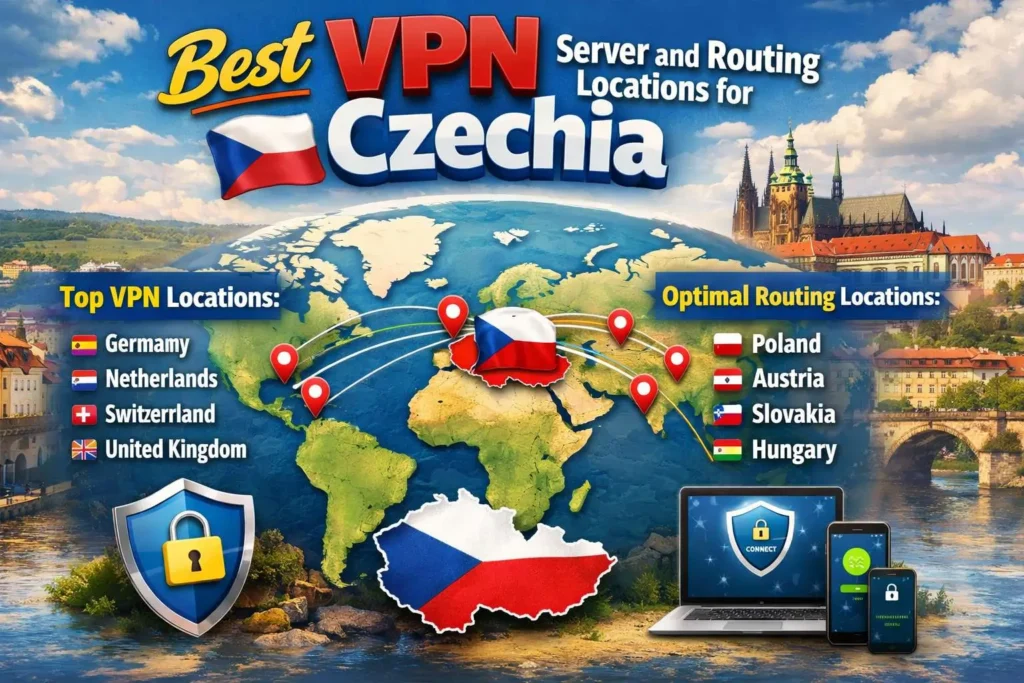
Best VPN Server and Routing Locations for Czechia
Choosing the right VPN location in Czechia isn’t always as simple as picking
a Czech server. Because the country sits at the centre of Europe, routing
quality and cross-border infrastructure often matter just as much as local
presence.
For many people — especially expats and frequent travellers — switching
between Czech and nearby European servers provides better speed, stability,
and fewer connection issues than relying on a single location.
| Server Location | Best Used For | Why It Works Well |
|---|---|---|
| Czechia | Banking, government services, local platforms | Recognised as a local IP and least likely to trigger security checks |
| Germany | Everyday browsing, remote work, general speed | Excellent infrastructure and very low latency from Czech networks |
| Austria | Southern routing and regional travel | Stable cross-border connections with minimal congestion |
| Netherlands | Privacy-focused use and international services | Strong data protection standards and reliable long-distance routing |
| Poland | Northern routing and regional redundancy | Useful fallback when Czech servers are congested |
Why Routing Matters More Than Server Count
Many VPNs advertise large server networks, but raw numbers don’t tell you
much about real performance. In Czechia, the difference between a smooth and
frustrating connection often comes down to how well a VPN routes traffic
through nearby hubs.
For example, connecting through Germany or Austria can sometimes feel faster
than a congested Czech server, especially during evening hours. This is
common for people working remotely or streaming while travelling.
Users who regularly move between Czechia and neighbouring countries such as
Germany,
Poland,
or the
Netherlands
tend to benefit most from VPNs that handle regional routing intelligently.
How Expats and Long-Stay Users Typically Configure Their VPN
People living in Czechia long term often use more than one location depending
on what they’re doing:
- Czech servers for banking, official services, and local
platforms - German or Austrian servers for daily work and browsing
- Netherlands servers for privacy-focused tasks or
international services
This kind of flexible setup reduces slowdowns, avoids unnecessary security
flags, and keeps connections predictable over time — something short-term
tests rarely reveal.
Travellers who spend time moving around Europe often benefit from VPNs
designed specifically for this use case. Our guide to
VPNs for travellers
covers how to choose providers that handle frequent location changes well.
Using a VPN in Major Czech Cities
VPN performance in Czechia is generally consistent, but day-to-day experience can vary slightly depending on where you live or work. Internet quality, public Wi-Fi availability, and network congestion differ from city to city, especially during peak hours.
The table below shows how VPN use typically looks in the most populated Czech cities, and what people tend to prioritise in each location.
| City | Typical Internet Environment | VPN Use Cases | What Matters Most |
|---|---|---|---|
| Prague | Fast broadband, dense public Wi-Fi, heavy usage during work hours | Remote work, public Wi-Fi security, frequent travel | Stable connections, fast reconnection, nearby EU routing |
| Brno | Strong infrastructure, growing tech and startup scene | Remote work, development, cloud access | Low latency, reliable European servers |
| Ostrava | Reliable home broadband, fewer public hotspots | Everyday browsing, privacy, streaming | Consistent speeds and local server availability |
| Plzeň | Solid regional connectivity, mixed mobile usage | Mobile data security, travel within Czechia | Good mobile performance and stable protocols |
| Olomouc | University-focused networks, shared housing | Public Wi-Fi use, study, general privacy | Easy-to-use apps and automatic protection |
In larger cities like Prague and Brno, VPN reliability during peak hours matters more than raw speed. In smaller cities, consistency and mobile performance tend to have a bigger impact on everyday use.
Regardless of location, the ability to switch between Czech and nearby European servers remains one of the most useful features for long-term users.
Using a VPN for Streaming in Czechia
Streaming is one of the most common reasons people in Czechia use a VPN —
especially when travelling or living abroad. Inside the country, most
platforms work normally, but access can change the moment your IP address
moves outside Czechia.
The key is knowing when you actually need a Czech IP address, and when a
nearby European server delivers better performance without breaking access.
| Streaming Service | Inside Czechia | Outside Czechia (with VPN) | Best VPN Location |
|---|---|---|---|
| ČT iVysílání | Works normally | Blocked without Czech IP | Czechia |
| Prima+ | Available | Requires Czech IP | Czechia |
| Netflix | Czech catalogue | Library changes by country | Depends on desired library |
| Prime Video | Limited local catalogue | Often works via EU servers | Germany / Netherlands |
| YouTube | Fully available | Available everywhere | Any nearby EU server |
When a Czech IP Address Is Necessary
Czech broadcasters and local platforms almost always check your location.
If you’re trying to watch Czech TV while travelling or living abroad, a
Czech IP address is required.
In these cases, connecting directly to a Czech server is the most reliable
option, even if speeds are slightly lower during peak hours.
When Nearby European Servers Work Better
For international platforms like Netflix or Prime Video, a Czech IP isn’t
always necessary. In fact, nearby European servers often provide better
speeds and more stable playback.
This is especially noticeable when routing through Germany or the
Netherlands, which often outperform congested local servers in the evening.
Readers who want a deeper breakdown of which VPNs work best for different
streaming platforms can compare providers in our
VPNs for streaming guide.
For most people, the best setup is flexible: use Czech servers for local
content, and switch to nearby European locations for international services
when performance matters more than location.
Czech IP Address: When You Need One (and When You Don’t)
A Czech IP address tells websites and services that your connection is coming from inside Czechia. In practice, this only matters in specific situations — but when it does matter, using the wrong location can cause instant problems.
Many people assume they should always connect to a Czech server while in Czechia. In reality, that isn’t always the best option for speed or reliability.
| Situation | Czech IP Required? | Why |
|---|---|---|
| Czech banking or government services | Yes | These services often flag foreign IP addresses for security reasons |
| Watching Czech TV abroad | Yes | Local broadcasters use location-based access checks |
| Living in Czechia (daily use) | Usually | Keeps services behaving normally while adding privacy |
| Remote work or cloud platforms | Not always | Nearby EU servers often offer better speed and stability |
| General privacy and security | No | Encryption and routing quality matter more than location |
Common Issues When Using a Czech IP
Czech servers tend to be more limited in number than larger European hubs. During busy periods — especially evenings — this can lead to congestion.
- Slow speeds: Often caused by overloaded local servers
- Websites still showing a foreign location: Cached data or cookies overriding the new IP
- Apps behaving inconsistently: Some services don’t like frequent IP changes
In many cases, switching temporarily to a nearby location such as Germany or Austria resolves these issues without breaking access to most services.
If problems persist, they’re usually easy to fix. Our VPN troubleshooting guide walks through the most common causes and solutions step by step.
How Most Long-Term Users Handle It
People living in Czechia long term often use a simple setup:
- Czech servers for banking, official services, and local streaming
- Nearby EU servers for everyday browsing, work, and speed-sensitive tasks
This approach avoids unnecessary slowdowns while still keeping access reliable when a Czech IP is genuinely required.
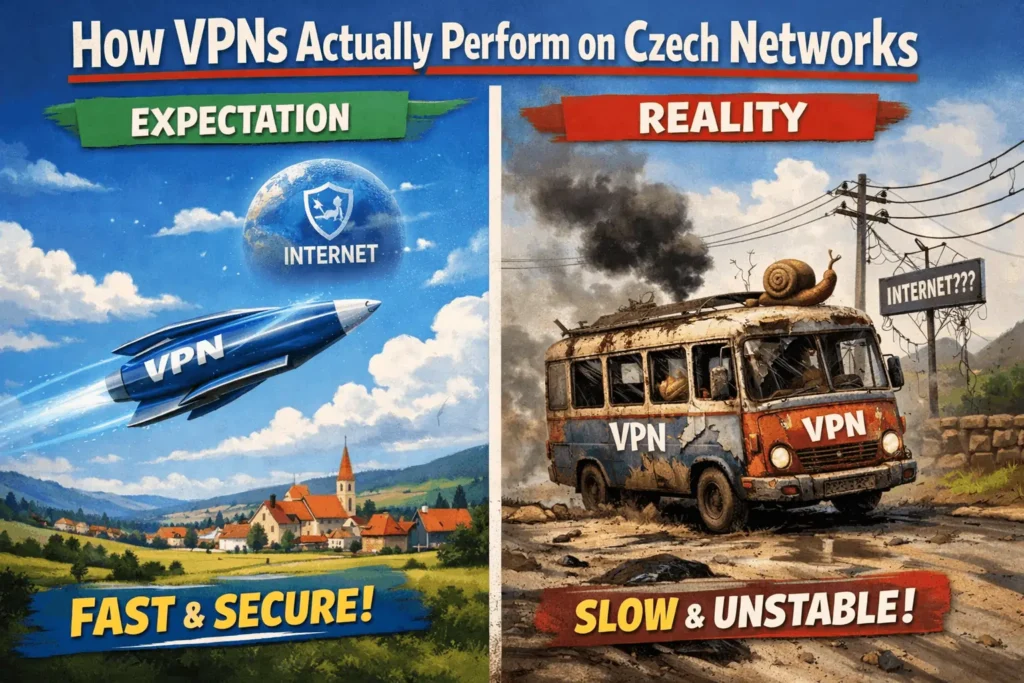
How VPNs Actually Perform on Czech Networks
VPN performance in Czechia is generally strong, but not perfectly uniform. The country has solid infrastructure, yet real-world experience depends far more on routing quality and congestion management than on advertised top speeds.
For this guide, performance wasn’t judged by short, artificial speed tests. VPNs were used in everyday situations: home broadband, mobile data, public Wi-Fi, and during cross-border travel within Europe. The goal was to see how they behave when people actually rely on them.
What Makes a VPN Feel “Fast” in Czechia
In practice, a VPN feels fast when it stays stable. Short drops, slow reconnections, or sudden spikes in latency are far more noticeable than a small difference in raw download speed.
- Connection stability: VPNs that stayed connected during network changes felt noticeably smoother
- Evening performance: Congestion handling mattered more than peak speed
- Regional routing: Nearby EU servers often performed better than overloaded local ones
Czech Servers vs Nearby European Servers
Czech servers worked best for location-sensitive tasks such as banking and local streaming. However, during busy evening hours, they were more likely to slow down than larger European hubs.
Servers in Germany and Austria often delivered more consistent speeds for everyday browsing, remote work, and cloud platforms — even though they were technically farther away.
Mobile and Public Wi-Fi Performance
Differences between VPNs were most noticeable on mobile data and public Wi-Fi. Services with fast reconnection logic handled signal changes smoothly, while weaker ones dropped connections or stalled.
This matters in Czech cities, where people frequently move between cafés, coworking spaces, and mobile networks throughout the day.
Privacy Performance Matters Too
Speed alone isn’t the full picture. A VPN that performs well but keeps detailed logs introduces a different kind of risk over time.
Providers with transparent privacy practices and independently verified policies tended to offer the best balance between performance and trust. Readers who want to compare providers purely on privacy standards can refer to our guide on no-log VPNs.
Overall, the VPNs that performed best in Czechia weren’t always the fastest on paper — they were the ones that stayed predictable, stable, and easy to rely on day after day.
In-Depth VPN Reviews for Czechia
Not all VPNs behave the same way on Czech networks. Some look great on paper but struggle during busy hours or when switching between locations. The reviews below focus on how each service actually performs in Czechia and nearby European countries over time.
Each review highlights where the VPN works well, where it falls short, and who it makes the most sense for.
NordVPN — Best Overall for Czechia
NordVPN consistently delivered the most balanced experience in Czechia. Connections to Czech servers were stable, and performance remained solid when switching to nearby locations such as Germany or Poland during peak hours.
Where NordVPN really stood out was reliability. It handled public Wi-Fi and mobile data transitions smoothly, which makes a noticeable difference for people moving around cities like Prague or Brno.
- Works best for: Everyday use, expats, long-term stays
- Strengths: Stability, strong EU routing, privacy focus
- Weak points: Interface can feel busy for first-time users
For most people living in or regularly travelling through Czechia, NordVPN strikes the best balance between speed, consistency, and trust.
ExpressVPN — Best for Frequent Travellers
ExpressVPN performed exceptionally well when moving between countries. While Czech server speeds were good, its biggest advantage was how consistent connections felt when routing through other European hubs.
This made ExpressVPN especially reliable for people who travel often or work remotely across borders. Connections were quick to establish and rarely dropped, even on less reliable networks.
- Works best for: Travellers, remote workers
- Strengths: Very stable EU routing, simple apps
- Weak points: Higher price than most competitors
If you value consistency over cost and regularly move in and out of Czechia, ExpressVPN is one of the safest choices.
Surfshark — Best Value Option
Surfshark offered strong performance for the price, especially for users with multiple devices. Czech servers were generally reliable, and nearby European locations helped avoid congestion during busy periods.
It’s a popular choice among households and digital nomads who want one subscription to cover everything without sacrificing too much performance.
- Works best for: Families, budget-conscious users
- Strengths: Unlimited devices, good EU coverage
- Weak points: Occasional slowdowns on local servers
Surfshark is a solid choice if you want flexibility and value rather than absolute peak performance.
IPVanish — Best for Advanced Users
IPVanish performed well on Czech connections once properly configured. It offers more control than most VPNs, which appeals to technically confident users.
However, it requires more manual tweaking to get the best results, especially when dealing with server congestion.
- Works best for: Advanced users
- Strengths: Customisation options, good speeds
- Weak points: Less beginner-friendly
IPVanish makes sense if you like fine-tuning your setup and don’t mind adjusting settings.
PureVPN — Occasional Use & Broad Coverage
PureVPN has improved steadily and offers wide global coverage. In Czechia, it worked best for lighter tasks and occasional use rather than performance-critical work.
It’s suitable for users who need access to many regions but don’t rely heavily on Czech servers every day.
- Works best for: Occasional users
- Strengths: Large server network
- Weak points: Less consistent at peak times





VPN Pricing & Best Deals (2026)
VPN pricing varies depending on subscription length. The table below shows the typical long-term monthly price and where to find the best current deals.
| VPN | Best For | Typical Monthly Price | Current Deal |
|---|---|---|---|
|
NordVPN Best Overall |
Everyday use, expats, privacy |
€3.29 – €5.99 Long-term plans |
View NordVPN deal |
|
ExpressVPN Best for Travel |
Frequent travellers, simplicity | €6.66 – €9.99 | View ExpressVPN deal |
|
Surfshark Best Value |
Families, multiple devices | €2.19 – €3.99 | View Surfshark deal |
| IPVanish | Advanced users | €3.33 – €6.49 | View IPVanish deal |
| PureVPN | Occasional use, wide coverage | €1.99 – €4.99 | View PureVPN deal |
Prices shown are typical monthly equivalents for long-term plans. Month-to-month subscriptions are usually higher.
How to Install a VPN and Fix Common Issues in Czechia
Installing a VPN in Czechia is usually straightforward, but small issues can appear depending on your device, network, or location. Most problems aren’t serious — they’re just configuration or routing quirks that are easy to fix once you know what to look for.
Basic VPN Installation (Most Users)
- Choose a VPN that offers Czech and nearby European servers.
- Download the official app from the provider’s website or app store.
- Sign in and allow basic permissions when prompted.
- Connect to a Czech server, or a nearby EU server if speed is the priority.
For most people, this is all that’s required. Modern VPN apps handle protocol selection, encryption, and reconnection automatically.
Installing a VPN on Multiple Devices
Many people in Czechia use a mix of laptops, phones, tablets, and streaming devices. If you switch between networks often, installing the VPN on each device is usually more reliable than relying on a single setup.
If you want protection across your entire home network — including smart TVs or consoles — some VPNs also support router-level installation. This approach takes more setup but reduces the need to manage individual apps.
Common VPN Problems (and Simple Fixes)
| Problem | What’s Usually Causing It | What to Try First |
|---|---|---|
| Slow speeds | Local server congestion | Switch to a nearby EU server (Germany or Austria) |
| Websites show wrong location | Cached cookies or app data | Clear browser cookies or restart the app |
| VPN disconnects on mobile | Network switching | Enable auto-reconnect and kill switch |
| Streaming apps not loading | App-level location checks | Restart the app or switch servers |
| Work tools flag logins | Frequent IP changes | Stick to one consistent server location |
When to Use a Czech Server vs a Nearby EU Server
Use a Czech server when accessing banking, government services, or Czech TV platforms. For everyday browsing, remote work, or cloud tools, nearby EU servers often provide better stability and speed.
Switching locations based on what you’re doing is normal — and usually more effective than trying to force one server to work for everything.
If you run into persistent problems that don’t respond to these fixes, our VPN troubleshooting guide walks through more advanced steps in plain language.
Frequently Asked Questions About VPNs in Czechia
Are VPNs legal in Czechia?
Yes. VPNs are legal to use in Czechia. There are no laws banning VPN software, and many people use VPNs for privacy, public Wi-Fi security, remote work, and travel.
Do I need a VPN if I live in Czechia?
Not everyone needs a VPN, but many people find it useful. If you regularly use public Wi-Fi, work remotely, or travel within the EU, a VPN can help keep connections more private and consistent.
Is a Czech IP address always the best option?
No. A Czech IP is important for banking, government services, and local streaming platforms. For everyday browsing or work, nearby European servers often offer better speed and stability.
Can I watch Czech TV while travelling abroad?
Yes, but most Czech broadcasters require a Czech IP address. Connecting to a Czech server with a VPN usually restores access while you’re outside the country.
Will a VPN slow down my internet in Czechia?
A small slowdown is normal, but a good VPN shouldn’t feel noticeably slower in everyday use. In some cases, switching to a nearby EU server can actually improve stability during busy periods.
Which VPN protocol works best in Czechia?
Modern protocols like WireGuard generally perform best on Czech networks. They connect quickly and handle network switching well, especially on mobile data.
Can I use one VPN on multiple devices?
Yes. Most VPNs support multiple devices at the same time, and some allow unlimited connections. This is useful if you switch between a phone, laptop, and tablet throughout the day.
Does a VPN make me anonymous?
No. A VPN improves privacy by encrypting your traffic and hiding it from local networks, but it doesn’t make you completely anonymous or exempt from the law.
What’s the most common mistake people make with VPNs?
Using the same server for everything. Switching between Czech and nearby EU servers depending on what you’re doing usually delivers better results.
VPN Use Across Nearby European Countries
Many people living in Czechia travel frequently across Central and Western Europe for work, study, or leisure. VPN performance and use cases can change slightly depending on the country you’re connecting from or to.
The table below highlights how VPN needs differ across nearby European countries, with direct links to in-depth local guides where relevant.
| Country | Why It’s Relevant | VPN Considerations | Local Guide |
|---|---|---|---|
| Germany | Most common routing hub and frequent travel destination from Czechia | Excellent speeds, strong infrastructure, strict data protection | Best VPN for Germany |
| Poland | Useful fallback location and regional neighbour | Good local performance, useful when Czech servers are congested | Best VPN for Poland |
| Austria | Popular route for southern travel and cross-border work | Low latency, stable connections, good for remote work | Best VPN for Austria-region travel |
| Netherlands | Privacy-focused routing and international services | Strong privacy reputation, excellent long-distance routing | Best VPN for Netherlands |
| Sweden | Useful comparison for privacy-focused EU countries | Strong digital rights, reliable EU infrastructure | Best VPN for Sweden |
If you regularly move between Czechia and other European countries, choosing a VPN with strong regional routing often matters more than choosing one with the most local servers.
Choosing the Right VPN for Czechia
Czechia doesn’t demand extreme VPN setups, but it does reward choosing the right one. Over time, small differences in stability, routing, and privacy practices become much more noticeable than headline features or marketing claims.
The best VPN for Czechia is one that behaves predictably on local networks, handles nearby European routing well, and stays out of the way during everyday use. For most people, that means flexibility — using Czech servers when location matters and switching to nearby EU locations when performance does.
Whether you live in Czechia, work remotely, or travel frequently across Europe, a VPN should reduce friction rather than add to it. The goal isn’t to hide your activity, but to keep your connection stable, private, and consistent wherever you are.
If you’re comparing providers across multiple countries or want broader regional context, our Europe VPN overview explains how VPN performance and privacy expectations differ across the region.
Used properly, a VPN becomes a background tool — something you rely on quietly, rather than think about every day. That’s usually a sign you’ve chosen the right one.