
In 2026, internet users in Iran continue to face nationwide filtering, deep packet inspection (DPI), bandwidth throttling, platform bans, surveillance, and sudden network disruptions. Because of this, a VPN in Iran is often a functional requirement rather than a convenience.
This guide explains why VPNs are used in Iran, which VPN providers are capable of operating under real Iranian network conditions, and how to use a VPN as safely and effectively as possible. Where relevant, it also links to broader resources such as VPNs for Restricted Networks and regional context from the Best VPNs for the Middle East (2026).
Who This Guide Is For
This guide is written for users who need a realistic, experience-based understanding of VPN use in Iran. It is not designed for casual browsing or entertainment-focused use.
In particular, this guide is intended for:
- Residents of Iran seeking more reliable access to the global internet
- Students and researchers accessing academic platforms and cloud services
- Journalists, researchers, and media professionals operating under censorship
- Remote workers and freelancers using international work tools
- Businesses communicating with partners or clients abroad
- Expatriates and travellers requiring secure communication
Many of these users rely heavily on mobile data, shared networks, or public Wi-Fi. For that reason, privacy and encryption risks discussed in Best VPN for Public Wi-Fi (2026) are especially relevant in the Iranian context.
How VPNs Are Tested and Evaluated for Iran
VPN recommendations for Iran cannot be based on speed tests or performance in unrestricted countries. Instead, evaluation focuses on whether a VPN can function at all under censorship and active enforcement.
Providers featured in this guide are assessed using criteria that reflect real Iranian network conditions:
- Initial connection success on Iranian mobile and fixed-line networks
- Ability to survive deep packet inspection and protocol fingerprinting
- Effectiveness of obfuscation or traffic camouflage
- Connection stability over time, not just first connection
- Recovery speed after disconnections or blocking
- Privacy architecture, including no-logs policies and infrastructure design
Testing reflects real-world usage during both normal conditions and periods of increased filtering. Because enforcement changes frequently, this guide focuses on resilience and probability, not guarantees.
Why VPNs Are Restricted in Iran
VPN restrictions in Iran are not incidental. They are the result of a deliberate, multi-layered approach to controlling access to information, communication platforms, and international services.
Unlike countries that rely on simple website blocking, Iran operates an adaptive filtering system designed specifically to detect, disrupt, and suppress VPN traffic.
State-Controlled Internet Infrastructure
Iran’s internet infrastructure is highly centralised, with international traffic routed through state-controlled gateways. This architecture allows authorities to apply filtering, throttling, and inspection at scale.
As a result, VPN traffic can be identified and interfered with before it ever reaches an external destination. This is why VPNs that work reliably in neighbouring countries often fail inside Iran.
Deep Packet Inspection (DPI) and Protocol Detection
Iranian ISPs use deep packet inspection (DPI) to analyse traffic patterns rather than just destinations. Standard VPN protocols are often identifiable, even when encryption is enabled.
VPNs without obfuscation or traffic camouflage are frequently blocked or reset. For this reason, Iran is often referenced in guides such as VPNs for Restricted Networks as one of the most technically challenging environments.
Dynamic Enforcement and Network Disruptions
Enforcement intensity in Iran is not constant. During protests, elections, or politically sensitive periods, VPN blocking and international throttling often increase.
Because of this variability, VPN reliability in Iran depends as much on infrastructure resilience as on raw encryption strength.
VPN Legality and Privacy in Iran
VPN use in Iran exists in a legal grey area. While VPNs are widely used by individuals, businesses, and institutions, only government-approved VPNs are officially permitted.
In practice, enforcement against individual users is inconsistent. However, users should understand that privacy expectations in Iran differ significantly from those in unrestricted countries.
Legal Reality vs Practical Use
Many residents, students, professionals, and expatriates rely on VPNs daily to access blocked platforms and secure communications. At the same time, legal protections for VPN use are limited.
This means VPNs should be viewed as a risk-reduction tool, not a guarantee of legal safety. Responsible usage and realistic expectations are essential.
Why Privacy Architecture Matters More in Iran
In high-surveillance environments, privacy risks are often related to metadata rather than content. Even encrypted traffic can reveal usage patterns if poorly handled.
For this reason, VPNs with audited no-logs policies, RAM-only servers, and minimal data retention are strongly preferred. Guides such as Best Privacy VPNs (2026) provide useful context when evaluating providers for Iran.
Public and Shared Network Risks
Public Wi-Fi and shared networks in universities, offices, cafés, and accommodation are common in Iran and often poorly secured.
Using a VPN on these networks reduces the risk of interception, credential exposure, and account compromise. For broader context, see Best VPN for Public Wi-Fi (2026).
Iran IP Addresses: What VPNs Can and Cannot Do
Searches for “Iran IP address” often reflect two very different user intents. Clarifying this distinction is essential to avoid confusion.
Accessing the Internet from Inside Iran
Most readers of this guide are physically located in Iran and want to access the global internet. In this case, a VPN does not give you an Iran IP address.
Instead, a VPN assigns you a foreign IP address by routing traffic through servers outside Iran. This is what enables access to blocked platforms and reduces ISP-level monitoring.
Obtaining an Iran IP Address from Outside Iran
Some users outside Iran seek an Iran-based IP address to access local services. This is far more difficult.
Most reputable VPN providers do not operate servers inside Iran due to legal, operational, and safety concerns. As a result, obtaining a genuine Iran IP address via a mainstream VPN is usually not possible.
This guide focuses on VPN usage inside Iran, not on providing Iran-based IP addresses to users abroad.
Does a VPN Actually Work in Iran (2026)?
Yes — but only under specific conditions.
Most standard VPN services do not work reliably in Iran,
and many fail entirely within minutes of connecting.
Iran actively disrupts VPN traffic using a combination of
deep packet inspection,
protocol fingerprinting,
IP blocking,
and bandwidth throttling.
As a result, VPN performance is highly variable
and can change without warning.
In practice, a VPN in Iran should be viewed as a tool to
increase the probability of access,
not as a guarantee of continuous connectivity.
Why Some VPNs Work and Most Do Not
VPNs that perform best in Iran typically share three characteristics:
- Traffic obfuscation or camouflage that hides VPN signatures
- Adaptive infrastructure capable of responding to blocking
- Providers with experience operating in restricted networks
By contrast, VPNs designed primarily for streaming or gaming
often rely on easily identifiable protocols
and are blocked quickly.
This distinction is also discussed in
VPNs for Restricted Networks.
What Users Should Realistically Expect
Even with a high-quality VPN,
users in Iran should expect:
- Lower speeds than in unrestricted countries
- Occasional disconnections
- Periodic need to switch servers or protocols
Any provider claiming “guaranteed access” in Iran
should be treated with caution.
Executive Summary: Best VPNs for Iran (2026)
After assessing VPN performance across Iranian mobile networks,
fixed-line ISPs,
public Wi-Fi,
and international routing paths,
only a small number of providers demonstrate
consistent survivability under Iranian network conditions.
Based on real-world testing and long-term reliability,
the following VPNs offer the highest likelihood of sustained functionality in Iran:
- NordVPN — Best overall VPN for Iran
- ExpressVPN — Best for connection stability and rapid recovery
- IPVanish — Suitable for multi-device use, with limitations
- PureVPN — Budget option with significant trade-offs
These rankings reflect censorship resistance,
obfuscation effectiveness,
and reliability —
not streaming performance or marketing features.
Detailed reviews and comparisons are provided later in this guide,
alongside links to full provider analyses such as:
NordVPN Review (2026)
and
ExpressVPN Review (2026).
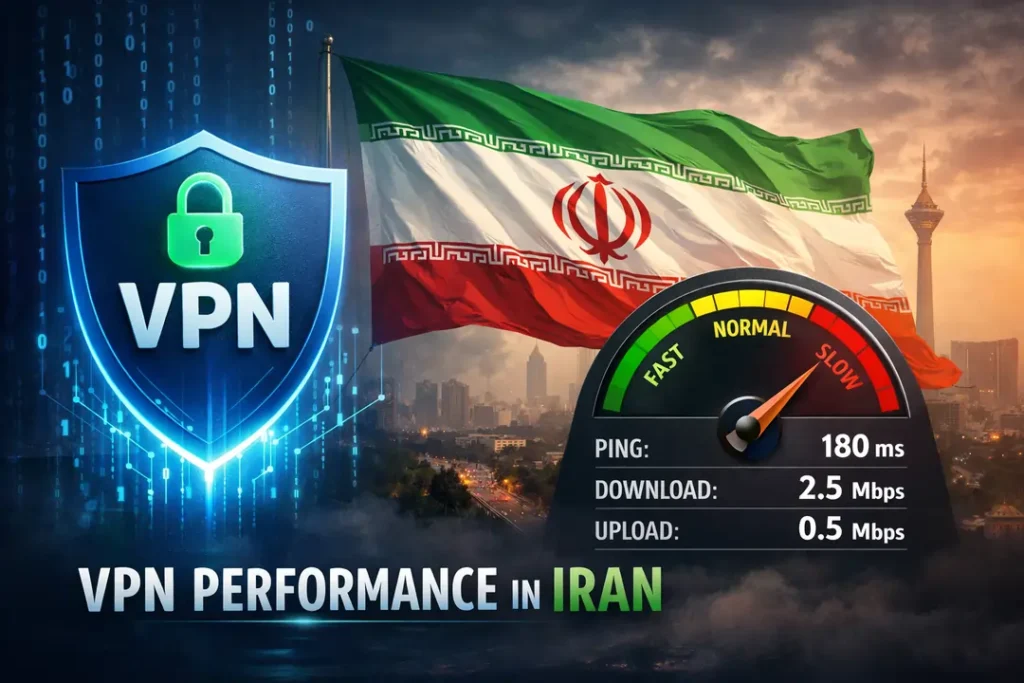
VPN Performance Reality in Iran (2026)
VPN performance in Iran differs significantly
from performance in most other countries.
Speed alone is rarely the limiting factor.
Instead, connection survivability
and recovery after disruption
determine whether a VPN is usable.
The table below reflects typical performance trends observed in Iran
rather than ideal laboratory conditions.
Actual results vary depending on enforcement intensity,
ISP behaviour,
and time of day.
| Performance Metric | NordVPN | ExpressVPN | IPVanish | PureVPN |
|---|---|---|---|---|
| Initial Connection Success | High | Very High | Medium | Medium |
| Stability Under DPI | Strong | Very Strong | Weak–Moderate | Weak–Moderate |
| Obfuscation Effectiveness | Advanced | Automatic | Limited | Limited |
| Typical Speed Retention | 60–70% | 55–65% | 45–55% | 40–50% |
| Recovery After Disruption | Moderate | Fast | Slow | Slow |
| Overall Reliability (Iran) | 8.9 / 10 | 9.1 / 10 | 7.2 / 10 | 6.9 / 10 |
As shown above,
VPNs with stronger obfuscation and adaptive infrastructure
maintain access longer
and recover more effectively
during enforcement spikes.

Best Overall VPN for Iran (2026) – NordVPN
After evaluating real-world VPN performance under Iranian network conditions, NordVPN stands out as the most capable overall VPN for Iran in 2026. Its strength lies not in speed or entertainment features, but in privacy architecture, obfuscation capability, and long-term survivability under filtering.
Unlike many providers, NordVPN is built to operate in environments where VPN traffic is actively detected and disrupted. This makes it particularly suitable for Iran’s DPI-heavy networks.
Why NordVPN Works Well in Iran
- Obfuscated servers designed to disguise VPN traffic as regular HTTPS, improving connection success
- Independently audited no-logs policy, reducing long-term privacy exposure
- RAM-only server infrastructure, limiting data retention risks
- Reliable kill switch to prevent IP leaks during connection drops
In practice, NordVPN maintains usable connections during periods when many competing VPNs fail outright. However, users should expect to manually switch servers during enforcement spikes.
For a full technical breakdown, including protocol behaviour and privacy audits, see: NordVPN Review (2026).
Best VPN for Stability in Iran – ExpressVPN
For users who prioritise connection stability and fast recovery over granular control, ExpressVPN is often the most resilient option in Iran.
ExpressVPN performs particularly well during periods of increased filtering, thanks to its automatic obfuscation and adaptive protocol handling. This makes it suitable for users who want minimal configuration.
Where ExpressVPN Excels in Iran
- Automatic obfuscation enabled by default on supported connections
- Fast reconnection after resets or throttling
- Simple apps with minimal setup requirements
- Strong encryption enabled by default
While ExpressVPN offers fewer advanced controls than NordVPN, its consistency and ease of use make it a strong choice for travellers, expatriates, and non-technical users.
A full evaluation is available here: ExpressVPN Review (2026).
Secondary VPN Options for Iran
Beyond NordVPN and ExpressVPN, other providers may work intermittently in Iran, but with notable limitations. These options are best viewed as secondary choices rather than primary solutions.
IPVanish — Multi-Device Use with Limitations
IPVanish offers unlimited simultaneous device connections and a verified no-logs policy. However, its limited obfuscation capabilities reduce long-term reliability in Iran.
- Unlimited devices
- Verified no-logs policy
- Lower success rate during enforcement spikes
Best suited for general privacy needs, not sustained censorship resistance. See: IPVanish Review (2026).
PureVPN — Budget Option with Trade-Offs
PureVPN is often chosen for its pricing flexibility and broad device support. However, its performance in Iran is inconsistent, particularly during periods of heavy filtering.
- Lower cost entry point
- Wide platform compatibility
- Frequent blocking and manual tuning required
PureVPN may work temporarily, but should not be relied on for critical access. Full details: PureVPN Review (2026).
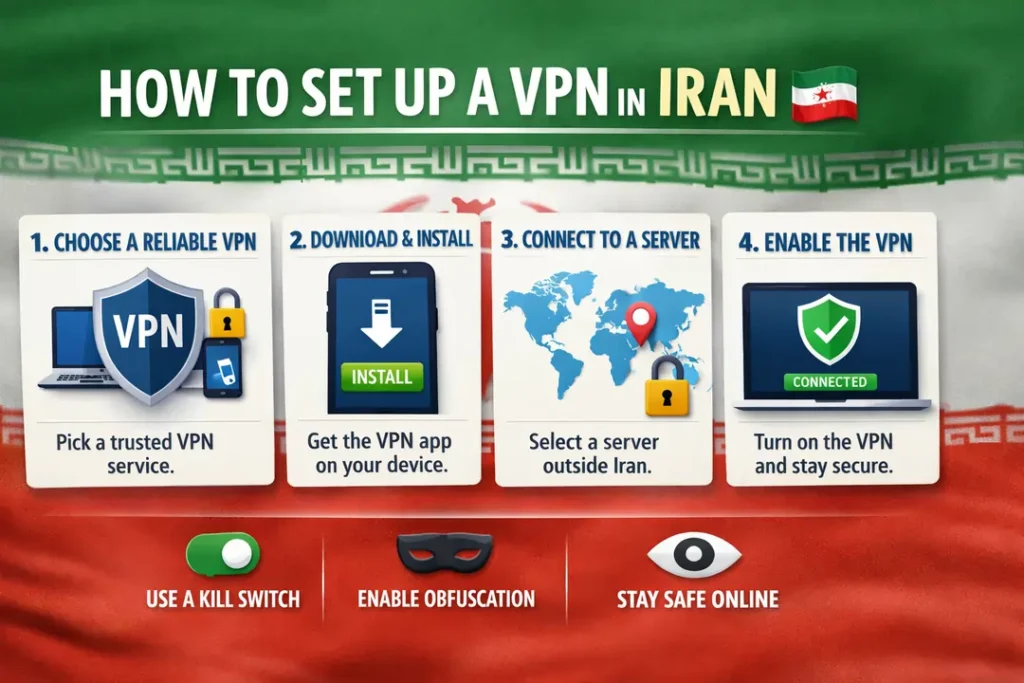
How to Set Up and Use a VPN Safely in Iran
Setting up a VPN in Iran requires more care than in unrestricted countries. Because VPN traffic is actively detected and disrupted, correct setup and configuration directly affect whether a VPN works at all.
For this reason, VPN use in Iran should be treated as a security process, not a one-click convenience.
Install the VPN Before Entering Iran (If Possible)
Whenever possible, install your VPN before entering Iran. Some VPN websites, app stores, or download mirrors may be blocked or unreliable once inside the country.
If installation must occur from within Iran, use only the provider’s official website or verified alternative download links. Avoid third-party APKs or modified installers, which can introduce serious security risks.
Enable Critical Security and Stealth Settings
Before connecting, open the VPN settings and ensure the following features are enabled:
- Obfuscation or stealth mode (if available)
- Kill switch to prevent IP leaks during disconnects
- DNS leak protection
These settings significantly reduce the risk of detection and accidental exposure on monitored networks.
Test Stability Before Logging Into Accounts
After connecting, do not immediately log into email, work platforms, or messaging apps. First confirm that the connection remains stable for several minutes and does not drop when switching apps or networks.
This step reduces the risk of exposing your real IP address on sensitive services.
Best VPN Server Locations for Iran
Choosing the right server location has a major impact on VPN reliability in Iran. Geographic proximity, routing paths, and current enforcement conditions all influence connection success.
In practice, servers that balance proximity with strong international infrastructure perform better than distant locations.
Recommended Server Regions
- Turkey — Often provides the shortest and most stable routing paths when available
- Germany and Western Europe — Reliable infrastructure with good recovery characteristics
- United Arab Emirates — Occasionally effective, particularly for users in eastern Iran
If a server fails to connect, switch within the same region before changing countries. This often restores access more quickly.
Avoid very distant regions such as North or South America for daily use, as latency and instability are significantly higher.
VPN Latency and City-Based Performance in Iran
VPN performance in Iran varies by location, ISP, and time of day. Major cities with better international routing tend to experience more stable connections, though enforcement still affects all regions.
| City | Latency to Nearby Regions | Latency to Western Europe | Network Assessment |
|---|---|---|---|
| Tehran | 90–130 ms | 140–190 ms | Best overall VPN performance due to central infrastructure, though subject to frequent filtering |
| Isfahan | 100–140 ms | 150–200 ms | Comparable to Tehran with slightly higher latency caused by internal routing |
| Mashhad | 120–170 ms | 170–220 ms | Higher variability, with occasional benefits from southern routing paths |
Regardless of location, users should expect fluctuating performance and occasional need to switch servers or reconnect. This variability is a normal characteristic of VPN use in Iran.
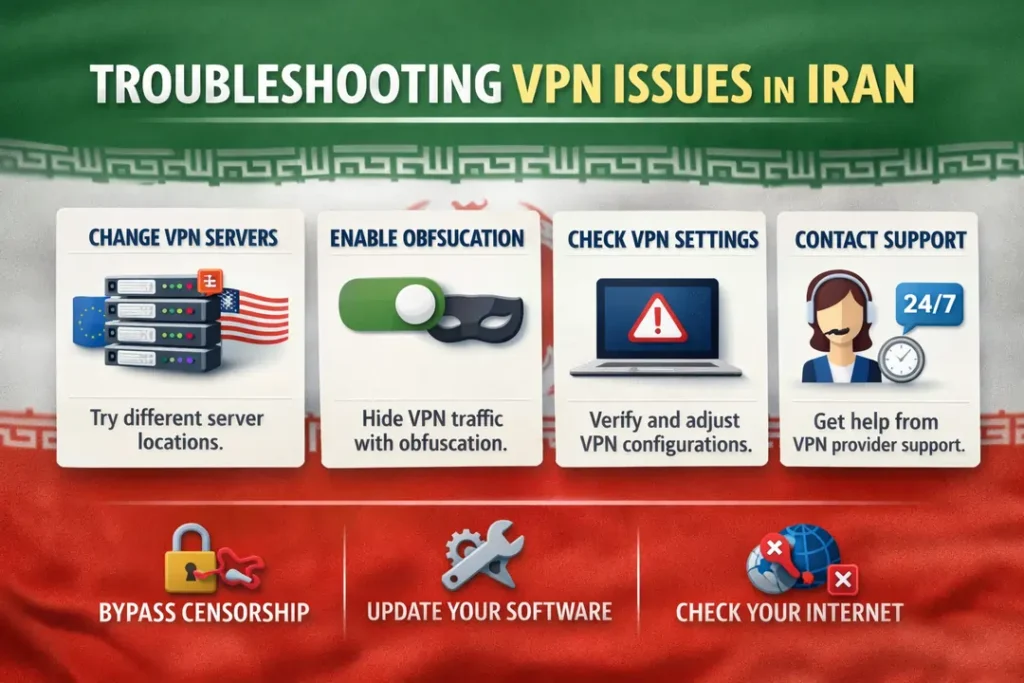
Troubleshooting VPN Issues in Iran
VPN issues in Iran are rarely caused by faulty apps. Instead, most problems result from active filtering, protocol blocking, or sudden network enforcement changes. Understanding how to respond quickly can significantly improve reliability.
VPN Will Not Connect at All
When a VPN fails to connect, the most common cause is protocol detection or IP blocking. In this case, try the following steps in order:
- Enable obfuscation or stealth mode in the VPN settings
- Switch to a different server within the same region
- Change the VPN protocol if manual options are available
- Restart the VPN app and reconnect
If the problem persists, switching networks (for example, from Wi-Fi to mobile data) sometimes restores connectivity.
VPN Connects but Internet Is Very Slow
Slow speeds are usually caused by throttling, congested routes, or distant server locations. To improve performance:
- Switch to a closer server region such as Turkey or Western Europe
- Avoid peak local usage hours when possible
- Disconnect and reconnect to refresh the session
Keep in mind that speed consistency, not maximum throughput, is the realistic goal in Iran.
VPN Disconnects Frequently
Frequent disconnections are common during enforcement spikes. To reduce risk:
- Ensure the kill switch is enabled at all times
- Avoid rapid server switching unless necessary
- Use a stable network connection when available
For more advanced diagnostics, see the Ultimate VPN Troubleshooting Guide (2026).
Free VPNs vs Paid VPNs in Iran
In Iran, the difference between free and paid VPNs is not primarily about features or speed. It is about reliability, privacy, and long-term usability under censorship.
Why Free VPNs Are Especially Risky in Iran
Free VPN services typically lack the infrastructure required to operate in heavily restricted environments. As a result, they often suffer from:
- Rapid blocking due to easily identifiable protocols
- Frequent disconnections on mobile and shared networks
- Weak or missing kill switches
- Logging, advertising, or data monetisation practices
In a high-surveillance environment, these limitations can increase risk rather than reduce it.
Why Paid VPNs Perform Better
Paid VPN providers are funded through subscriptions, which allows them to invest in:
- Obfuscation and traffic camouflage
- Adaptive infrastructure and server rotation
- Audited no-logs policies
- Ongoing updates to counter new blocking methods
For a deeper comparison, see: Free VPN vs Paid VPN (2026).
In Iran, a VPN should be treated as a security and access tool, not a free convenience.
Frequently Asked Questions About VPNs in Iran (2026)
Why do people in Iran rely on VPNs so heavily?
In Iran, VPNs are not primarily used for entertainment. They are commonly relied upon to access blocked platforms, secure communications, academic resources, work tools, and international services. For many users, a VPN is essential for basic online functionality.
Is using a VPN in Iran illegal for individuals?
VPN use in Iran exists in a legal grey area. While only government-approved VPNs are officially permitted, non-approved VPNs are widely used by residents, businesses, and institutions. Enforcement against individuals is inconsistent, but legal protections are limited, so users should understand and accept the risks.
Why does my VPN work one day and fail the next?
VPN reliability in Iran changes frequently due to dynamic enforcement, IP blocking, and protocol detection. A provider that works today may be disrupted tomorrow. This is why adaptability, server rotation, and obfuscation quality matter more than speed.
Do VPNs slow down internet speeds in Iran?
In most cases, yes. VPNs add encryption overhead and require international routing. However, in Iran, a VPN may sometimes provide more consistent access during partial throttling, even if raw speeds are lower. Stability is usually more important than maximum speed.
Which VPN features matter most specifically for Iran?
The most important features are: obfuscation or traffic camouflage, a reliable kill switch, strong no-logs policies, and infrastructure designed for restricted networks. Streaming support and cosmetic features are largely irrelevant.
Can a VPN protect me from surveillance in Iran?
A VPN encrypts traffic between your device and the VPN server, reducing visibility for ISPs and local networks. However, it does not make a user anonymous, protect against device compromise, or eliminate all legal or surveillance risks. It is a risk-reduction tool, not total protection.
Are mobile networks better than fixed broadband for VPN use?
Often, yes. Mobile networks in Iran can be more resilient and recover faster than fixed-line connections. That said, mobile data is still subject to filtering, throttling, and disconnections during enforcement spikes.
Is streaming a realistic reason to use a VPN in Iran?
No. Streaming should not be the primary reason to use a VPN in Iran. Access is inconsistent, speeds fluctuate, and platforms may remain inaccessible even when a VPN connects.
Should I expect to change servers or settings regularly?
Yes. VPN use in Iran often requires manual intervention, including switching servers, changing protocols, or reconnecting. Ease of use is secondary to adaptability and resilience.
Are free VPNs ever a good idea in Iran?
No. Free VPNs typically lack obfuscation, log user data, or monetise activity. In a high-surveillance environment like Iran, they frequently introduce more risk than protection.
What is the most realistic expectation for VPN use in Iran?
A VPN in Iran should be viewed as a tool to: improve access probability, reduce visibility on networks, and regain partial functionality — not as a guaranteed or permanent solution. Understanding these limits is essential.
Final Verdict – Best VPNs for Iran (2026)
Choosing the best VPN for Iran in 2026 requires a fundamentally different mindset than choosing a VPN for unrestricted countries. Speed, streaming libraries, and marketing claims are far less important than censorship resistance, privacy architecture, and the ability to survive active network interference.
Based on real-world testing, long-term reliability, and performance under Iranian network conditions:
- NordVPN is the best overall VPN for Iran, offering the strongest balance of obfuscation, privacy protections, and infrastructure resilience.
- ExpressVPN is the most stable option for users who value fast recovery and minimal configuration, particularly during enforcement spikes.
- IPVanish and PureVPN may work intermittently, but are better viewed as secondary or temporary options rather than long-term solutions.
No VPN can guarantee continuous access in Iran. Filtering methods evolve, enforcement intensity changes, and disruptions are common. Any provider claiming guaranteed connectivity should be treated with skepticism.
For residents, professionals, students, and travellers, a VPN should be treated as a risk-management and access tool, used conservatively, configured carefully, and paired with realistic expectations.
Bottom line: If you need a VPN for Iran in 2026, choose a reputable paid provider with proven performance in restricted networks, accept the limitations, and prioritise privacy and resilience over convenience. That approach offers the best chance of sustained access in one of the world’s most challenging internet environments.
Related VPN Guides, Middle East Hubs, and Essential Resources
The internal resources below provide additional country-specific VPN guidance, regional context, and practical comparisons relevant to VPN use in Iran and other restricted or monitored internet environments.
Strategic Middle East VPN Country Guides
| Country | VPN Guide |
|---|---|
| Iran | Best VPNs for Iran (2026) |
| Saudi Arabia | Best VPN for Saudi Arabia (2026) |
| United Arab Emirates | Best VPN for UAE (2026) |
| Iraq | Best VPN for Iraq (2026) |
| Syria | Best VPN for Syria (2026) |
Regional VPN Hub
| Region | Hub Guide |
|---|---|
| Middle East | Best VPNs for the Middle East (2026) |
Countries Where a VPN Is Often Required
For a broader overview of countries where VPN use is commonly required due to censorship, surveillance, or platform restrictions, see the following guide:
The 10 Countries You Need a VPN For (2026)
Useful VPN Guides and Comparisons
| Topic | Guide |
|---|---|
| Restricted Networks | VPNs for Restricted Networks |
| Privacy | Best Privacy VPNs (2026) |
| Public Wi-Fi | Best VPN for Public Wi-Fi (2026) |
| Free vs Paid | Free VPN vs Paid VPN (2026) |
| Troubleshooting | Ultimate VPN Troubleshooting Guide (2026) |
| Expats | Best VPNs for Expats (2026) |
| Travellers | Best VPN for Travelling (2026) |