


Chile has one of the most reliable and modern internet infrastructures in South America. Fibre broadband is widely available in major cities, mobile networks are stable, and access to the open internet is generally unrestricted.
Because of this, VPN use in Chile is typically practical rather than defensive. Most people are not trying to bypass censorship or unstable access. Instead, VPNs are used to improve everyday privacy, secure shared networks, maintain consistent access to services, and protect data while travelling or working remotely.
This stability is exactly what differentiates Chile from many neighbouring countries. Advice that assumes heavy restrictions or fragile infrastructure does not apply here. At the same time, Chile should not be treated as interchangeable with Europe or North America — regional routing, peak-hour congestion, and ISP-level differences still affect real-world performance.
In cities such as Santiago and Valparaíso, VPN performance is typically strong on both broadband and mobile connections. Outside major urban centres, speeds remain usable, but consistency can vary depending on provider, location, and time of day.
This guide explains whether you actually need a VPN in Chile, what it is realistically useful for, which risks to avoid, and which VPNs perform best under local conditions in 2026.
For regional context, see the South America VPN hub, or compare Chile with neighbouring countries such as Argentina, Peru, and Bolivia.
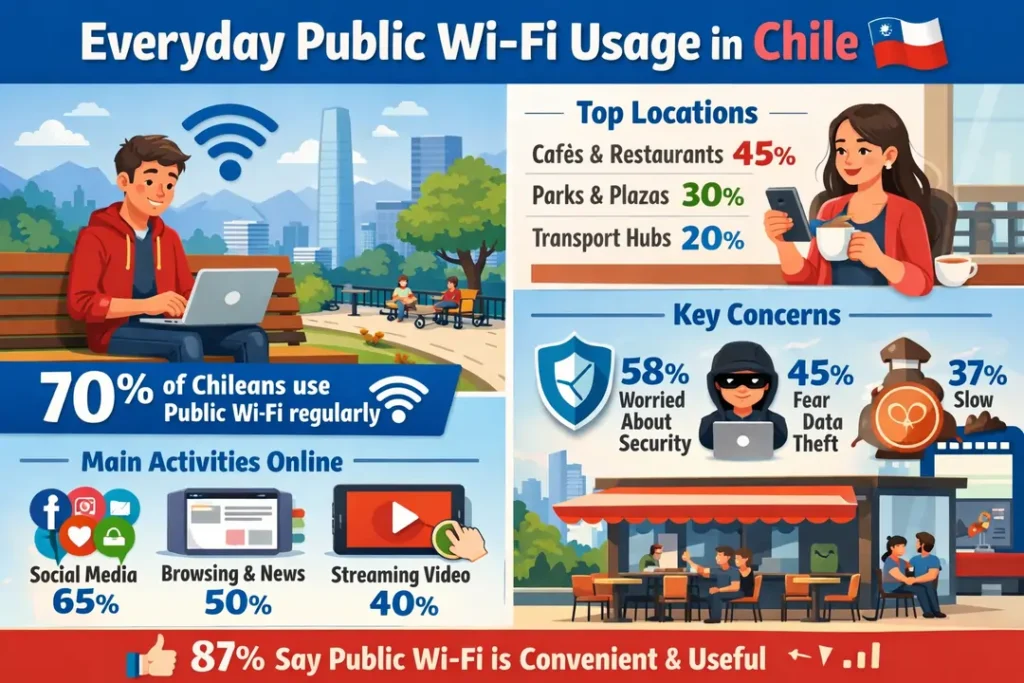
Why You Might Need a VPN in Chile
Chile does not require a VPN in the same way that more restricted or unstable internet environments do. Access to the open internet is broadly reliable, and most services function without interference.
However, many people still choose to use a VPN in Chile for practical, preventative reasons rather than necessity. The value of a VPN here lies in consistency, privacy, and risk reduction — not in bypassing heavy restrictions.
Public and Shared Networks Are Common
Cafés, apartment buildings, co-working spaces, universities, and hotels throughout Chile rely heavily on shared Wi-Fi networks. These environments are convenient, but they offer limited isolation between users.
A VPN is commonly used to protect:
- Login credentials and session data
- Email and cloud access on unsecured networks
- Financial and work-related traffic outside trusted connections
Even in countries with strong infrastructure, shared networks remain one of the most common sources of avoidable exposure.
ISP Visibility and Everyday Privacy
Internet service providers in Chile operate within modern regulatory frameworks, but that does not mean browsing activity is invisible. Like elsewhere, ISPs can observe connection metadata and traffic patterns.
Many users employ a VPN simply to reduce routine tracking, separate personal activity from network-level visibility, and maintain a more private baseline when browsing or working online.
Cross-Border Services and Account Access
VPNs are also widely used by people who rely on services tied to other countries. This includes banking platforms, work tools, and subscription services that behave differently depending on location.
For travellers, expats, and remote workers, a VPN helps maintain consistent access when switching networks, SIM cards, or temporarily leaving the country.
Security Without Overcomplication
In Chile, using a VPN is best understood as a security and consistency tool, not a workaround for broken access. When configured properly, a VPN adds a layer of protection without materially disrupting everyday internet use.
The sections that follow break down how Chile’s internet infrastructure affects VPN performance, what risks to avoid, and which use cases actually benefit from using one.


Internet Conditions in Chile
Chile has one of the strongest internet infrastructures in South America, particularly in major urban centres. Fibre broadband is widely deployed, mobile networks are reliable, and international routing is generally efficient. This creates a favourable baseline for VPN use.
That said, performance is not uniform nationwide. VPN behaviour in Chile is shaped by where you are, how you connect, and when you are online.
Urban vs Non-Urban Connectivity
In cities such as Santiago, Valparaíso, and Concepción, fibre connections are common and offer stable speeds with low latency. VPNs running on modern protocols typically perform close to non-VPN baseline speeds in these environments.
Outside major urban areas, connectivity is still usable but less consistent. Regional broadband and mobile connections can experience higher latency, variable speeds, and greater sensitivity to congestion. VPN performance here depends more on stability than raw throughput.
Broadband vs Mobile Networks
Home and office broadband connections in Chile provide the most predictable VPN performance. These are well suited to streaming, remote work, and sustained connections.
Mobile networks are reliable in cities but more variable when travelling or switching between regions. On mobile data, VPNs that handle packet loss and rapid network changes tend to perform better than those optimised purely for speed.
Peak Hours and Congestion
Evening congestion is noticeable in densely populated areas, particularly between early evening and late night. During these periods, both VPN and non-VPN traffic can experience reduced speeds.
This is not unique to Chile, but it does affect expectations. Slower performance during peak hours is usually a network limitation rather than a VPN failure.
What This Means for VPN Use
In practical terms, Chile’s internet conditions mean that:
- VPNs generally perform well in urban areas
- Mobile and regional connections benefit from resilient protocols
- Peak-hour slowdowns should be expected, with or without a VPN
- Provider quality matters less here than configuration and routing
These conditions make Chile well suited to a wide range of VPN use cases, from streaming and gaming to torrenting and remote work. The next sections break down where VPNs help most — and where expectations should be kept realistic.

The Dangers of Free VPNs in Chile
Free VPNs are widely used in Chile, particularly on mobile devices. The appeal is understandable — internet access is generally good, and many users assume a free VPN is sufficient for basic privacy.
In practice, free VPN services introduce risks that are often more significant than not using a VPN at all, especially on shared and public networks.
Logging and Data Monetisation
Operating a VPN infrastructure is expensive. Free providers commonly offset these costs by logging user activity and monetising data through advertising networks or third-party partnerships.
In Chile, where VPN use is largely about improving privacy rather than bypassing restrictions, this trade-off defeats the purpose. A VPN that actively records browsing behaviour does not meaningfully improve user privacy.
Injected Advertising and Traffic Manipulation
Many free VPN apps inject advertisements or alter web traffic at the network level. On shared Wi-Fi networks — such as cafés, apartments, or co-working spaces — this increases exposure rather than reducing it.
These practices can interfere with secure connections, break website functionality, and create additional attack surfaces.
Performance Issues Misattributed to Chile’s Internet
Free VPNs typically operate with overloaded servers, limited bandwidth, and poor routing. The resulting slow speeds and dropped connections are often mistaken for problems with Chile’s internet infrastructure.
In reality, Chile’s networks are capable of far better performance. Poor results are more commonly caused by the VPN service itself.
Mobile-Specific Risks
Mobile-first free VPNs frequently request excessive permissions, operate outside app store best practices, and lack transparency around data handling.
For users relying on mobile data while travelling or working remotely, these risks are amplified.
Why Paid VPNs Are the Safer Option in Chile
In a stable environment like Chile, a reputable paid VPN offers predictable performance, clearer privacy guarantees, and proper encryption without hidden trade-offs.
Understanding the differences between free and paid VPNs — and knowing which free services are not outright scams — is essential before choosing a provider. A detailed breakdown is available in the free VPN safety guide.
With free VPN risks understood, the next section covers the legal status of VPNs in Chile and how they are commonly used in everyday situations.

VPN Legality and Everyday Use in Chile
VPN use is legal in Chile. There are no laws that prohibit individuals, businesses, or travellers from using a VPN to secure their internet connection or protect their data.
VPNs are widely used across the country for legitimate purposes, including remote work, privacy on shared networks, and securing connections while travelling. Their use is considered normal rather than exceptional.
Legality Does Not Mean Anonymity
While VPNs are legal, it is important to understand what they do and what they do not provide. A VPN encrypts your connection and hides your activity from local networks and internet service providers, but it does not grant absolute anonymity.
Online services, platforms, and accounts still apply their own rules and monitoring. Using a VPN does not exempt users from terms of service or local laws.
How VPNs Are Commonly Used in Chile
In everyday use, VPNs in Chile are most often used to:
- Secure data on public and shared Wi-Fi networks
- Reduce routine ISP-level tracking
- Maintain stable access to work tools and cloud services
- Protect personal data while travelling
Unlike in more restrictive environments, VPN use in Chile does not typically require special configurations or obfuscation. Most reputable providers function normally using default settings.
Business, Remote Work, and VPN Use
VPNs are commonly used by businesses and remote workers to access internal systems, protect sensitive data, and maintain secure connections.
This type of usage is well understood and widely accepted. There is no expectation that VPN use alone raises concern or draws attention when used responsibly.
With legality and everyday usage clarified, the next section focuses on which VPNs perform best in Chile and why certain providers are better suited to local conditions.
Best VPNs for Chile (2026)
Chile’s stable internet infrastructure means that most reputable VPNs will function adequately. The difference between a good and a poor choice comes down to consistency, routing quality, and reliability during peak hours, rather than raw headline speeds.
The VPNs listed below have been fully reviewed and tested under real-world conditions and perform well under Chilean network conditions.
| VPN | Why it works well in Chile | Speed & Stability | Streaming suitability |
|---|---|---|---|
| ExpressVPN | Consistent routing, strong protocol implementation, and excellent stability across Chilean ISPs. | Excellent | Very good |
| NordVPN | Strong performance-to-price balance, reliable speeds, and good congestion handling. | Very good | Very good |
| Surfshark | Cost-effective option with solid mobile performance and flexible multi-device use. | Good | Good |
ExpressVPN — Best Overall Consistency
ExpressVPN performs exceptionally well in Chile due to its reliable routing and strong protocol behaviour. Connections remain stable across fibre and mobile networks, even during peak evening congestion.
Pros
- Very stable speeds on Chilean fibre connections
- Strong performance on public and shared Wi-Fi
- Minimal configuration required
Cons
- Higher price than budget-focused alternatives
Best for users who want a dependable VPN that works consistently without frequent tuning.
NordVPN — Best Balance of Performance and Value
NordVPN offers strong speeds in Chile, particularly in urban areas, and performs well for streaming and remote work.
Pros
- Fast, consistent speeds in major Chilean cities
- Good streaming reliability
- Competitive pricing for long-term plans
Cons
- Occasional speed variation on mobile networks
Best for users who want strong overall performance at a more moderate cost.
Surfshark — Best for Multi-Device and Budget Users
Surfshark performs reliably in Chile, particularly for users relying on mobile data or connecting multiple devices at once.
Pros
- Unlimited device connections
- Good performance on mobile networks
- Affordable long-term pricing
Cons
- Less consistent speeds during peak hours
Best for families, long-term travellers, or users prioritising cost over maximum speed.
With provider recommendations covered, the next section looks at how VPNs perform in Chile for streaming, gaming, and torrenting.

Streaming, Gaming, and Torrenting in Chile
Chile is one of the most capable South American countries for high-bandwidth internet use. Fibre broadband, reliable mobile networks, and relatively efficient routing make streaming, gaming, and torrenting viable for most users — including when using a VPN.
Performance is not identical in every situation. Results depend on location, connection type, and time of day. The tables below reflect realistic expectations under Chilean network conditions.
VPN Suitability by Use Case (Chile)
| VPN | Streaming | Gaming | Torrenting | Notes for Chile |
|---|---|---|---|---|
| ExpressVPN | Excellent | Good | Good | Very stable on fibre; minimal peak-hour drops |
| NordVPN | Very good | Very good | Very good | Strong balance for urban users and expats |
| Surfshark | Good | Fair | Good | Best suited to mobile and multi-device setups |
Streaming with a VPN in Chile
Streaming is one of the most common reasons people use a VPN in Chile. In urban areas with fibre broadband, reputable VPNs typically support stable HD and 4K streaming.
| Connection Scenario | Expected Performance | What to Expect |
|---|---|---|
| Urban fibre + VPN | HD / 4K stable | Minor slowdowns possible during evening peaks |
| Urban mobile + VPN | HD usually stable | More sensitive to congestion and signal quality |
| Regional broadband | HD variable | VPN stability matters more than speed |
A VPN does not increase available bandwidth. If buffering occurs during peak hours, the limiting factor is usually local congestion rather than the VPN itself.
For platform-specific behaviour, see the streaming VPN overview and the Netflix VPN guide, which explain how regional libraries and detection differ by service.
Gaming with a VPN in Chile
Chile generally offers low-latency gaming connections, particularly when connecting to South American servers. Competitive players typically achieve the best results without a VPN enabled.
| Setup | Latency Impact | Recommendation |
|---|---|---|
| No VPN | Lowest possible | Best for competitive gaming |
| VPN (nearby server) | Slight increase | Acceptable for casual play |
| VPN (distant server) | Noticeable increase | Avoid for latency-sensitive games |
In practice, gamers in Chile use VPNs primarily for account security on shared networks and when travelling. For latency-focused configuration advice, see the gaming VPN overview and low-ping VPN guide.
Torrenting and P2P Traffic in Chile
Torrenting in Chile exists in a relatively clear legal environment, but ISPs can still observe traffic patterns and apply throttling. This is why many users choose to use a VPN for P2P activity.
| Factor | Without VPN | With VPN |
|---|---|---|
| ISP visibility | High | Reduced |
| Privacy on shared networks | Low | Higher |
| Speed consistency | High | High (paid VPN) |
Torrenting performance is generally strong on broadband connections when using a VPN that explicitly supports P2P traffic. Free VPNs are particularly poorly suited due to bandwidth caps and logging practices.
For a deeper breakdown of provider suitability, see the torrenting VPN guide.
With high-demand use cases covered, the next section focuses on expats, remote workers, and travellers — where network switching and long-term reliability become more important.

VPN Use for Expats, Remote Workers, and Travellers in Chile
Chile is one of the most accommodating South American countries for long-term stays, remote work, and extended travel. Internet access is reliable in major cities, accommodation standards are generally high, and mobile connectivity is strong.
For expats and travellers, VPN use in Chile is less about access and more about continuity, privacy, and account security across changing networks and locations.
Working Remotely from Chile
Remote work from Chile is common, particularly in Santiago and other urban centres with widespread fibre broadband. VPNs are frequently used to secure access to work platforms, protect sensitive data, and maintain consistent connectivity.
| Work Scenario | VPN Benefit | What to Expect in Chile |
|---|---|---|
| Home fibre broadband | Stable encrypted connection | Very reliable for video calls and cloud tools |
| Apartment shared Wi-Fi | Isolation from other users | VPN strongly recommended |
| Coworking spaces | Protection on open networks | VPN commonly used by remote workers |
VPNs are also used to maintain access to employer systems, financial platforms, and internal dashboards that may behave differently outside the user’s home country. For broader context, see the VPNs for expats guide.
Travelling Within and Beyond Chile
Travellers moving within Chile — or crossing borders into Argentina, Peru, or Bolivia — often experience changes in network quality and routing behaviour. VPNs help maintain consistent access during these transitions.
| Travel Scenario | Common Risk | VPN Advantage |
|---|---|---|
| Hotel Wi-Fi | Shared, lightly secured networks | Encrypts traffic and protects accounts |
| Airport Wi-Fi | High user density, minimal isolation | Prevents local network exposure |
| Cross-border SIM changes | Service disruption | Maintains access to online accounts |
Users travelling frequently benefit most from VPNs that handle network switching gracefully and require minimal manual configuration. A broader breakdown is available in the VPNs for travelling guide.
Long-Term Stays and Everyday Use
For expats and long-term visitors, VPN use in Chile often becomes part of everyday digital hygiene rather than a special tool. This includes protecting financial activity, securing personal communications, and maintaining separation between work and private traffic.
Chile’s stable internet environment means VPNs rarely require advanced configuration. When chosen carefully, they integrate cleanly into daily use without noticeable disruption.
The next section covers one of the most overlooked risks even in stable countries like Chile: public and shared Wi-Fi exposure.
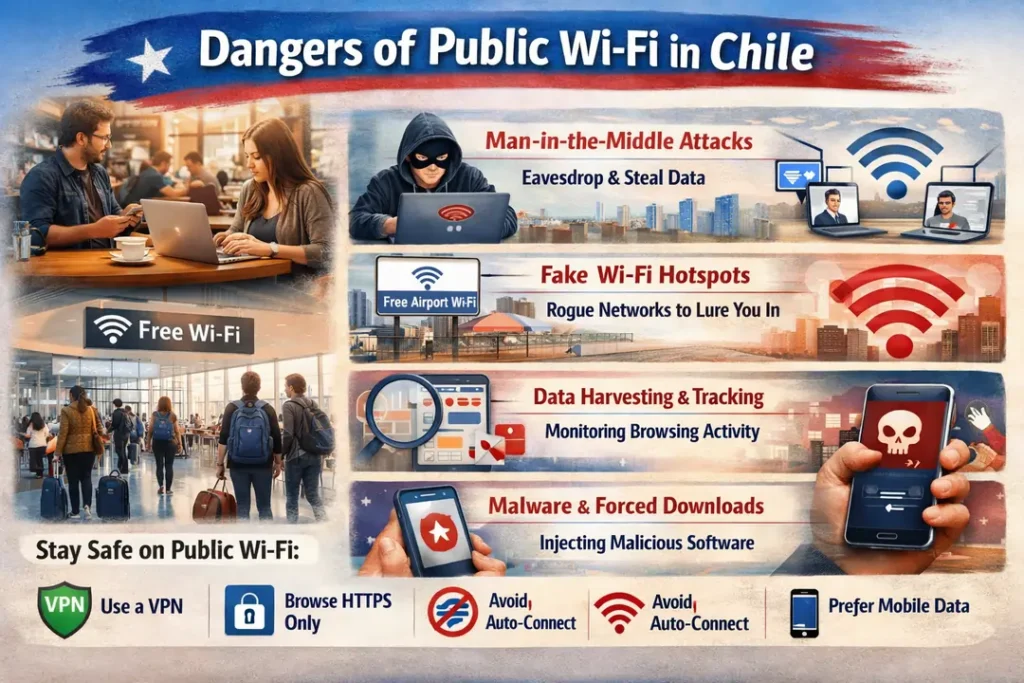
The Dangers of Public Wi-Fi in Chile
Chile is generally considered a safe country for everyday internet use, but public and shared Wi-Fi networks remain one of the most common sources of avoidable digital risk. This is true even in modern, well-connected cities.
Public Wi-Fi is widely available in cafés, airports, hotels, apartment buildings, and co-working spaces. These networks prioritise convenience over isolation, which creates predictable exposure points.
Why Public Wi-Fi Still Matters in a Stable Country
Many users assume that because Chile does not heavily restrict the internet, public Wi-Fi is inherently safe. In reality, the risks associated with shared networks are largely independent of national infrastructure quality.
On public or shared Wi-Fi, other users on the same network may be able to observe traffic patterns, exploit misconfigured devices, or intercept unsecured connections. This is one of the most common scenarios where using a VPN provides immediate, practical protection.
Common Public Wi-Fi Scenarios in Chile
| Location | Typical Risk Level | VPN Recommended? |
|---|---|---|
| Cafés and restaurants | Medium | Yes |
| Hotels and serviced apartments | Medium to high | Yes |
| Airports | High | Strongly recommended |
| Co-working spaces | Medium | Yes |
| University or shared housing networks | Medium | Yes |
What a VPN Protects on Public Wi-Fi
When connected to public Wi-Fi in Chile, a VPN is commonly used to:
- Encrypt traffic between your device and the internet
- Protect login credentials and session data
- Reduce exposure to local network monitoring
- Maintain privacy when accessing financial or work services
These protections are especially relevant for travellers and remote workers. Practical examples of VPN use while moving between locations are covered in the VPNs for travelling guide.
Public Wi-Fi vs Mobile Data
Mobile data networks in Chile are generally more isolated than public Wi-Fi connections. When possible, mobile data is often safer than open Wi-Fi, particularly when travelling.
However, when public Wi-Fi is unavoidable, a properly configured VPN significantly reduces risk without materially affecting performance in most urban areas.
With public Wi-Fi risks addressed, the next section explains how to obtain a Chilean IP address, what benefits it offers, and what it does not provide.

How to Get a Chilean IP Address
A Chilean IP address makes your connection appear as if it is coming from within Chile. This is most commonly achieved by connecting to a VPN server located in the country.
People usually want a Chilean IP for practical reasons rather than anonymity or censorship avoidance. In a stable internet environment like Chile, the benefits are specific and situational.
Common Reasons for Using a Chilean IP
| Use Case | Why a Chilean IP Helps | What It Does Not Do |
|---|---|---|
| Access local services | Ensures full functionality of Chile-based platforms | Does not bypass account restrictions or verification |
| Banking and finance | Reduces location-based security flags | Does not replace account authentication |
| Travel consistency | Maintains access when temporarily abroad | Does not change service terms |
| Testing or work access | Allows region-specific testing or dashboards | Does not grant special permissions |
How VPNs Assign a Chilean IP
When you connect to a VPN server located in Chile, your traffic is routed through that server and assigned an IP address from Chile’s IP range.
This process is automatic and does not require manual configuration for most users. It is explained in more detail in the VPN basics guide, which covers how IP assignment works in practice.
Limitations to Understand
A Chilean IP address changes how your location appears online, but it does not provide unrestricted access to every service. Platforms may still apply their own rules, checks, and account-based controls.
For example:
- Streaming services may still enforce licensing limits
- Financial platforms may require additional verification
- Work systems may restrict access based on account policies
This is why choosing a VPN with reliable Chilean servers and stable routing matters more than simply having a Chilean IP on paper.
With IP address use clarified, the final section brings together key takeaways, answers common Chile-specific questions, and links to relevant regional guides.
Key Answers, Regional Context, and Final Analysis
Chile is one of the most straightforward countries in South America for VPN use, but that does not mean the decision is trivial. The table below summarises the most common questions users have when deciding whether a VPN makes sense in Chile.
Chile VPN Quick Answers
| Question | Short Answer | What Actually Matters |
|---|---|---|
| Do I need a VPN in Chile? | No, but it is often useful | Privacy, public Wi-Fi, and account security |
| Are VPNs legal? | Yes | VPNs are widely used and unrestricted |
| Will a VPN slow my internet? | Slightly, in most cases | Peak-hour congestion matters more than the VPN |
| Is streaming reliable with a VPN? | Usually in urban areas | Licensing and time of day set limits |
| Is public Wi-Fi safe without a VPN? | No | Shared networks remain the biggest risk |
Chile Compared to the Rest of South America
Chile sits at the more stable end of the South America connectivity spectrum. Fibre penetration, mobile reliability, and international routing are significantly stronger than in many neighbouring countries.
This means VPN advice that assumes censorship, instability, or constant workarounds does not apply here. At the same time, Chile should not be treated as equivalent to Europe or North America — regional routing, peak congestion, and ISP behaviour still shape outcomes.
For regional framing and cross-border considerations, see the South America VPN hub.
Neighbouring Country Guides
If you are travelling, relocating, or comparing conditions, these country-specific guides provide clearer local context:
- Argentina — Strong urban networks, higher variability
- Peru — Mixed infrastructure, mobile-first outside cities
- Bolivia — Partial infrastructure, cautious VPN use
- Uruguay — Small market, very stable connectivity
- Brazil — Large scale, congestion-sensitive
Final Analysis: When a VPN Makes Sense in Chile
Chile does not require defensive VPN usage. Most users can access the internet freely and reliably without special tools.
A VPN becomes valuable in Chile when it is used deliberately: to protect shared connections, to reduce routine ISP visibility, to maintain account consistency while travelling, and to secure work or financial activity.
When chosen carefully, a VPN integrates cleanly into everyday use without disrupting performance. When chosen poorly — particularly free services — it can introduce more risk than it removes.
This page is designed to be the definitive reference for VPN use in Chile. If your situation changes — different country, different infrastructure, different risk profile — move outward through the regional guides rather than relying on assumptions.