

Central America does not have a single, uniform internet environment. While the region is geographically compact, online access, privacy expectations, and network reliability vary significantly from country to country.
Some countries offer relatively stable urban connectivity and open access, while others rely more heavily on shared networks, mobile data, or operate under different privacy and oversight norms. As a result, VPN needs in Central America are highly context-dependent.
This hub exists to address that reality. Rather than offering a one-size-fits-all recommendation, it provides a regional overview and directs users to country-specific guides that reflect local infrastructure, usage patterns, and practical risks.
Whether you are traveling across borders, working remotely, relocating, or simply passing through the region, understanding how VPN requirements differ between Central American countries helps you choose the right setup — and avoid relying on generic advice that doesn’t apply on the ground.

How Internet Access Varies Across Central America
Although Central America is often discussed as a single region, internet access and usage patterns differ sharply between countries. These differences affect how well VPNs perform, what features matter most, and when VPN use shifts from optional to advisable.
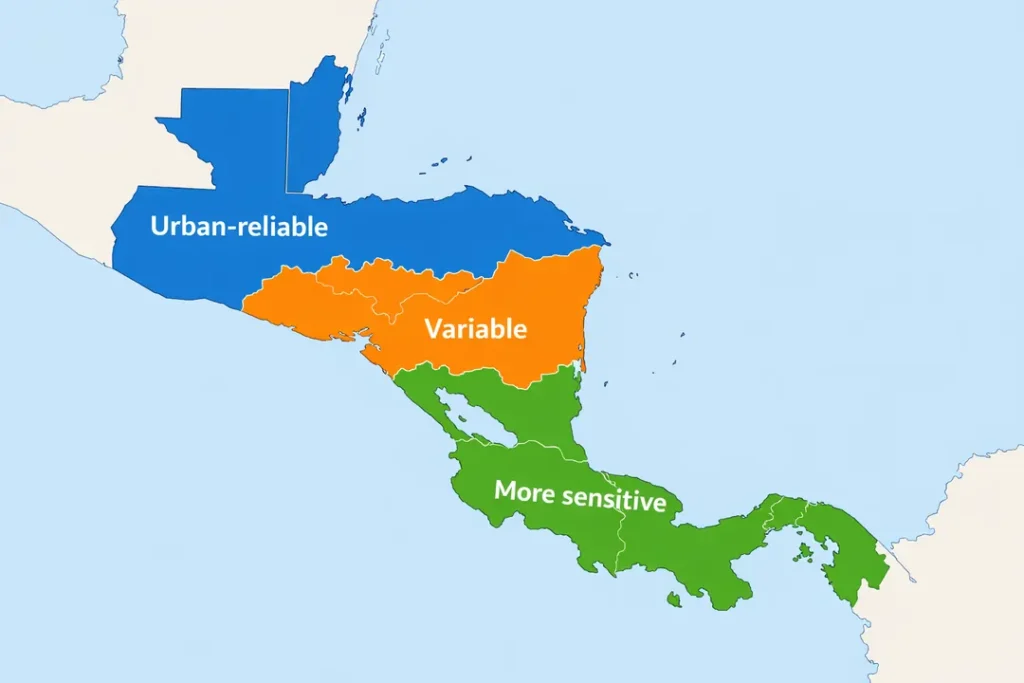
From a practical VPN perspective, Central American countries broadly fall into three categories:
1. Urban-Reliable Connectivity
Countries in this group offer relatively stable internet access in major cities, with widespread broadband and mobile coverage supporting everyday use such as streaming, video calls, and remote work.
- El Salvador — improving infrastructure and strong urban performance
- Costa Rica — mature expat market and reliable urban networks
- Panama — business-focused connectivity with strong city coverage
In these countries, VPN choice is driven more by speed consistency, privacy, and access to international services than by basic connectivity concerns.
2. Variable & Mixed Infrastructure
These countries have usable internet access but experience greater variability depending on location, provider, and network type. Shared Wi-Fi and mobile data play a larger role.
- Honduras — uneven performance and frequent congestion
- Guatemala — noticeable urban–rural split
- Belize — tourism-heavy, shared-network usage
Here, VPN stability, fast reconnection, and routing efficiency matter more than headline speeds.
3. Higher-Sensitivity Environments
In some countries, VPN use is influenced not just by connectivity, but by privacy expectations and network oversight.
- Nicaragua — greater emphasis on privacy and cautious usage
In these environments, VPNs are primarily used as protective tools to encrypt traffic and reduce exposure on shared or monitored networks.
This regional variation is why a single “best VPN for Central America” does not exist. The right VPN depends on where you are, how you connect, and what you need to protect or access.
Best VPNs for Central America
Choosing a VPN for Central America is different from choosing one for a single country. Travelers, expats, and remote workers often move between borders or rely on multiple network types — home broadband, public Wi-Fi, and mobile data — sometimes within the same week.
The VPNs that perform best regionally are those that maintain consistent performance across different countries, handle network switching smoothly, and offer reliable access to nearby international servers.
| VPN | Why It Works Well Regionally | Cross-Border Reliability | Best Use Case |
|---|---|---|---|
| ExpressVPN | Stable performance across multiple countries with minimal setup | Excellent | Frequent travelers & non-technical users |
| NordVPN | Strong routing and flexibility across mixed network conditions | Very good | Remote workers & long-term stays |
| Surfshark | Good regional coverage at a lower cost | Good | Budget-conscious multi-device users |
Why These VPNs Scale Best Across Central America
Across Central America, VPN performance is influenced less by raw speed and more by how well a provider handles:
- Frequent network switching (Wi-Fi ↔ mobile data)
- Congestion on shared or tourism-heavy networks
- Routing efficiency to nearby international servers
Providers with strong regional routing, fast reconnection logic, and consistent apps across devices tend to outperform those optimized only for speed benchmarks in a single location.
For country-specific recommendations and deeper analysis, use the individual guides linked throughout this hub. Each page reflects local infrastructure, privacy expectations, and practical usage patterns.
Related comparisons:
VPN Use Cases Across Central America
VPN needs in Central America vary widely depending on how and where you connect. While some users rely on stable home broadband, others move between countries, networks, and devices, often within short periods.
Understanding the most common use cases helps you choose a VPN configuration that works across borders rather than relying on a single-country setup.
Travel & Border Crossings
Travelers frequently connect through hotels, cafés, airports, and short-term rentals. These networks are shared by default and prioritise access over privacy.
- Secure connections on public and semi-public Wi-Fi
- Fast reconnection when switching networks
- Consistent access to personal accounts while moving between countries
Start here: Best VPNs for Travel & Border Crossings
Remote Work & Long-Term Stays
Expats and remote workers often need predictable access to cloud platforms, email, and video calls across mixed network conditions.
- Stable performance on urban broadband and mobile data
- Protection on shared apartment or office networks
- Low disruption during peak congestion
Country-specific guidance:
- El Salvador — urban-reliable environments
- Panama — business-focused connectivity
- Honduras — variable networks requiring stability
Streaming & Entertainment
Streaming availability varies by country due to licensing, while performance depends on congestion and local bandwidth rather than the VPN alone.
- Access to international libraries via nearby servers
- Better results on urban or private connections
- More variability on tourism-heavy or shared networks
Related guides:
For the most accurate recommendations, always refer to the country-specific guides linked throughout this hub. Each one reflects local infrastructure, privacy expectations, and real-world usage patterns.
Privacy, Legality & What to Expect Across Central America
Across Central America, VPN use is generally legal and widely accessible. There are no region-wide bans on personal or commercial VPN services, and VPN apps are available through standard providers and app stores.
However, legality alone does not determine how or why VPNs are used. Privacy expectations, network oversight, and everyday usage patterns differ between countries, which is why VPN needs vary even within a relatively small geographic region.
Legal Status vs Practical Use
In most Central American countries, VPNs are used openly for everyday purposes such as securing public Wi-Fi, protecting work accounts, and maintaining access to international services while traveling.
In some environments, VPN use is primarily a convenience and privacy choice. In others, it becomes a more deliberate tool for reducing exposure on shared or monitored networks.
Shared Networks Are the Common Factor
One consistent theme across the region is reliance on shared connectivity:
- Hotel, café, and short-term rental Wi-Fi
- Shared apartment or office networks
- Mobile data used as a fallback when Wi-Fi fluctuates
Because these networks are not private by default, VPNs are most often used to encrypt traffic and protect credentials rather than to bypass restrictions.
Why Country-Specific Guidance Matters
While the regional picture is broadly permissive, local conditions still shape real-world VPN use:
- Urban-reliable countries prioritise speed consistency and latency
- Variable-infrastructure countries prioritise stability and recovery
- More sensitive environments prioritise privacy and cautious usage
This is why the Central America hub focuses on context and routing rather than blanket recommendations. For accurate, practical advice, always refer to the individual country guides linked throughout this page.
Related background reading:
Central America VPN Country Guides
Because VPN needs vary significantly across Central America, the most accurate guidance is always country-specific. Use the table below to access detailed guides based on local connectivity, privacy expectations, and real-world usage patterns.
| Country | Connectivity Profile | Typical VPN Use Case | Guide |
|---|---|---|---|
| Belize | Tourism-heavy, shared networks | Public Wi-Fi security & streaming access | View Guide |
| Guatemala | Urban–rural split | Stability across mixed infrastructure | View Guide |
| Honduras | Highly variable connectivity | Recovery & routing reliability | View Guide |
| El Salvador | Urban-reliable, improving networks | Speed consistency & privacy | View Guide |
| Nicaragua | Inconsistent access, higher sensitivity | Privacy-focused VPN usage | View Guide |
| Costa Rica | Stable urban connectivity | Remote work & expat use | View Guide |
| Panama | Business-focused infrastructure | Secure access & international services | View Guide |
If you’re moving between countries or unsure where your needs fall, start with the regional recommendations above, then use the country guides for deeper, location-specific advice.
Troubleshooting VPN Issues While Traveling in Central America
VPN problems while traveling in Central America are rarely caused by the VPN service itself. Most issues stem from frequent network changes, shared Wi-Fi restrictions, or congestion on public and residential connections.
Because travelers often move between hotels, cafés, apartments, airports, and mobile data, VPN behavior can change several times in a single day. Knowing how to adjust quickly prevents unnecessary provider switching.
If Your VPN Won’t Connect on Hotel or Café Wi-Fi
Many shared networks restrict encrypted traffic or require a captive portal login.
- Complete any Wi-Fi login or splash page before enabling the VPN
- Switch VPN protocols and reconnect
- Try a nearby international server rather than a distant region
If the VPN Disconnects When Crossing Borders
Mobile carriers and roaming agreements can briefly interrupt connections.
- Enable auto-reconnect in the VPN app
- Restart the VPN after changing countries or SIMs
- Reconnect manually once mobile data stabilizes
If Speeds Drop Dramatically in the Evenings
Peak congestion is common on shared residential and tourist networks.
- Switch to a different server in the same region
- Avoid peak evening hours when possible
- Pause background updates or cloud sync on other devices
If Streaming or Banking Sites Fail to Load
This is often caused by cached location data or temporary routing issues.
- Clear browser or app cache and retry
- Restart the VPN before opening the service
- Switch to another server in the same country
In most cases, small adjustments resolve issues without changing providers. For structured diagnostics and deeper fixes, see our VPN Troubleshooting Pro Guide (2026).
Final Thoughts: Choosing the Right VPN for Central America
Central America cannot be treated as a single VPN environment. While the region is geographically compact, internet reliability, privacy expectations, and everyday usage patterns differ meaningfully between countries.
In urban-reliable environments, VPN choice is shaped by speed consistency, latency, and access to international services. In countries with more variable infrastructure, stability, reconnection behavior, and routing efficiency become more important. In higher-sensitivity environments, privacy and cautious usage take priority.
This is why the most common mistake travelers and expats make is relying on generic “best VPN” advice that ignores local conditions. A VPN that performs well in one Central American country may behave very differently just a few hours away across a border.
The goal of this hub is not to promote a single provider, but to help you choose a VPN setup that matches where you are, how you connect, and what you need to protect or access.
How to use this guide effectively:
- Start with the regional recommendations to understand which VPNs scale well across borders
- Use the country guides to see how local infrastructure and privacy norms affect real-world performance
- Adjust expectations based on whether your priority is travel, remote work, streaming, or privacy
All recommendations across this hub and its country pages are based on independent testing, real-world usage analysis, and transparent evaluation standards rather than marketing claims.
If you are unsure where to begin, start with the country you are currently in or plan to spend the most time in. From there, use the regional context provided here to fine-tune your setup as you move across Central America.
For broader comparisons: