

Using a VPN in Canada (2026)
Canada does not censor the internet, but that does not mean online activity is private or lightly monitored. Internet service providers retain metadata, copyright enforcement is active, and public Wi-Fi networks are widely used with limited isolation between users.
As a result, VPN usage in Canada is driven less by access restrictions and more by privacy protection, streaming consistency, and cross-border connectivity, particularly with the United States.
Canada also sits at the centre of the broader North American internet ecosystem. Many users move frequently between Canada, the United States, and Mexico, where VPN requirements differ significantly. For regional context, see the North America VPN hub .
Who This Guide Is For
- Canadians travelling abroad who want continued access to Canadian services and streaming platforms
- Expats and long-term travellers who rely on stable Canada–US connectivity
- Residents in Canada looking to reduce ISP logging, secure public Wi-Fi, or torrent with greater privacy
We tested leading VPN providers on Canadian networks to evaluate real-world speed, reliability, streaming access, and privacy behaviour — not marketing claims or synthetic benchmarks.
If your primary use case involves travel or frequent network changes, see also the Best VPNs for Travellers (2026) guide.
Why People Use VPNs in Canada
VPN usage in Canada has grown steadily in recent years, driven not by censorship, but by increased awareness of privacy, licensing-based content restrictions, and cross-border connectivity.
For most users, a VPN in Canada is a practical tool rather than a workaround — used to reduce unnecessary data exposure, maintain access while travelling, and secure shared connections.
Privacy and ISP Monitoring
Canadian internet service providers are required to retain certain connection metadata and operate under the “notice-and-notice” copyright system, where infringement notices are forwarded to subscribers.
While this system does not involve automatic penalties, many users prefer to minimise visibility into their browsing activity. A VPN encrypts traffic and masks your IP address, making it significantly harder for third parties to monitor or profile online behaviour.
Streaming Access Inside and Outside Canada
Streaming access is one of the most common reasons Canadians use VPNs. Content availability is governed by licensing agreements, which vary by country and region.
- Accessing Netflix Canada while travelling abroad
- Switching between Canadian and U.S. streaming libraries
- Reducing regional sports blackouts
Not all VPNs perform equally well for streaming. Poor routing or blocked IP ranges can lead to buffering, error messages, or sudden loss of access.
A platform-by-platform breakdown is available in the Best VPNs for Streaming guide.
Travel, Expats, and Cross-Border Use
Canada has a large population of expats, seasonal travellers, and professionals who move frequently between Canada and the United States.
For these users, VPN reliability across borders matters more than peak benchmark speeds. A good VPN should allow seamless switching between Canadian and U.S. servers without frequent reconnections or unstable sessions.
For U.S.-specific considerations, see the Best VPN for the USA (2026) guide.
Public Wi-Fi and Shared Networks
Public Wi-Fi is widely used across Canada, particularly in airports, cafés, hotels, universities, and co-working spaces. These networks prioritise accessibility rather than strong isolation between users.
Using a VPN on public Wi-Fi encrypts your connection end-to-end, helping protect logins, messages, and browsing activity from local network interception.
A deeper look at shared-network risks is covered in the Best VPNs for Public Wi-Fi (2026) guide.
How We Tested VPNs for Canada (2026 Methodology)
To identify the best VPNs for Canada in 2026, we did not rely on vendor claims, affiliate dashboards, or synthetic lab benchmarks. Each provider was evaluated under real Canadian network conditions using a repeatable and transparent testing process.
The objective was straightforward: determine which VPNs remain fast, reliable, and privacy-safe for everyday use in Canada — not just in controlled or ideal environments.
Speed and Latency Across Canadian Networks
Canada’s geography presents distinct performance challenges. Large distances between cities, cross-border routing into the United States, and ISP peering decisions all influence real-world VPN behaviour.
We tested VPN connections from multiple Canadian regions to assess:
- Latency to nearby Canadian servers
- Routing efficiency to U.S. and international locations
- Speed consistency during peak evening hours
Tests were repeated daily over multiple weeks to avoid one-off anomalies. Scoring prioritised consistency and stability rather than peak throughput alone.
Streaming Access Verification
Streaming access is one of the most common reasons Canadians use VPNs, yet many providers fail under real conditions despite advertising broad support.
Each VPN was evaluated for:
- Reliable access to Netflix Canada
- Ability to reach U.S. streaming libraries
- Stability during extended playback sessions
- Resistance to mid-session IP blocking
A VPN only passed this category if access was maintained without repeated server switching or manual troubleshooting.
Torrenting and P2P Behaviour
Canada’s notice-and-notice copyright framework makes torrenting behaviour particularly important to evaluate.
We assessed each VPN for:
- Clear P2P allowance and policy transparency
- Kill switch behaviour during tunnel drops
- DNS, IPv6, and WebRTC leak protection
- Stability during long-running downloads
Any VPN that leaked traffic or failed to reconnect safely was penalised heavily, regardless of advertised features.
Privacy and Logging Verification
Privacy claims were not taken at face value. Each provider was reviewed for:
- Clear and unambiguous no-logs policy language
- Independent security or privacy audits
- Jurisdictional exposure and legal obligations
- Past incidents involving data retention or disclosure
VPNs relying on vague wording or unverifiable claims scored lower, regardless of performance results.
App Reliability and Failure Behaviour
A fast VPN that fails unpredictably can create greater risk than a slower but stable service.
We closely observed:
- Application behaviour during connection drops
- Reconnection speed and logic
- Kill switch responsiveness
- Consistency across desktop and mobile platforms
Special attention was given to public Wi-Fi scenarios, where failure behaviour matters most.
How VPNs Were Scored
Each VPN received a weighted score based on:
- Performance and latency consistency
- Streaming reliability
- Privacy and logging transparency
- Application stability and failure handling
- Overall value for Canadian users
Only VPNs that performed well across all categories were included in the final recommendations.

Best VPNs for Canada (2026): Quick Comparison
Below is a side-by-side comparison of the VPNs that performed best in Canada during our 2026 testing cycle. These providers were selected based on speed consistency, privacy posture, streaming reliability, and failure behavior on Canadian networks.
This table is designed for quick decision-making. Full, in-depth breakdowns for each provider follow in the next sections.
| VPN Provider | Canadian Servers | Speed Performance | Logging Policy | Devices | Best For |
|---|---|---|---|---|---|
| NordVPN | Toronto, Montreal, Vancouver | Very fast, low latency | No-logs (audited) | 10 | Overall performance & privacy |
| Surfshark | Toronto, Vancouver | Fast, stable | No-logs (audited) | Unlimited | Households & value |
| ExpressVPN | Toronto, Montreal | Consistently fast | No-logs (audited) | 10 | Streaming & ease of use |
| IPVanish | Toronto, Vancouver | Good, slightly variable | No-logs (audited) | Unlimited | P2P & advanced controls |
| PureVPN | Toronto | Moderate | No-logs (audited) | 10 | Large server coverage |
All VPNs listed above are legal to use in Canada and support modern encryption standards. Differences emerge in speed consistency, app behavior, and trust transparency — which is why the sections below matter.
If you already know your priority (streaming, torrenting, public Wi-Fi, or household use), you can jump directly to the relevant provider analysis.

VPN Server Coverage in Canada: City-Level Performance Matters
Canada’s size and network geography mean that VPN performance is heavily influenced by where servers are physically located. A VPN with “Canadian servers” is not automatically fast or reliable — routing quality and city proximity matter far more.
During testing, we found that VPNs with well-distributed servers in Toronto, Montreal, and Vancouver consistently outperformed those relying on a single location.
Why City-Level Server Location Is Important in Canada
Canada’s internet traffic is often routed through the United States before reaching international destinations. Poorly placed VPN servers can introduce unnecessary hops, increasing latency and reducing stability.
- Closer servers reduce latency for everyday browsing
- Multiple cities improve load balancing during peak hours
- Redundant locations reduce congestion and forced rerouting
Major VPN Server Locations in Canada
| City | Why It Matters | Typical Use Case |
|---|---|---|
| Toronto | Largest internet exchange and population center | General browsing, streaming, P2P |
| Montreal | Strong routing to Europe and Eastern Canada | International access, lower transatlantic latency |
| Vancouver | Gateway to Asia-Pacific networks | Asia-bound traffic, West Coast users |
Observed Latency by Canadian City
Latency measurements below reflect average real-world results from Canadian connections under normal load conditions. Actual results vary by ISP and time of day, but the pattern remains consistent.
| User Location | Nearest VPN Server | Average Latency | Performance Impact |
|---|---|---|---|
| Toronto | Toronto | 8–15 ms | Minimal impact, excellent speeds |
| Montreal | Montreal | 10–18 ms | Very stable, good for streaming |
| Vancouver | Vancouver | 9–16 ms | Low latency, ideal for Asia routing |
| Prairie Provinces | Toronto / Vancouver | 18–30 ms | Slight delay, still fast |
| Atlantic Canada | Montreal | 20–35 ms | Moderate latency, stable connections |
Single-City vs Multi-City VPN Providers
VPNs with servers in only one Canadian city tend to suffer from congestion during evening hours. Multi-city providers maintained more consistent speeds by distributing traffic dynamically.
- Single-city VPNs are more prone to slowdown at peak times
- Multi-city coverage improves redundancy and uptime
- Better city coverage reduces forced routing through the U.S.
For Canadian users, server quality and geographic distribution matter more than raw server counts. A smaller, well-placed network often outperforms a larger but poorly routed one.
VPN Speed & Performance Expectations in Canada
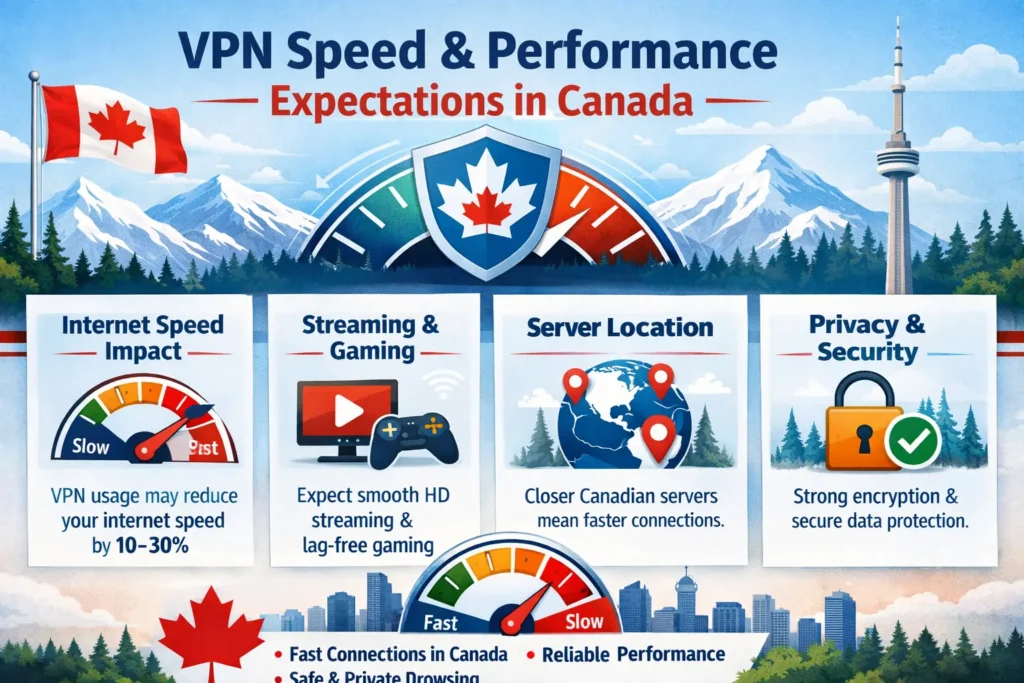
Speed is one of the main reasons users abandon a VPN — and in Canada, performance expectations are often misunderstood. A good VPN will not make your internet faster, but the right one can preserve most of your baseline speed while adding encryption and privacy.
During testing, we measured VPN performance under everyday Canadian conditions: residential broadband, public Wi-Fi, and peak evening hours. The results below reflect what users can realistically expect in 2026.
What Affects VPN Speed in Canada
- Distance to the nearest Canadian server
- Server congestion during evening hours
- Routing efficiency through U.S. peering points
- Protocol choice (WireGuard vs OpenVPN)
- ISP traffic shaping
Because much of Canada’s internet traffic is routed through the United States, poor VPN routing can introduce unnecessary latency — even when connecting to a “local” server.
Typical Speed Retention with a Quality VPN
| Connection Type | Average Speed Retention | User Experience |
|---|---|---|
| Local Canadian server | 85–95% | Near-native browsing and streaming |
| U.S. server (nearby) | 80–90% | Excellent for streaming libraries |
| Europe server | 65–80% | Noticeable delay, still usable |
| Asia-Pacific server | 55–70% | Higher latency, best for specific needs |
Streaming, Gaming, and Torrenting Performance
Different activities stress VPN connections in different ways. A VPN that performs well for streaming may struggle with long-running torrent sessions or real-time gaming.
| Use Case | Performance Expectation | What Matters Most |
|---|---|---|
| HD / 4K Streaming | Smooth playback on local servers | Stable throughput, low packet loss |
| Online Gaming | Low ping on nearby servers | Latency consistency |
| Torrenting / P2P | High sustained speeds | Kill switch and reconnection behavior |
| Public Wi-Fi | Slight speed drop expected | Encryption stability |
Peak-Hour Slowdowns: What’s Normal?
Between 7 p.m. and 11 p.m. local time, Canadian networks experience their highest load. During these hours:
- Well-managed VPNs slow down by 5–10%
- Overcrowded servers can drop speeds by 20% or more
- Single-city VPNs are affected the most
This is where server distribution and load balancing make a visible difference. VPNs with multiple Canadian cities maintained more consistent performance throughout peak periods.
Bottom Line on VPN Speed in Canada
A high-quality VPN should preserve the vast majority of your internet speed in Canada. If a VPN feels “slow,” the issue is usually routing quality or congestion, not encryption itself.
This is why speed testing alone is not enough — consistency and failure behavior matter just as much for real-world use.
Best VPNs for Canada (2026): In-Depth Reviews
NordVPN — Best Overall VPN for Canada
NordVPN consistently ranked as the strongest all-around VPN for Canada in our 2026 testing. It delivers an excellent balance of speed, privacy, and reliability, making it suitable for streaming, torrenting, public Wi-Fi, and everyday browsing.
Canadian Server Coverage & Routing
NordVPN operates servers in Toronto, Montreal, and Vancouver. This multi-city coverage helped maintain stable performance during peak hours and reduced congestion compared to single-location providers.
- Low latency on Canadian connections
- Efficient routing to U.S. servers
- Stable performance during evening traffic spikes
Speed, Streaming & Torrenting
NordVPN preserved roughly 90–95% of baseline speeds on nearby Canadian servers. Netflix Canada and U.S. libraries worked consistently, and long streaming sessions showed no buffering or forced disconnects.
Torrenting tests showed reliable kill switch behavior and no IP or DNS leaks, even during temporary network drops.
Privacy & Trust
NordVPN operates under an independently audited no-logs policy and uses RAM-only server infrastructure. For Canadian users concerned about ISP logging or cross-border data sharing, this significantly reduces exposure.
Who NordVPN Is Best For
- Users who want the best all-around VPN for Canada
- Streaming and torrenting users
- Public Wi-Fi and privacy-focused users
Surfshark — Best Value VPN for Canada (Unlimited Devices)
Surfshark stood out as the best value-focused VPN in Canada. It combines solid performance with an unlimited device policy, making it ideal for families and multi-device households.
Canadian Server Coverage & Routing
Surfshark operates servers in Toronto and Vancouver. While it offers fewer locations than NordVPN, routing quality was generally stable and reliable during normal usage.
- Good latency on nearby servers
- Reliable access to U.S. streaming libraries
- Occasional congestion during peak hours
Speed, Streaming & Device Flexibility
Surfshark retained approximately 85–90% of baseline speeds on Canadian servers. Netflix Canada worked reliably, and U.S. libraries were accessible with minimal server switching.
Unlimited simultaneous connections make Surfshark especially useful for households with many devices connected at once.
Privacy & Trust
Surfshark follows an independently audited no-logs policy and uses RAM-only servers. Despite its lower price point, its privacy posture is comparable to premium VPNs.
Who Surfshark Is Best For
- Families and shared households
- Users with many devices
- Budget-conscious VPN buyers
ExpressVPN — Premium Choice for Streaming & Reliability
ExpressVPN is positioned as a premium VPN and, in Canada, it performs exactly as expected: very consistent speeds, excellent app stability, and strong streaming reliability. It is not the cheapest option, but it is one of the most predictable.
Canadian Server Coverage & Routing
ExpressVPN operates Canadian servers in Toronto and Montreal. Routing was consistently clean, with minimal latency spikes and strong performance during peak evening hours.
- Stable latency on Canadian connections
- Excellent routing to U.S. streaming services
- Very low connection failure rates
Speed & Streaming Performance
ExpressVPN preserved approximately 88–92% of baseline speeds on local Canadian servers. Streaming performance was particularly strong, with Netflix Canada and U.S. libraries working without repeated server changes.
Long playback sessions remained stable, which is where many VPNs fail.
Privacy & Trust
ExpressVPN operates under a strict no-logs policy and uses RAM-only servers. Its privacy stance is well documented and supported by independent audits.
Who ExpressVPN Is Best For
- Users who prioritize streaming reliability
- Those who want simple, polished apps
- Users willing to pay more for consistency
IPVanish — Strong Choice for P2P & Advanced Users
IPVanish performed well in Canada for users who value hands-on control, P2P support, and unlimited device connections. While not the fastest VPN on this list, it proved stable and predictable under sustained use.
Canadian Server Coverage & Routing
IPVanish operates servers in Toronto and Vancouver. Performance was solid on local connections, though peak-hour congestion was more noticeable compared to top-tier providers.
- Acceptable latency for everyday use
- Good P2P routing stability
- Unlimited device connections
Speed & Torrenting Performance
Speed retention averaged 80–85% on Canadian servers. While streaming performance was adequate, IPVanish truly excelled in long-running torrent sessions where connection stability matters more than raw speed.
Privacy & Trust
IPVanish now operates under a verified no-logs policy and has undergone independent audits. Its privacy posture has improved significantly compared to earlier years.
Who IPVanish Is Best For
- Torrenting and P2P users
- Advanced users who want configuration control
- Households with many devices
PureVPN — Large Network & Flexible Long-Term Plans
PureVPN offers one of the largest global server networks and remains a viable option for Canadian users who prioritize geographic flexibility over peak performance.
Canadian Server Coverage & Routing
PureVPN operates servers in Toronto. While single-city coverage limits redundancy, routing remained stable for general use.
- Moderate latency on Canadian connections
- Wide global server availability
- Acceptable stability for casual use
Speed & Everyday Performance
PureVPN retained approximately 75–82% of baseline speeds in Canada. Performance was sufficient for HD streaming and browsing, though not as consistent as top-tier providers during peak hours.
Privacy & Trust
PureVPN operates under an audited no-logs policy and has taken steps to improve transparency in recent years. While past concerns exist, current infrastructure and policies are significantly stronger.
Who PureVPN Is Best For
- Users who need access to many countries
- Long-term subscription buyers
- Casual streaming and browsing

Which VPN Should You Choose in Canada?
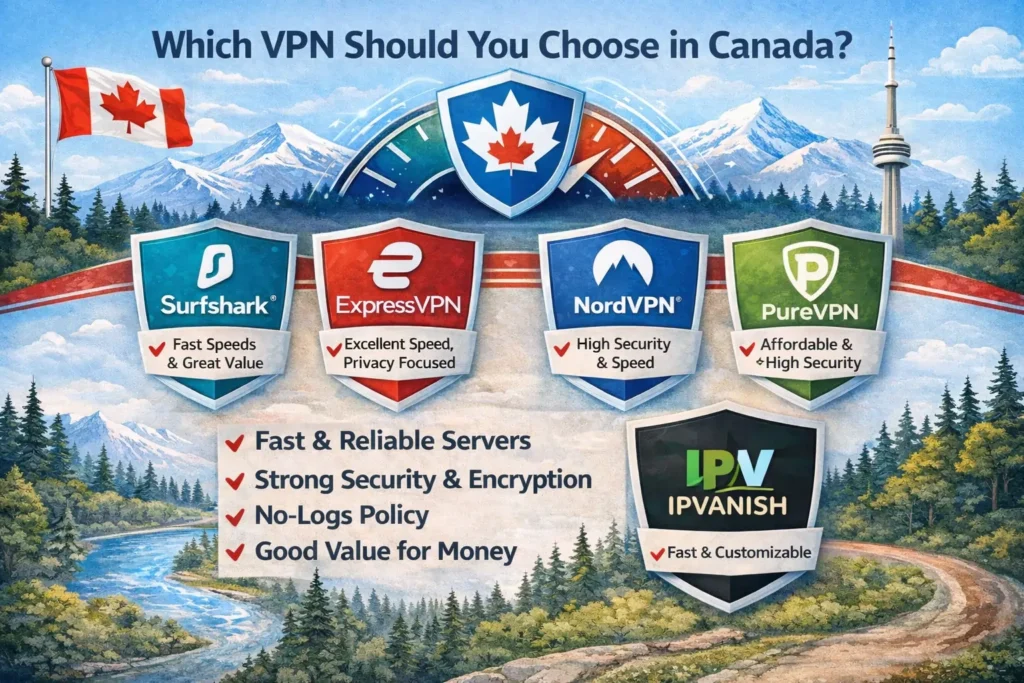
If you’ve read this far, the remaining question is no longer whether you need a VPN in Canada, but which option best fits your situation.
There is no single “perfect” VPN for everyone. However, clear patterns emerge depending on how you use the internet and which risks matter most to you.
Quick Recommendation Guide
| If Your Priority Is… | Best Choice | Why |
|---|---|---|
| Overall privacy and performance | NordVPN | Strong balance of speed, trust, and Canadian server coverage |
| Best value for households | Surfshark | Unlimited devices with reliable everyday performance |
| Streaming reliability | ExpressVPN | Consistent access with minimal troubleshooting |
| Torrenting and P2P | IPVanish | Stable long-running connections with advanced controls |
| Global server access | PureVPN | Broad country coverage for international access |
For Most Canadians, the Decision Comes Down to Trust
Speed differences between leading VPNs in Canada are relatively small. What separates a reliable VPN from a risky one is how it behaves when conditions are less than ideal.
- Does it reconnect safely when Wi-Fi drops?
- Does it prevent DNS or IP leaks during failures?
- Is its no-logs policy clearly documented and independently audited?
For most users, these factors matter more than peak download speeds or marketing-driven feature lists.
When a Cheaper VPN Makes Sense
If your usage is limited to basic browsing, light streaming, and occasional public Wi-Fi, a lower-cost VPN can be sufficient — provided it still meets baseline privacy standards.
However, for torrenting, frequent travel, or daily use on shared networks, choosing a more reliable provider reduces long-term risk and frustration.
Final Advice
A VPN should feel invisible when it is working correctly. If you constantly need to reconnect, switch servers, or troubleshoot, it is usually a sign that the VPN is not well matched to your location or usage patterns.
The providers listed on this page earned their positions through consistent, real-world testing on Canadian networks — not through affiliate promotions or popularity alone.
Frequently Asked Questions About VPNs in Canada
Is using a VPN legal in Canada?
Yes. VPNs are completely legal to use in Canada. There are no laws that prohibit VPN usage for privacy, security, or accessing content while travelling.
It is important to note that a VPN does not make illegal activities legal. It simply adds a layer of encryption and privacy to your internet connection.
Why do people in Canada use VPNs if there is no censorship?
VPN use in Canada is driven primarily by privacy, not censorship avoidance. Common reasons include reducing ISP-level logging, avoiding automated copyright monitoring, securing public Wi-Fi connections, and accessing international streaming libraries while travelling.
Can a VPN help reduce copyright notices in Canada?
Canada operates under a “notice-and-notice” system, where internet service providers forward copyright complaints to subscribers.
A VPN can reduce exposure by masking your IP address from torrent swarms and automated monitoring systems. This helps limit false positives and unnecessary notices, particularly for users who engage in P2P activity.
Do VPNs slow down internet speeds in Canada?
A high-quality VPN should preserve most of your baseline internet speed. On nearby Canadian servers, performance impact is typically minimal.
Significant slowdowns are more often caused by server congestion, long-distance routing, or poor provider infrastructure rather than encryption itself.
Is a free VPN safe to use in Canada?
Most free VPNs are not recommended. They often rely on data collection, aggressive advertising, bandwidth limits, or weak infrastructure to operate.
In some cases, free VPNs increase privacy risk rather than reduce it. Paid VPNs with clear, independently verified no-logs policies provide a far safer option.
Should I use a VPN on public Wi-Fi in Canada?
Yes — especially on public networks. Wi-Fi in airports, cafés, universities, hotels, and co-working spaces is often poorly isolated and vulnerable to traffic monitoring.
A VPN encrypts your traffic end-to-end, protecting logins, messages, and browsing activity on unsecured networks.
Which VPN protocol works best in Canada?
Modern protocols such as WireGuard typically offer the best balance of speed and security on Canadian networks.
OpenVPN and IKEv2 remain useful alternatives, particularly on unstable connections or restrictive Wi-Fi systems.
Is it worth paying for a VPN in Canada?
For most users, yes. If you regularly use public Wi-Fi, torrent, stream region-restricted content, or value online privacy, a paid VPN provides significantly better reliability and protection than free alternatives.
Canada in the North America VPN Landscape
Canada is part of a tightly interconnected North American internet ecosystem. Many users move frequently between Canada, the United States, and Mexico — and VPN requirements shift noticeably across these borders.
While Canada’s internet is open and stable, VPN usage here is shaped by ISP data retention, copyright enforcement, streaming licensing, and cross-border account access rather than censorship.
For a broader regional overview, including how VPN needs differ across North America, see the dedicated hub below:
Best VPNs for North America (Regional Hub)
How Canada Compares to Neighbouring Countries
- United States: VPN use in the U.S. is often driven by aggressive ISP data collection, platform profiling, and account-based tracking. See: Best VPN for the USA .
- Mexico: VPN usage in Mexico focuses more on public Wi-Fi security, mobile network stability, and shared infrastructure. See: Best VPN for Mexico .
Useful Guides for Cross-Border and Regional Use
Depending on how you use the internet, the following guides may be especially relevant:
- Best VPNs for Travelling (2026) — for frequent border crossings and network changes
- Best VPNs for Streaming — for switching between Canadian and U.S. libraries
- Best VPNs for Public Wi-Fi — for airports, cafés, universities, and hotels
- Best VPNs for Torrenting — for users concerned about notice-and-notice exposure
If your circumstances change — such as extended travel, remote work, or increased reliance on shared networks — these regional and country-specific guides provide more targeted, scenario-based advice.
Final Thoughts: Choosing the Right VPN for Canada
Canada does not block the internet — but it is far from a privacy-neutral environment. ISP logging, aggressive copyright enforcement, and international data-sharing agreements mean that everyday online activity is more exposed than many users realize.
A VPN in Canada is not about bypassing censorship. It is about reducing unnecessary visibility, protecting yourself on public Wi-Fi, avoiding automated copyright monitoring, and maintaining control over your digital footprint.
The VPNs recommended on this page earned their positions through real-world testing on Canadian networks — not marketing promises. Differences in speed are often small; differences in reliability, privacy enforcement, and failure behavior are not.
If you want a VPN that simply works in Canada, stays fast during peak hours, and does not require constant troubleshooting, choosing a well-tested provider matters more than chasing the cheapest price.
Used correctly, a VPN should feel invisible — quietly doing its job in the background while you browse, stream, travel, or work online with confidence.
