

Internet access in Bolivia has improved, but it is still very different from what users experience in North America or Europe. Connections are often slower, less stable, and more dependent on mobile data and shared Wi-Fi.
Because of this, VPN use in Bolivia is usually not about bypassing censorship. Instead, people use VPNs for privacy, security, and connection stability, especially when using public or shared networks.
In 2026, VPNs are commonly used in Bolivia by:
- Travellers using hotel and café Wi-Fi
- Remote workers relying on mobile data
- Students using shared apartment or campus networks
- Users accessing international websites and services
This guide explains:
- How Bolivia’s internet actually works
- When a VPN is useful — and when it is not
- Which VPNs perform best under local conditions
- How VPNs help with privacy on public Wi-Fi
If you are new to VPNs, our VPN basics guide explains how they work in simple terms.
To understand why VPN use in Bolivia is different from other countries, we first need to look at the local internet environment.
Bolivia’s Internet Reality in 2026
Bolivia’s internet is best described as uneven and unpredictable. Some users have decent connections in large cities, while others rely almost entirely on mobile data or shared Wi-Fi.
In cities like La Paz, Santa Cruz, and Cochabamba, mobile internet is widely available, and fixed broadband exists, but speeds and reliability vary a lot. Outside major cities, connections are often slower and less stable.
How Most People Connect in Bolivia
- Mobile data is more common than home broadband
- Public and shared Wi-Fi is widely used
- Connection quality depends on location and time of day
- Evening congestion is common
- International connections can be unreliable
Bolivia does not heavily restrict the internet. Most websites and platforms are accessible, and VPNs are legal to use. However, privacy and security risks still exist, especially on shared networks.
Why Stability Matters More Than Speed
In Bolivia, slow speeds are not the only issue. Many users also experience:
- Sudden disconnections on mobile networks
- Unstable video calls and cloud access
- Problems accessing international services
- Inconsistent performance on public Wi-Fi
A VPN cannot fix poor infrastructure. But a good VPN can sometimes improve reliability by using better international routing and protecting sessions when networks drop or change.
This is especially important for people who:
- Work remotely
- Travel frequently
- Use public Wi-Fi in cafés or hotels
If you often connect on shared networks, our Best VPN for Public Wi-Fi guide explains the risks in more detail.
Now that Bolivia’s internet conditions are clear, the next section explains why people actually use VPNs in Bolivia and what problems they help solve.


Why People Use VPNs in Bolivia
VPN use in Bolivia is mostly about protection and reliability, not about bypassing government censorship. Most websites are already accessible, but everyday internet use still comes with risks.
People in Bolivia commonly use VPNs for four main reasons.
1. Public and Shared Wi-Fi Safety
Public Wi-Fi is widely used in Bolivia, especially in cafés, hotels, hostels, and shared apartments. These networks are convenient, but they are also shared with many other users.
Without a VPN, other people on the same network may be able to:
- See traffic patterns
- Monitor unsecured connections
- Exploit weak device settings
A VPN encrypts your connection before your data reaches the Wi-Fi network. This makes it much harder for others to see or interfere with your activity.
This is explained in more detail in our public Wi-Fi VPN guide.
2. Privacy From ISPs and Network Operators
Internet providers and network owners can see a lot of information about how a connection is used. This includes browsing patterns, connection times, and sometimes DNS requests.
A VPN reduces this visibility by encrypting traffic between your device and the VPN server. While it does not make you anonymous, it does improve everyday privacy.
For users who care about data collection, our no-logs VPN guide explains what to look for in a provider.
3. More Stable Access to International Services
Many websites and online services used in Bolivia are hosted abroad. International routing can sometimes be slow or inconsistent, especially during busy hours.
Some VPNs can improve stability by routing traffic through better international paths. This does not guarantee faster speeds, but it can reduce disconnections and failed sessions.
4. Travel and Remote Work
Bolivia attracts long-term travellers, digital nomads, and remote workers. These users often switch between mobile data, hotel Wi-Fi, and cafés.
A VPN helps keep connections consistent when networks change, which is useful for:
- Email and cloud tools
- Work dashboards
- Video calls
Travel-focused usage is covered in our VPNs for travelling guide.
Now that the reasons are clear, the next section explains VPN legality in Bolivia and what users should know before choosing a provider.
Is Using a VPN Legal in Bolivia?
Yes. Using a VPN in Bolivia is legal. There are no laws that ban VPN use for personal, business, or travel purposes.
VPNs are commonly used for:
- Securing public Wi-Fi connections
- Remote work
- General privacy protection
Legal Does Not Mean Risk-Free
While VPNs are legal, they do not make users immune to local laws or platform rules. Illegal activity remains illegal whether a VPN is used or not.
A VPN should be viewed as a security and privacy tool, not a way to avoid responsibility.
Do VPNs Attract Attention in Bolivia?
In normal use, VPNs do not attract attention in Bolivia. They are widely used by:
- Businesses
- Remote workers
- Travellers
There is no routine blocking of VPN traffic, and most reputable VPN providers work using default settings.
What This Means for Users
For most people in Bolivia, this means:
- You can use a VPN safely and legally
- No special configuration is required
- Choosing a reliable provider matters more than legality
For a general explanation of how VPNs work, see our VPN fundamentals guide.
Next, we look at which VPNs perform best in Bolivia and why some providers handle local conditions better than others.


Best VPNs for Bolivia (2026)
Bolivia does not require advanced or specialised VPN setups. Most good VPNs will work. The real differences show up in connection stability, privacy policies, and how well the VPN handles shared and mobile networks.
The VPNs below were tested for everyday use in Bolivia, including public Wi-Fi, mobile data, and international connections.
This table is a quick overview. Each provider is explained in more detail in the next section.
| VPN | Best For | Why It Works Well in Bolivia | Main Trade-Off |
|---|---|---|---|
| NordVPN | Overall privacy & reliability | Strong encryption, no-logs policy, and stable international routing | No physical servers in Bolivia |
| ExpressVPN | Travel & mobile use | Very stable on changing networks and public Wi-Fi | More expensive than most |
| Surfshark | Multiple devices | Unlimited device connections and easy-to-use apps | Speeds can vary at busy times |
| IPVanish | Households & shared connections | Unlimited connections and solid protection on shared Wi-Fi | International routing less consistent |
| PureVPN | Budget users | Lower long-term pricing with wide device support | Performance varies during peak hours |
If you plan to stream video or use smart TVs on shared networks, you may also want to read our streaming VPN guide.
Next, we break down what each VPN does best and who should choose it.
Best VPNs for Bolivia: What Each One Is Best At
Not everyone uses the internet in the same way. Some people travel, some work remotely, and others just want safer browsing. Below is a simple explanation of what each VPN does best in Bolivia.
NordVPN — Best Overall VPN for Bolivia
NordVPN is the strongest all-round option. It offers good privacy protection, stable connections, and works well on both Wi-Fi and mobile data.
- Strong encryption and no-logs policy
- Reliable international connections
- Good performance on public Wi-Fi
Best for: Users who want long-term privacy and reliability without complicated settings.
ExpressVPN — Best for Travellers
ExpressVPN is very good at handling network changes. It stays connected when switching between mobile data, hotel Wi-Fi, and cafés.
- Fast reconnection on unstable networks
- Very easy to use
- Strong security by default
Best for: Travellers and short-term visitors in Bolivia.
Read the full ExpressVPN review
Surfshark — Best for Many Devices
Surfshark allows unlimited devices on one account. This is useful for families or people with phones, laptops, and streaming devices.
- Unlimited device connections
- Simple apps for beginners
- Good value for long-term plans
Best for: Users with lots of devices or shared households.
Read the full Surfshark review
IPVanish — Best for Shared Connections
IPVanish works well on shared networks, such as apartments or hostels. It also allows unlimited connections.
- Unlimited devices
- Solid protection on shared Wi-Fi
- Simple setup
Best for: Households and shared living spaces.
PureVPN — Best Budget Option
PureVPN is a lower-cost option for users who want basic protection. It works well for light browsing and occasional use.
- Affordable long-term pricing
- Wide device compatibility
- Easy to install
Best for: Budget-conscious users with simple needs.
Next, we look at streaming, gaming, and torrenting in Bolivia and what to expect when using a VPN.

Streaming, Gaming & Torrenting in Bolivia
Bolivia’s internet is generally open, but speeds and stability can vary, especially outside major cities. A VPN does not make your internet faster, but it can make connections more stable and protect your activity on shared networks.
Streaming With a VPN in Bolivia
Streaming services in Bolivia often show smaller content libraries than in the US or Europe. Users may also experience buffering on shared or busy networks.
| Streaming Situation | Common Issue | How a VPN Helps |
|---|---|---|
| International streaming platforms | Limited local libraries | Access content via other regions |
| Hotel or shared Wi-Fi | Throttling or buffering | More stable encrypted connection |
| Travelling abroad | Account access issues | Maintains consistent connection |
If streaming is important to you, see our Best VPN for Streaming guide for platform-specific advice.
Gaming With a VPN in Bolivia
Online gaming performance in Bolivia depends heavily on distance to servers. Most multiplayer servers are located in Brazil, the US, or Europe.
| Gaming Setup | Expected Result | Recommendation |
|---|---|---|
| No VPN | Lowest possible latency | Best for competitive play |
| VPN (nearby region) | Slight latency increase | Fine for casual gaming |
| VPN (far-away server) | High latency | Avoid for fast-paced games |
VPNs are most useful for gaming in Bolivia when playing on shared networks or protecting accounts on public Wi-Fi. For deeper guidance, see Best VPN for Gaming.
Torrenting & P2P Use in Bolivia
Torrenting is not heavily restricted in Bolivia, but ISPs can still monitor traffic and apply throttling.
| Without a VPN | With a VPN |
|---|---|
| ISP can see P2P activity | Traffic encrypted and hidden |
| Possible speed throttling | More consistent speeds |
| Lower privacy on shared networks | Better privacy and security |
For P2P-specific recommendations, see our Best VPN for Torrenting guide.
Next, we look at VPN use for travellers, expats, and remote workers in Bolivia.
VPN Use for Travellers, Expats & Remote Workers in Bolivia
Bolivia attracts travellers, long-term visitors, and remote workers. Internet access is available, but quality and security vary by location and network.
In Bolivia, VPN use is mainly about privacy, consistency, and safety on shared Wi-Fi, not bypassing censorship.
Using a VPN While Travelling in Bolivia
Hotels, hostels, cafés, and airports often use shared Wi-Fi. These networks prioritise convenience, not security.
| Travel Situation | Risk | VPN Benefit |
|---|---|---|
| Hotel Wi-Fi | Shared network exposure | Encrypts all traffic |
| Café Wi-Fi | Other users on same network | Protects logins and apps |
| Airport Wi-Fi | High user density | Reduces interception risk |
For frequent travellers, see our Best VPN for Travelling guide.
VPNs for Expats & Long-Term Stays
Expats and long-term visitors often rely on shared apartments, co-working spaces, or mobile data. A VPN helps keep online activity consistent across these networks.
- Protects work accounts
- Reduces login security flags
- Secures financial activity
This type of usage is covered in more detail in our VPNs for Expats guide.
Remote Work From Bolivia
Remote work is possible in Bolivia, especially in major cities. A VPN helps secure access to company systems, cloud tools, and video calls.
| Connection Type | VPN Recommendation |
|---|---|
| Private home Wi-Fi | Optional but useful |
| Shared apartment Wi-Fi | Strongly recommended |
| Public or co-working Wi-Fi | Essential |
Next, we explain how to get a Bolivian IP address and when it actually matters.
Bolivian IP Address: What It Is & When You Need One
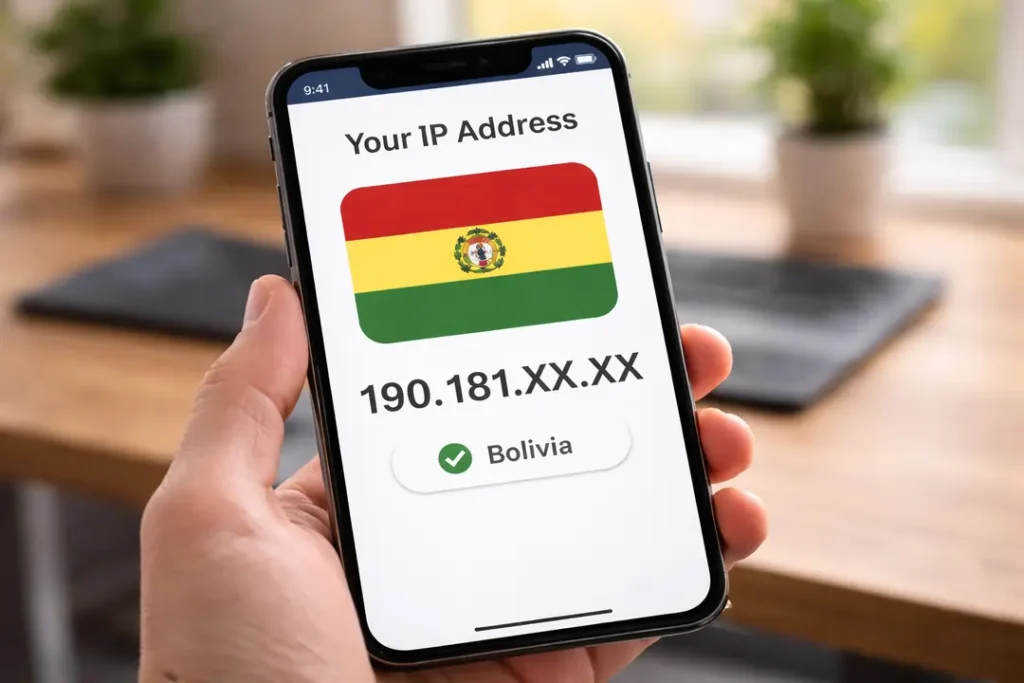
An IP address is what websites use to guess where you are located. When you connect to the internet normally in Bolivia, your IP address shows that you are inside the country.
A VPN lets you change or mask your IP address. You can appear to be in another country, or sometimes keep a Bolivian IP while adding encryption.
When a Bolivian IP Address Is Useful
| Situation | Why a Bolivian IP Helps |
|---|---|
| Accessing local services | Some sites only work from Bolivia |
| Banking or government portals | Reduces login security warnings |
| Travelling abroad | Keeps access to Bolivia-based accounts |
When You Don’t Need a Bolivian IP
If you are already in Bolivia and just want privacy or security, you usually do not need a local IP.
Many VPN users choose nearby regions with better routing instead of a local server. This often gives better stability.
Do All VPNs Offer Bolivian IPs?
No. Many VPNs do not operate servers in Bolivia. This is normal.
For most users, encryption and routing quality matter more than having a local IP address. This difference is explained clearly in our VPN fundamentals guide.
If you need a local IP for work or services, check provider availability before subscribing. Our VPN comparison table shows which regions are supported.
Next, we cover common VPN problems in Bolivia and how to fix them quickly.
Common VPN Problems in Bolivia (And How to Fix Them)
VPNs usually work well in Bolivia, but users may still experience issues. These problems are usually caused by network quality or configuration, not blocking.
| Problem | Why It Happens | Simple Fix |
|---|---|---|
| VPN won’t connect | Public Wi-Fi blocks traffic | Log in first, then turn on VPN |
| Internet stops when VPN starts | DNS or protocol conflict | Switch protocol in settings |
| Frequent disconnects | Weak or unstable signal | Enable auto-reconnect |
| Slow speeds | Congestion or long routing | Change server or nearby region |
| Streaming won’t load | IP blocked by platform | Reconnect or switch server |
Public Wi-Fi Issues Are the Most Common
Hotels, cafés, and shared apartments often use older or overloaded routers. VPNs may disconnect when the signal drops.
This is why VPNs designed for travelling and long-term stays tend to work better on unstable networks.
Device Updates Matter
Outdated VPN apps or old operating systems can cause connection problems.
- Update the VPN app
- Restart the device
- Reconnect to Wi-Fi
These steps fix many issues without changing providers.
For deeper help, see our VPN troubleshooting guide.
Next, we wrap everything up with final thoughts, FAQs, and regional VPN links for South America.
Final Thoughts: VPN Use in Bolivia
Bolivia does not heavily restrict the internet. Most websites and online services work normally, and many people browse without any extra tools.
That said, a VPN is still useful in Bolivia for privacy, security, and consistency, especially when using shared or public networks.
If you regularly use:
- Hotel or café Wi-Fi
- Shared apartment internet
- Remote work platforms or cloud accounts
- Email, banking, or multiple logins
then a VPN provides clear, practical benefits.
In Bolivia, a VPN is best viewed as a protective tool, not a way to bypass restrictions. It reduces exposure on shared networks and keeps everyday online activity private.
VPN Questions in Bolivia
Is using a VPN legal in Bolivia?
Yes. VPN use is legal in Bolivia. There are no laws that ban personal or business VPN use.
Does Bolivia block websites?
No. Bolivia does not have widespread internet censorship. Most international sites are accessible.
Do I need a VPN on public Wi-Fi?
Yes. Public Wi-Fi is the main risk. A VPN encrypts your data before it reaches the network, which helps protect logins and personal information.
Will a VPN slow down my internet?
A good VPN causes only a small speed drop. On unstable networks, it can actually improve connection reliability.
Are free VPNs a good idea?
Usually not. Many free VPNs log data, limit speeds, or inject ads. Paid VPNs are generally safer and more reliable.
VPN Guides for South America
Internet conditions vary across South America. Some countries have stable fibre networks, while others rely heavily on mobile data or shared infrastructure.
| Country | Internet Conditions | Guide |
|---|---|---|
| Bolivia | Open access, uneven infrastructure | Current page |
| Peru | Good urban access, rural instability | Best VPN for Peru |
| Argentina | Open access, congestion issues | Best VPN for Argentina |
| Chile | Very stable fibre internet | Best VPN for Chile |
| Brazil | Large networks, heavy peak congestion | Best VPN for Brazil |
| Paraguay | Developing infrastructure | Best VPN for Paraguay |
For a broader overview of the region, including travel and cross-border use, see our South America VPN hub.