
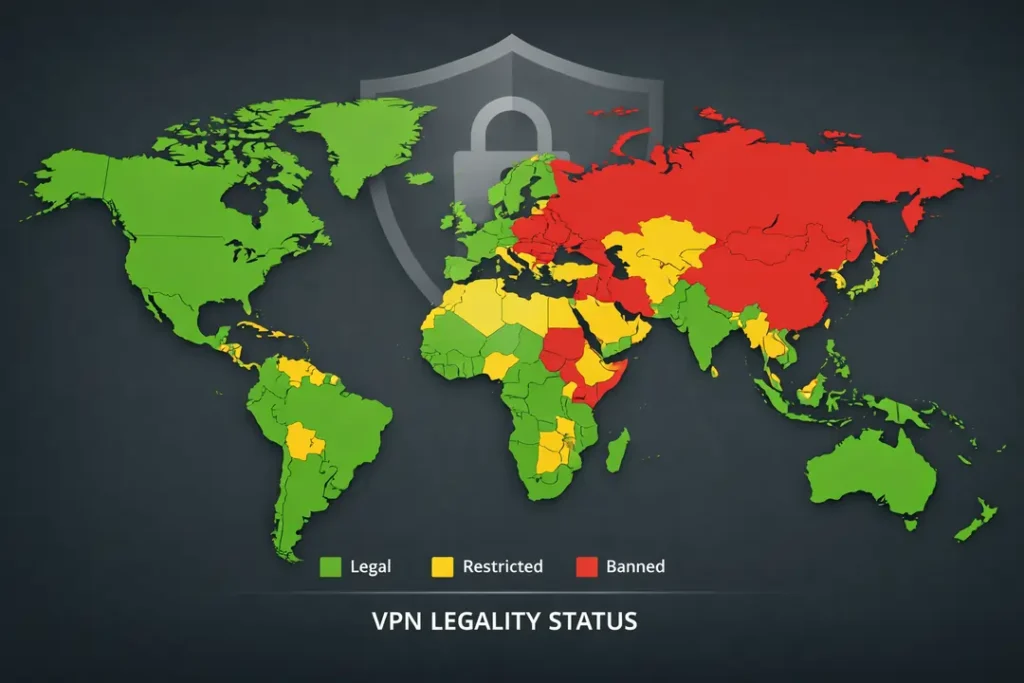
Short answer: VPNs are legal in most countries.
However, a small number of governments restrict or regulate VPN use. In certain countries, unauthorized VPN services may be blocked or require government approval.
This guide explains:
- Where VPNs are fully legal
- Where they are restricted or regulated
- Where they are effectively banned
- Whether you can be fined or prosecuted
- What activities remain illegal even when using a VPN
This page is informational only and does not provide legal advice. Laws change frequently. Always verify local regulations before traveling.
Are VPNs Legal in the United States?
Yes. VPNs are legal in the United States.
There are no federal laws prohibiting VPN use. In fact, cybersecurity agencies often recommend encrypted connections to protect data on public Wi-Fi networks.
Using a VPN for privacy, security, remote work, or business purposes is fully lawful.
However, a VPN does not make illegal activity legal. If an action is illegal without a VPN, it remains illegal with one.
To understand how VPNs function technically, see our complete VPN guide.

Where Are VPNs Legal?
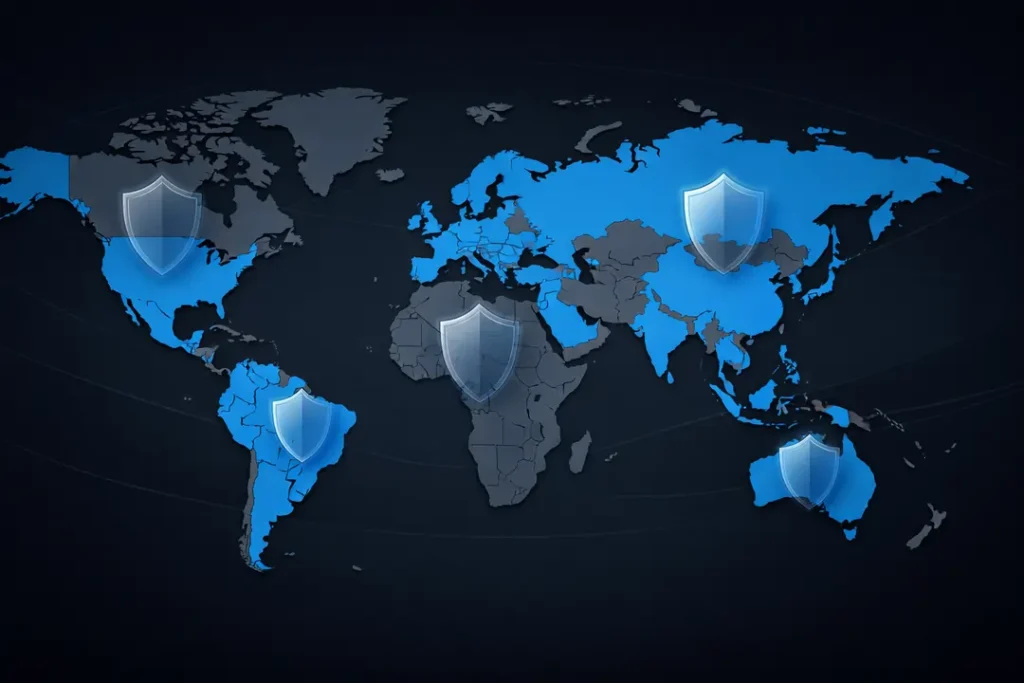
VPNs are legal in most countries around the world.
In North America, Europe, Australia, Japan, and most of Latin America, using a VPN for privacy, business, or streaming is completely lawful.
Millions of people use VPNs daily for:
- Remote work
- Public Wi-Fi protection
- Preventing ISP throttling
- Secure online banking
- Business data encryption
Governments in these regions regulate internet activity, but they do not prohibit encrypted connections.
If you are unsure how VPN encryption works, read our detailed guide: What Is a VPN?
Examples of Countries Where VPNs Are Fully Legal
- United States
- Canada
- United Kingdom
- Germany
- France
- Australia
- Japan
- South Korea
- Brazil
- Mexico
In these countries, VPN services operate freely and are widely used by businesses and individuals alike.

Countries Where VPNs Are Restricted or Regulated
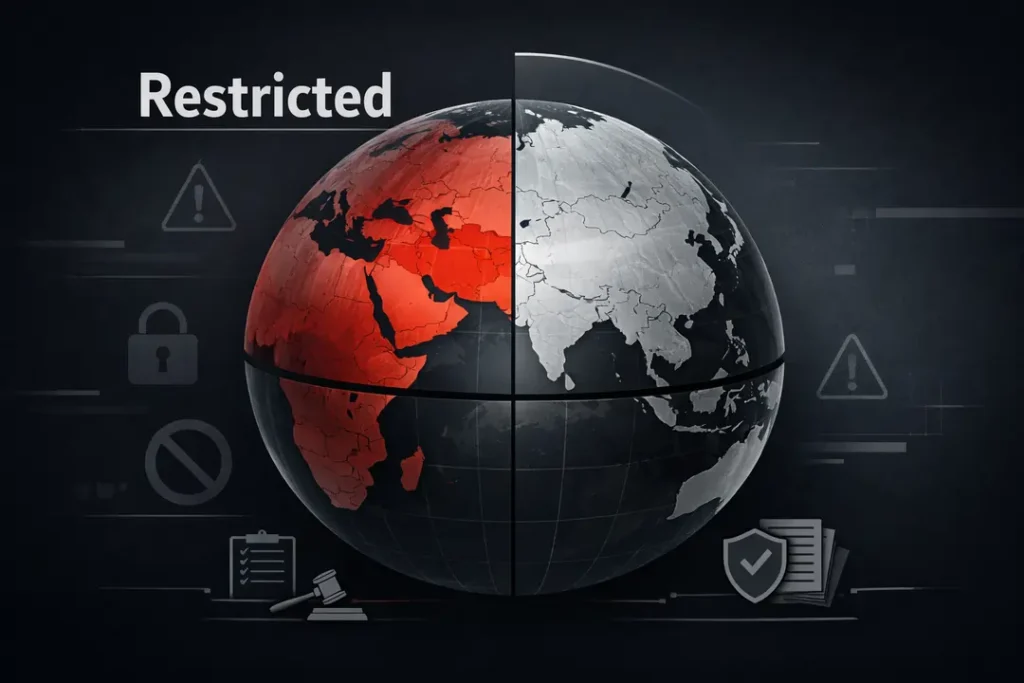
Some governments allow VPN use but regulate how VPN services operate.
In these countries, VPN providers may be required to:
- Register with authorities
- Comply with data retention laws
- Block certain websites
- Operate only government-approved servers
Using an unapproved VPN service in these regions may violate local regulations.
Examples of Countries With VPN Restrictions
| Country | Status | Notes |
|---|---|---|
| China | Heavily Restricted | Only government-approved VPNs are permitted. |
| Russia | Restricted | VPNs must block banned websites to operate legally. |
| Iran | Restricted | Only licensed VPN providers are allowed. |
| Turkey | Partially Restricted | Access to many VPN websites is blocked. |
| United Arab Emirates | Regulated | VPN use is legal, but illegal activities remain punishable. |
| India | Regulated | VPN providers must retain certain user data under 2022 rules. |
If you are traveling, always verify official regulations before using encryption tools.
For country-specific guidance, see our full VPNs by Country directory.
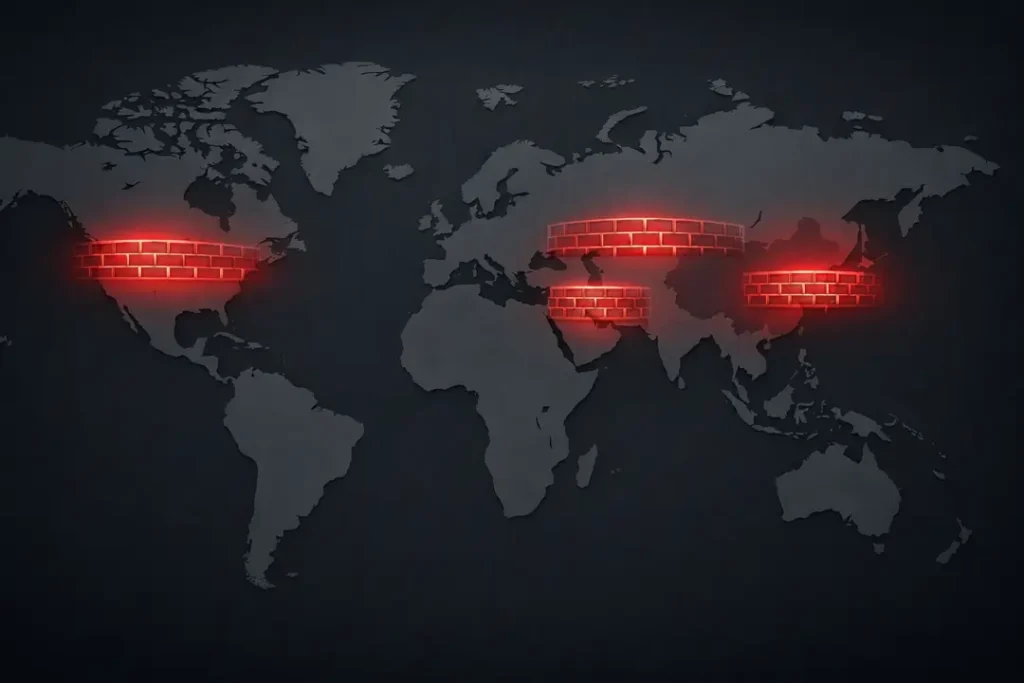
Countries Where VPNs Are Effectively Banned
In a small number of countries, VPN use is either explicitly banned or tightly controlled to the point that only state-approved services are allowed.
This usually applies to VPN providers — not always individual users — but enforcement can include fines or administrative penalties.
Countries With Effective VPN Bans (2026)
| Country | Status | Enforcement Level |
|---|---|---|
| North Korea | Fully Banned | Public internet access itself is restricted. |
| Belarus | Banned | VPN tools blocked at ISP level. |
| Iraq | Blocked Periodically | Temporary shutdowns during unrest. |
| Turkmenistan | Effectively Banned | Strong firewall filtering and monitoring. |
In these regions, restrictions typically relate to government censorship policies rather than general privacy regulation.
Travelers should research local laws before using encryption tools abroad.
For detailed regional analysis, see our Best VPNs for Restricted Countries (2026) guide.


Is It Illegal to Use a VPN for Netflix or Streaming?
In most countries, using a VPN to stream content is not illegal.
However, it may violate the streaming platform’s Terms of Service.
That is an important distinction.
Legal vs Terms of Service Violations
Streaming platforms like Netflix, BBC iPlayer, and Amazon Prime Video
license content by region. This means movies and shows available in one country
may not be available in another.
When you use a VPN to change your virtual location, you are not committing a crime in most countries.
But you may be breaching the platform’s user agreement.
A Terms of Service violation is not a criminal offense. It is a contract issue between you and the streaming company.
What Can Happen If You Use a VPN for Streaming?
- You may see a “proxy detected” error.
- The stream may stop until you disconnect the VPN.
- Your account could theoretically be restricted (rare in practice).
Streaming services typically block IP addresses rather than penalizing users directly.
For detailed streaming performance testing, see our
Best VPN for Streaming report.
Country Differences Matter
In open internet countries like the United States, United Kingdom, Canada, and Australia,
using a VPN for streaming is legal.
In countries where VPNs themselves are restricted (covered earlier in this guide),
the legal issue relates to VPN use — not streaming specifically.
If you travel frequently, review our
Restricted Countries VPN Guide before using any encryption tools abroad.
Bottom Line
Using a VPN for Netflix or streaming is not a criminal offense in most countries.
But it can violate platform rules.
Always follow local laws and service agreements.
Can You Be Fined or Arrested for Using a VPN?
In most countries, no. Using a VPN by itself does not result in fines or arrest.
However, in a small number of countries where VPNs are restricted or banned, unauthorized use can lead to penalties.
Open Internet Countries
In countries such as the United States, United Kingdom, Canada, Australia, and most of Europe, VPNs are legal tools. You cannot be fined or arrested simply for encrypting your internet connection.
Law enforcement only becomes involved if someone uses a VPN while committing a crime — but the crime itself is illegal, not the VPN.
If you want a breakdown of privacy laws in Western countries, see our Best No-Log VPNs (2026) guide.
Restricted Countries
In certain countries — such as China, Iran, and Russia — only government-approved VPNs may be legal. Using an unauthorized VPN can result in:
- Fines
- Temporary account suspension
- Administrative penalties
- In rare cases, short-term detention
Penalties vary widely depending on the country and political climate.
For example:
- China has issued administrative fines for bypassing the Great Firewall.
- The UAE has fined individuals for using VPNs to access restricted VoIP services.
- Russia requires VPN providers to comply with government filtering systems.
These actions are typically targeted at bypassing state censorship — not casual encryption use.
If you are traveling to a restrictive region, review our China VPN Survival Guide and our Restricted Countries VPN Guide before installing a VPN.
Important Clarification
A VPN does not make illegal activity legal.
If someone commits fraud, piracy, harassment, or other criminal acts while using a VPN, the crime remains illegal. The VPN does not provide immunity.
VPNs are privacy tools — not shields against prosecution.
Realistic Risk Assessment
In practice, enforcement related to VPN use is uncommon outside highly restrictive regimes.
Most users worldwide use VPNs for:
- Privacy protection
- Public Wi-Fi security
- Remote work encryption
- Preventing ISP throttling
For these use cases, there is no legal risk in countries where VPNs are permitted.
Bottom Line
In the vast majority of the world, using a VPN is completely legal.
Legal consequences only arise in countries where VPNs are restricted or banned — and even then, enforcement varies.
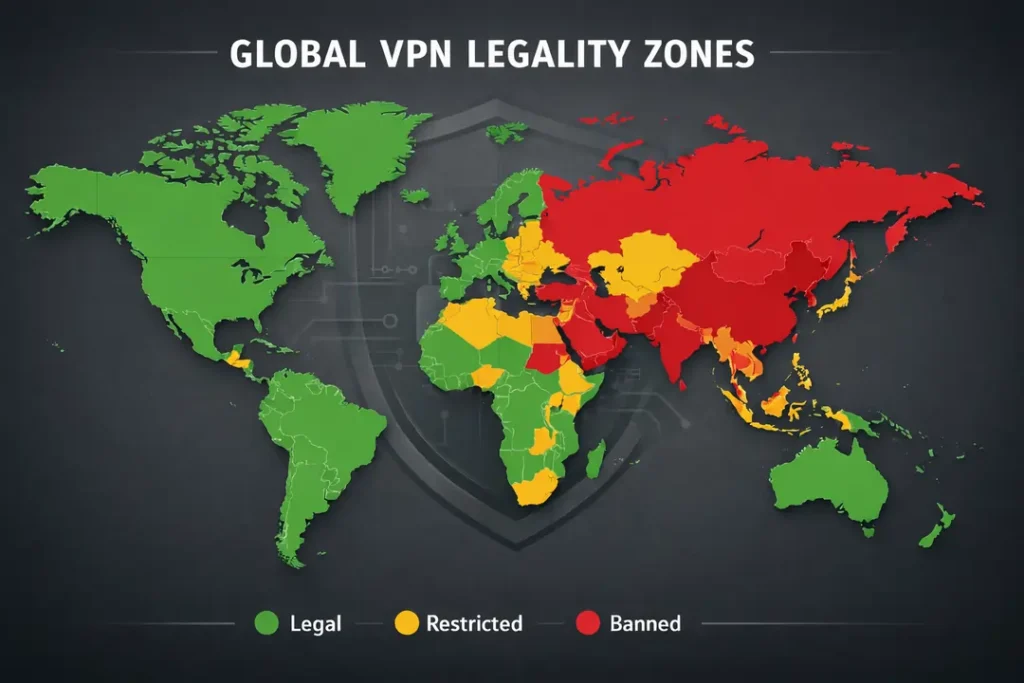
VPN Laws by Region (2026 Global Overview)
VPN legality varies by country — but broad regional patterns make the landscape easier to understand.
Below is a clear breakdown of how VPN laws differ across major regions in 2026.
United States & Canada
VPNs are fully legal in both the United States and Canada.
There are no restrictions on encryption tools, and VPN usage for privacy, streaming, or remote work is permitted.
However, VPNs cannot be used to hide illegal activity. Crimes remain illegal regardless of encryption.
For deeper privacy comparisons, see:
United Kingdom & European Union
VPNs are legal throughout the UK and EU.
Data protection laws like GDPR actually strengthen user privacy rights, and encryption tools are widely accepted.
However, some EU countries may monitor VPN providers operating within their jurisdiction. This is why many top VPN companies are headquartered in Panama or the British Virgin Islands.
See our full breakdown in:
Australia & New Zealand
VPNs are legal in both Australia and New Zealand.
However, Australia is part of the Five Eyes intelligence alliance. Some users prefer VPN providers headquartered outside surveillance alliances.
VPN use for streaming, gaming, and privacy protection is common and permitted.
China
China operates the world’s most advanced censorship system, known as the Great Firewall.
Only government-approved VPNs are technically legal. Unauthorized VPN apps are frequently blocked.
Tourists and business travelers often rely on VPNs before arrival, but reliability varies.
Before traveling, review:
Russia
Russia requires VPN providers to comply with state filtering systems.
Several major VPN services have been blocked for refusing to comply.
VPN usage is heavily regulated and monitored.
Middle East (UAE, Oman, Iran)
VPN legality varies:
- UAE: VPNs are legal, but using them to access restricted services may result in fines.
- Oman: Heavily regulated.
- Iran: Only government-approved VPNs are permitted.
Travelers should always verify current regulations before connecting.
South & Southeast Asia
VPN legality varies widely across the region:
- India: VPNs are legal, but local data retention laws forced many providers to remove physical servers.
- Vietnam: Legal but monitored.
- Thailand, Malaysia, Singapore: Legal and commonly used.
See regional guides:
Countries Where VPNs Are Banned or Heavily Restricted (2026)
Examples include:
- Belarus
- Iran
- Iraq
- North Korea
- Turkmenistan
Enforcement varies significantly and may depend on political conditions.
For a broader breakdown, see:
Summary
In 2026, VPNs are legal in most democratic countries. Restrictions are concentrated in regions with strong internet censorship policies.
If you are unsure about your country, always check official government guidance before using a VPN.
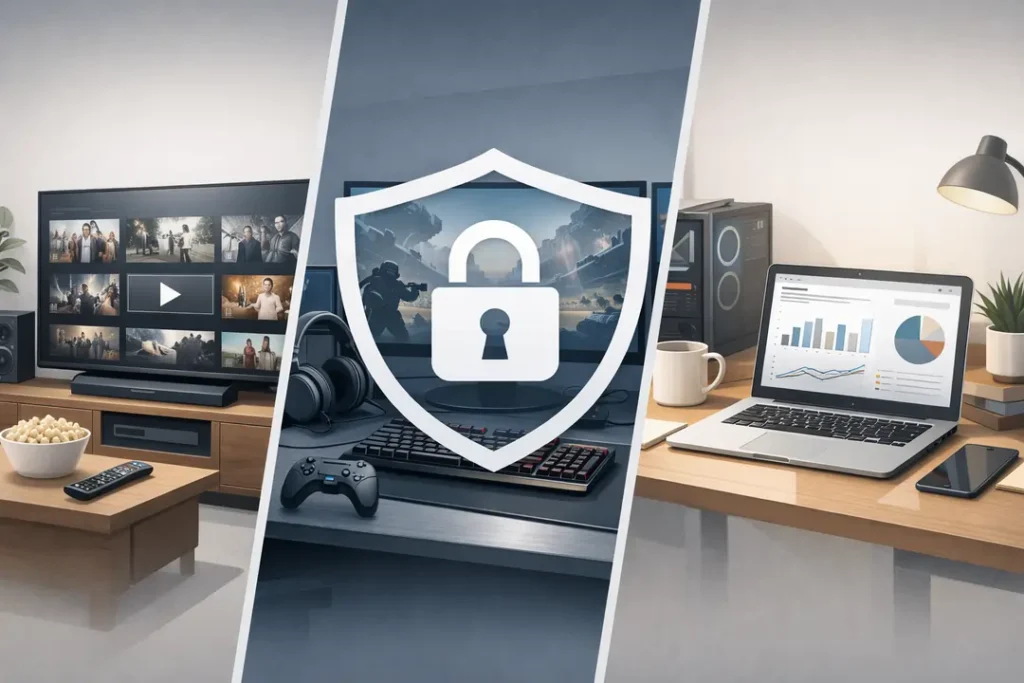
Are VPNs Legal for Streaming, Torrenting & Gaming?
Many users are not asking whether VPNs are legal in general. They are asking something more specific:
- Is it legal to use a VPN for Netflix?
- Is torrenting with a VPN legal?
- Can I use a VPN for gaming?
The answer depends on what you are doing — not the VPN itself.
Are VPNs Legal for Streaming?
Yes. Using a VPN to stream content is legal in most countries where VPNs are permitted.
However, streaming platforms like Netflix, BBC iPlayer, and Prime Video may prohibit VPN usage under their terms of service.
This means:
- You are not breaking the law in most countries.
- You may be violating the platform’s user agreement.
- The platform may block your connection or display a proxy error.
Streaming companies use IP detection systems to identify known VPN ranges. That is why performance varies between providers.
For performance testing, see:
Important: Accessing content that is legally licensed in another country is not the same as piracy. But always follow local laws and service agreements.
Are VPNs Legal for Torrenting?
This depends entirely on what you are downloading.
Using a VPN to download legal, non-copyrighted content is permitted in most countries.
Using a VPN to download copyrighted movies, games, or software without permission is illegal in many jurisdictions.
A VPN does not make illegal downloading legal.
It only encrypts your connection and hides your IP address from peers in the torrent swarm.
If you are researching torrent privacy tools, see:
Are VPNs Legal for Gaming?
Yes. VPNs are legal for gaming in most countries.
Common legal uses include:
- Reducing ISP throttling
- Improving routing stability
- Accessing region-locked game servers
- Protecting against DDoS attacks
However, using a VPN to bypass competitive bans or manipulate matchmaking systems may violate a game’s terms of service.
For gaming performance analysis, see:
Are VPNs Legal for Remote Work?
Yes. In fact, VPNs are widely used by businesses to secure remote employees.
Corporate VPNs encrypt connections between employees and internal company systems.
Business VPN use is not only legal — it is considered best practice for cybersecurity.
Quick Summary
| Activity | Is the VPN Legal? | Important Notes |
|---|---|---|
| Streaming | Yes | May violate platform terms, not usually criminal law |
| Torrenting (legal files) | Yes | Allowed if content is legal |
| Torrenting (copyrighted files) | No | Illegal regardless of VPN use |
| Gaming | Yes | Must follow game terms of service |
| Remote Work | Yes | Standard cybersecurity practice |
Bottom Line
A VPN is a privacy tool. It does not change the legality of your actions.
If the activity is legal without a VPN, it remains legal with one.
How to Use a VPN Legally (Risk-Minimization Framework)
Using a VPN legally is simple in most countries — but understanding the boundaries matters.
This section explains how to minimize legal risk and stay compliant wherever you are.
1. Check Local VPN Laws Before Traveling
If you are traveling to a country with internet restrictions, research VPN regulations before arrival.
Some countries allow VPNs but require government-approved providers. Others prohibit non-licensed services entirely.
See our full breakdown in:
2. Do Not Use a VPN for Illegal Activity
A VPN does not shield you from criminal liability.
Illegal activity remains illegal with or without encryption.
Examples include:
- Copyright infringement
- Fraud or hacking
- Harassment or cybercrime
- Bypassing government bans in restricted states
3. Understand Platform Terms of Service
Streaming platforms, gaming networks, and financial services may restrict VPN usage under their terms.
This is usually not criminal — but your account may be blocked.
For streaming-specific performance analysis, see:
4. Choose a Transparent, Audited VPN
In countries where VPN use is legal, the real risk is poor provider quality — not legality.
Choose providers that:
- Have independent no-logs audits
- Operate outside intrusive data-retention jurisdictions
- Use modern encryption standards
- Provide clear transparency reports
For methodology details, read:
5. Understand the Difference Between Privacy and Anonymity
A VPN increases privacy. It does not guarantee anonymity against state-level investigation.
High-risk users in restrictive regimes should consider:
- Jurisdiction strength
- Multi-hop routing
- Obfuscation support
- Operational security practices
For deeper technical breakdowns, see:
Legal Use Checklist
| Step | Action |
|---|---|
| 1 | Confirm VPN legality in your country |
| 2 | Use VPN only for lawful purposes |
| 3 | Review platform terms of service |
| 4 | Choose audited, transparent providers |
| 5 | Understand privacy limitations |
Bottom Line
In most democratic countries, using a VPN is completely legal.
Legal risk usually comes from:
- Using a VPN in a country where it is banned
- Using a VPN for illegal activity
- Violating private platform agreements
When used responsibly, a VPN is a lawful privacy tool — not a legal liability.

Final Verdict: Are VPNs Legal?
In 2026, VPNs are legal in the vast majority of countries. In regions like the United States, United Kingdom, Canada, Australia, and most of Europe, VPNs are widely used for privacy, business security, and secure public Wi-Fi access.
However, in certain countries with strict internet control policies, VPN use may be restricted, regulated, or limited to government-approved providers.
The key principle is simple:
- Using a VPN for privacy and security is legal in most regions.
- Using a VPN does not make illegal activity legal.
- Always follow local laws and service terms.
When a VPN Makes Sense
A VPN is most useful when you want to:
- Protect yourself on public Wi-Fi
- Reduce ISP tracking and throttling
- Secure remote work connections
- Improve online privacy
- Access content while traveling
Our Legal Disclaimer
This guide provides general informational content and does not constitute legal advice. VPN regulations can change quickly. Always verify the current legal framework in your country before using encryption tools.
Bottom Line
For most readers, VPN use is completely legal and widely accepted.
If your goal is privacy, secure browsing, and safer public network use, a reputable VPN remains one of the simplest tools available in 2026.